

40
S. Dhyani and D. Dhyani
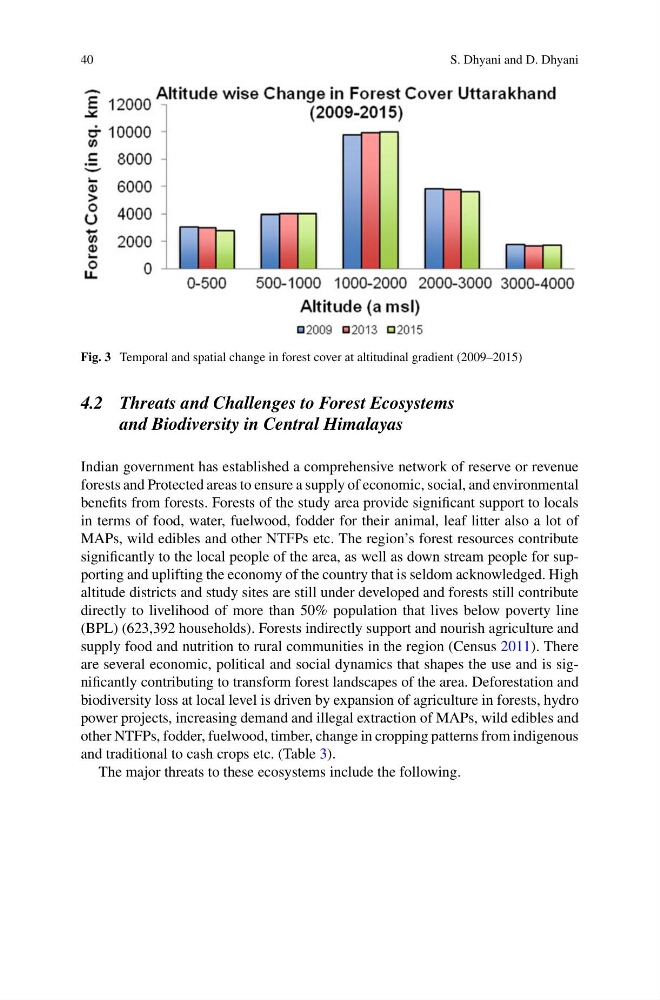
Fig. 3 Temporal and spatial change in forest cover at altitudinal gradient (2009–2015)
4.2 Threats and Challenges to Forest Ecosystems
and Biodiversity in Central Himalayas
Indian government has established a comprehensive network of reserve or revenue
forests and Protected areas to ensure a supply of economic, social, and environmental
benefits from forests. Forests of the study area provide significant support to locals
in terms of food, water, fuelwood, fodder for their animal, leaf litter also a lot of
MAPs, wild edibles and other NTFPs etc. The region’s forest resources contribute
significantly to the local people of the area, as well as down stream people for supporting and uplifting the economy of the country that is seldom acknowledged. High
altitude districts and study sites are still under developed and forests still contribute
directly to livelihood of more than 50% population that lives below poverty line
(BPL) (623,392 households). Forests indirectly support and nourish agriculture and
supply food and nutrition to rural communities in the region (Census 2011). There
are several economic, political and social dynamics that shapes the use and is significantly contributing to transform forest landscapes of the area. Deforestation and
biodiversity loss at local level is driven by expansion of agriculture in forests, hydro
power projects, increasing demand and illegal extraction of MAPs, wild edibles and
other NTFPs, fodder, fuelwood, timber, change in cropping patterns from indigenous
and traditional to cash crops etc. (Table 3).
The major threats to these ecosystems include the following.
S. Dhyani and D. Dhyani
Fig. 3 Temporal and spatial change in forest cover at altitudinal gradient (2009–2015)
4.2 Threats and Challenges to Forest Ecosystems
and Biodiversity in Central Himalayas
Indian government has established a comprehensive network of reserve or revenue
forests and Protected areas to ensure a supply of economic, social, and environmental
benefits from forests. Forests of the study area provide significant support to locals
in terms of food, water, fuelwood, fodder for their animal, leaf litter also a lot of
MAPs, wild edibles and other NTFPs etc. The region’s forest resources contribute
significantly to the local people of the area, as well as down stream people for supporting and uplifting the economy of the country that is seldom acknowledged. High
altitude districts and study sites are still under developed and forests still contribute
directly to livelihood of more than 50% population that lives below poverty line
(BPL) (623,392 households). Forests indirectly support and nourish agriculture and
supply food and nutrition to rural communities in the region (Census 2011). There
are several economic, political and social dynamics that shapes the use and is significantly contributing to transform forest landscapes of the area. Deforestation and
biodiversity loss at local level is driven by expansion of agriculture in forests, hydro
power projects, increasing demand and illegal extraction of MAPs, wild edibles and
other NTFPs, fodder, fuelwood, timber, change in cropping patterns from indigenous
and traditional to cash crops etc. (Table 3).
The major threats to these ecosystems include the following.