

452
M. Goswami and S. Nautiyal
7 Unsustainable Practices in the Landscape
Peri-urban areas are more environmentally unstable than their adjacent rural and
urban areas because of transitional nature. Changing physical and socioeconomic
landscape has led the community to adopt practices to extract more resources exerting tremendous pressure on ecosystem. Apart from community’s action on natural
resources, ill-planning for urban expansion and waste disposal have threatened the
sustainability of the resources. Shrinking of the wetland area, deforestation, decline
in cultivable area etc. have not only affected the ecosystem balance but also the
indigenous population living in the city periphery. Agricultural practices of the villages have also been affected due to land degradation. The growth of urban areas and
developmental activities has been exerting pressure on the ecosystem. As discussed
in the previous chapters, majority of the biological goods of the landscape has been
gradually depleting due to increased human interference. The water quality of the
wetland is threatened by sewage and solid waste disposal, excessive fishing, hunting
of water birds, agricultural runoff and infestation by aquatic weeds. The degradation in the wetland part of the landscape is primarily caused by encroachment and
waste dumping. Urban sprawling has carried its impact towards the fringe areas
through changes in land use land cover and consequent ecosystem services showing
a decreasing impact gradient from the core of the city. The significant changes the
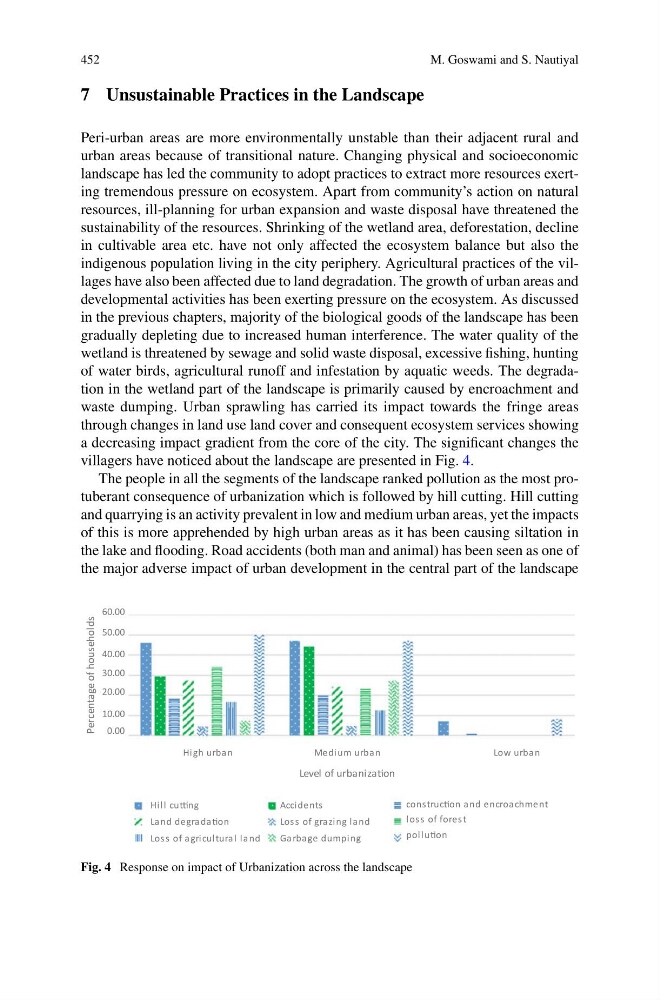
villagers have noticed about the landscape are presented in Fig. 4.
The people in all the segments of the landscape ranked pollution as the most protuberant consequence of urbanization which is followed by hill cutting. Hill cutting
and quarrying is an activity prevalent in low and medium urban areas, yet the impacts
of this is more apprehended by high urban areas as it has been causing siltation in
the lake and flooding. Road accidents (both man and animal) has been seen as one of
the major adverse impact of urban development in the central part of the landscape
High urban
Medium urban
Low urban
0.00
10.00
20.00
30.00
40.00
50.00
60.00
Hill cung
Accidents
cons trucon and encroachment
Level of urbanizaon
Percentage of households
loss of forest
polluon
Loss of agricultural land
Garbage dumping
Loss of grazing land
Land degradaon
Fig. 4 Response on impact of Urbanization across the landscape
M. Goswami and S. Nautiyal
7 Unsustainable Practices in the Landscape
Peri-urban areas are more environmentally unstable than their adjacent rural and
urban areas because of transitional nature. Changing physical and socioeconomic
landscape has led the community to adopt practices to extract more resources exerting tremendous pressure on ecosystem. Apart from community’s action on natural
resources, ill-planning for urban expansion and waste disposal have threatened the
sustainability of the resources. Shrinking of the wetland area, deforestation, decline
in cultivable area etc. have not only affected the ecosystem balance but also the
indigenous population living in the city periphery. Agricultural practices of the villages have also been affected due to land degradation. The growth of urban areas and
developmental activities has been exerting pressure on the ecosystem. As discussed
in the previous chapters, majority of the biological goods of the landscape has been
gradually depleting due to increased human interference. The water quality of the
wetland is threatened by sewage and solid waste disposal, excessive fishing, hunting
of water birds, agricultural runoff and infestation by aquatic weeds. The degradation in the wetland part of the landscape is primarily caused by encroachment and
waste dumping. Urban sprawling has carried its impact towards the fringe areas
through changes in land use land cover and consequent ecosystem services showing
a decreasing impact gradient from the core of the city. The significant changes the
villagers have noticed about the landscape are presented in Fig. 4.
The people in all the segments of the landscape ranked pollution as the most protuberant consequence of urbanization which is followed by hill cutting. Hill cutting
and quarrying is an activity prevalent in low and medium urban areas, yet the impacts
of this is more apprehended by high urban areas as it has been causing siltation in
the lake and flooding. Road accidents (both man and animal) has been seen as one of
the major adverse impact of urban development in the central part of the landscape
High urban
Medium urban
Low urban
0.00
10.00
20.00
30.00
40.00
50.00
60.00
Hill cung
Accidents
cons trucon and encroachment
Level of urbanizaon
Percentage of households
loss of forest
polluon
Loss of agricultural land
Garbage dumping
Loss of grazing land
Land degradaon
Fig. 4 Response on impact of Urbanization across the landscape