

Transitional Peri-urban Landscape …
439
High
Urban
Medium
urban
Low
urban
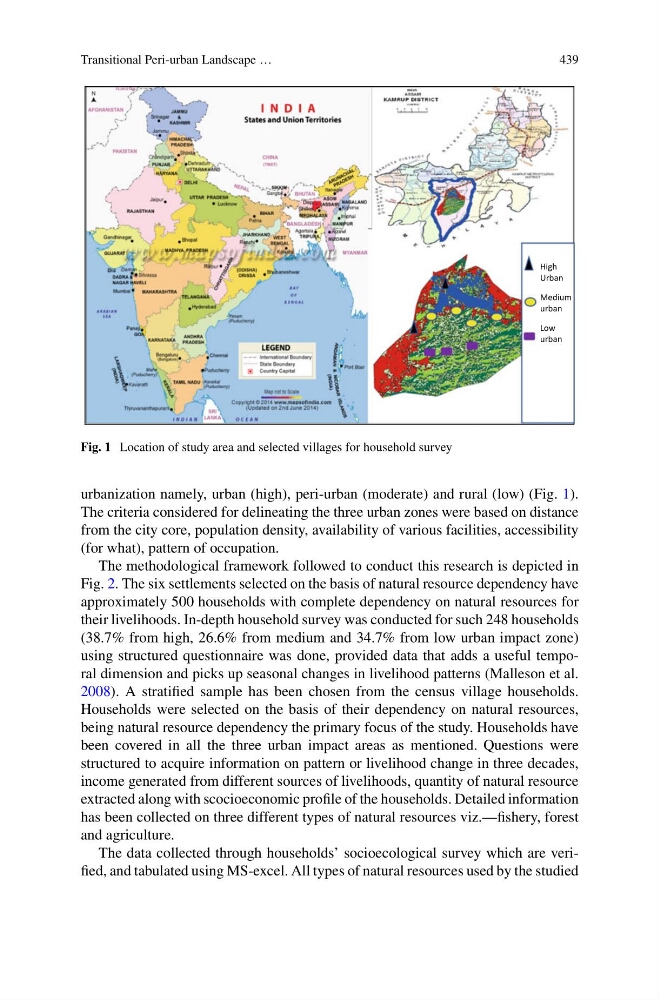
Fig. 1 Location of study area and selected villages for household survey
urbanization namely, urban (high), peri-urban (moderate) and rural (low) (Fig. 1).
The criteria considered for delineating the three urban zones were based on distance
from the city core, population density, availability of various facilities, accessibility
(for what), pattern of occupation.
The methodological framework followed to conduct this research is depicted in
Fig. 2. The six settlements selected on the basis of natural resource dependency have
approximately 500 households with complete dependency on natural resources for
their livelihoods. In-depth household survey was conducted for such 248 households
(38.7% from high, 26.6% from medium and 34.7% from low urban impact zone)
using structured questionnaire was done, provided data that adds a useful temporal dimension and picks up seasonal changes in livelihood patterns (Malleson et al.
2008). A stratified sample has been chosen from the census village households.
Households were selected on the basis of their dependency on natural resources,
being natural resource dependency the primary focus of the study. Households have
been covered in all the three urban impact areas as mentioned. Questions were
structured to acquire information on pattern or livelihood change in three decades,
income generated from different sources of livelihoods, quantity of natural resource
extracted along with scocioeconomic profile of the households. Detailed information
has been collected on three different types of natural resources viz.—fishery, forest
and agriculture.
The data collected through households’ socioecological survey which are verified, and tabulated using MS-excel. All types of natural resources used by the studied
439
High
Urban
Medium
urban
Low
urban
Fig. 1 Location of study area and selected villages for household survey
urbanization namely, urban (high), peri-urban (moderate) and rural (low) (Fig. 1).
The criteria considered for delineating the three urban zones were based on distance
from the city core, population density, availability of various facilities, accessibility
(for what), pattern of occupation.
The methodological framework followed to conduct this research is depicted in
Fig. 2. The six settlements selected on the basis of natural resource dependency have
approximately 500 households with complete dependency on natural resources for
their livelihoods. In-depth household survey was conducted for such 248 households
(38.7% from high, 26.6% from medium and 34.7% from low urban impact zone)
using structured questionnaire was done, provided data that adds a useful temporal dimension and picks up seasonal changes in livelihood patterns (Malleson et al.
2008). A stratified sample has been chosen from the census village households.
Households were selected on the basis of their dependency on natural resources,
being natural resource dependency the primary focus of the study. Households have
been covered in all the three urban impact areas as mentioned. Questions were
structured to acquire information on pattern or livelihood change in three decades,
income generated from different sources of livelihoods, quantity of natural resource
extracted along with scocioeconomic profile of the households. Detailed information
has been collected on three different types of natural resources viz.—fishery, forest
and agriculture.
The data collected through households’ socioecological survey which are verified, and tabulated using MS-excel. All types of natural resources used by the studied