

Wildlife Conservation Perspective of Fringe Villagers …
295
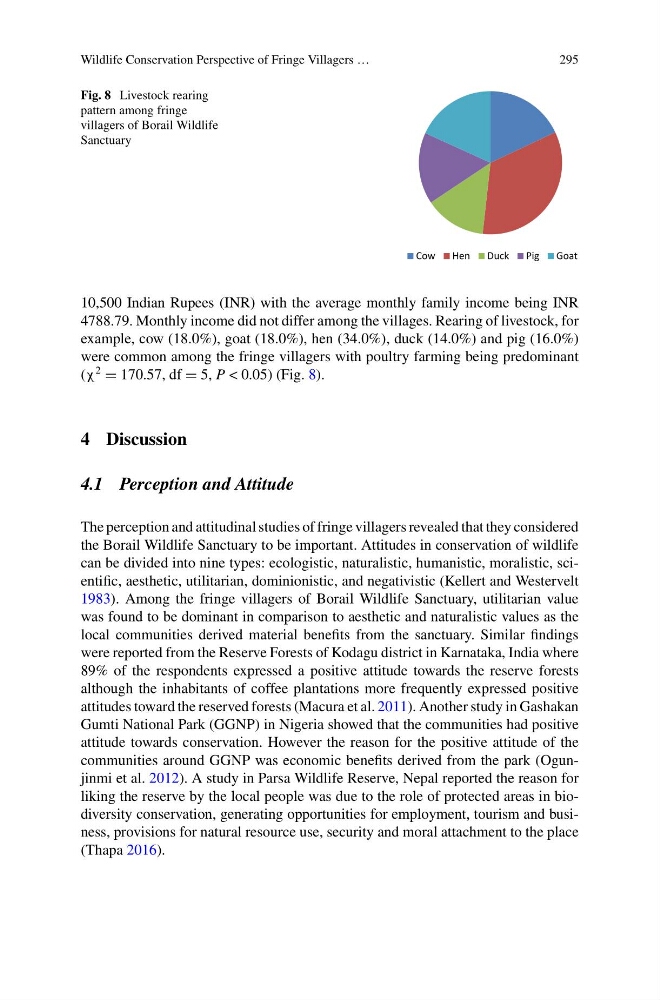
Fig. 8 Livestock rearing
pattern among fringe
villagers of Borail Wildlife
Sanctuary
Cow
Hen
Duck
Pig
Goat
10,500 Indian Rupees (INR) with the average monthly family income being INR
4788.79. Monthly income did not differ among the villages. Rearing of livestock, for
example, cow (18.0%), goat (18.0%), hen (34.0%), duck (14.0%) and pig (16.0%)
were common among the fringe villagers with poultry farming being predominant
(χ
2
= 170.57, df = 5, P < 0.05) (Fig. 8).
4 Discussion
4.1 Perception and Attitude
The perception and attitudinal studies of fringe villagers revealed that they considered
the Borail Wildlife Sanctuary to be important. Attitudes in conservation of wildlife
can be divided into nine types: ecologistic, naturalistic, humanistic, moralistic, scientific, aesthetic, utilitarian, dominionistic, and negativistic (Kellert and Westervelt
1983). Among the fringe villagers of Borail Wildlife Sanctuary, utilitarian value
was found to be dominant in comparison to aesthetic and naturalistic values as the
local communities derived material benefits from the sanctuary. Similar findings
were reported from the Reserve Forests of Kodagu district in Karnataka, India where
89% of the respondents expressed a positive attitude towards the reserve forests
although the inhabitants of coffee plantations more frequently expressed positive
attitudes toward the reserved forests (Macura et al. 2011). Another study in Gashakan
Gumti National Park (GGNP) in Nigeria showed that the communities had positive
attitude towards conservation. However the reason for the positive attitude of the
communities around GGNP was economic benefits derived from the park (Ogunjinmi et al. 2012). A study in Parsa Wildlife Reserve, Nepal reported the reason for
liking the reserve by the local people was due to the role of protected areas in biodiversity conservation, generating opportunities for employment, tourism and business, provisions for natural resource use, security and moral attachment to the place
(Thapa 2016).
295
Fig. 8 Livestock rearing
pattern among fringe
villagers of Borail Wildlife
Sanctuary
Cow
Hen
Duck
Pig
Goat
10,500 Indian Rupees (INR) with the average monthly family income being INR
4788.79. Monthly income did not differ among the villages. Rearing of livestock, for
example, cow (18.0%), goat (18.0%), hen (34.0%), duck (14.0%) and pig (16.0%)
were common among the fringe villagers with poultry farming being predominant
(χ
2
= 170.57, df = 5, P < 0.05) (Fig. 8).
4 Discussion
4.1 Perception and Attitude
The perception and attitudinal studies of fringe villagers revealed that they considered
the Borail Wildlife Sanctuary to be important. Attitudes in conservation of wildlife
can be divided into nine types: ecologistic, naturalistic, humanistic, moralistic, scientific, aesthetic, utilitarian, dominionistic, and negativistic (Kellert and Westervelt
1983). Among the fringe villagers of Borail Wildlife Sanctuary, utilitarian value
was found to be dominant in comparison to aesthetic and naturalistic values as the
local communities derived material benefits from the sanctuary. Similar findings
were reported from the Reserve Forests of Kodagu district in Karnataka, India where
89% of the respondents expressed a positive attitude towards the reserve forests
although the inhabitants of coffee plantations more frequently expressed positive
attitudes toward the reserved forests (Macura et al. 2011). Another study in Gashakan
Gumti National Park (GGNP) in Nigeria showed that the communities had positive
attitude towards conservation. However the reason for the positive attitude of the
communities around GGNP was economic benefits derived from the park (Ogunjinmi et al. 2012). A study in Parsa Wildlife Reserve, Nepal reported the reason for
liking the reserve by the local people was due to the role of protected areas in biodiversity conservation, generating opportunities for employment, tourism and business, provisions for natural resource use, security and moral attachment to the place
(Thapa 2016).