

294
S. Das et al.
3.2 Socio-economy
The study revealed that the village population around the Borail Wildlife Sanctuary belonged to three religious communities—Christians (54.0%), Hindus (39.0%)
and Muslims (7.0%). Fringe villagers living around the Sanctuary belonged to the
five castes predominated by scheduled tribes (ST—55.0%) followed by tea tribes
(36.0%), scheduled caste (SC—1.0%), general (7.0%) and other backward caste
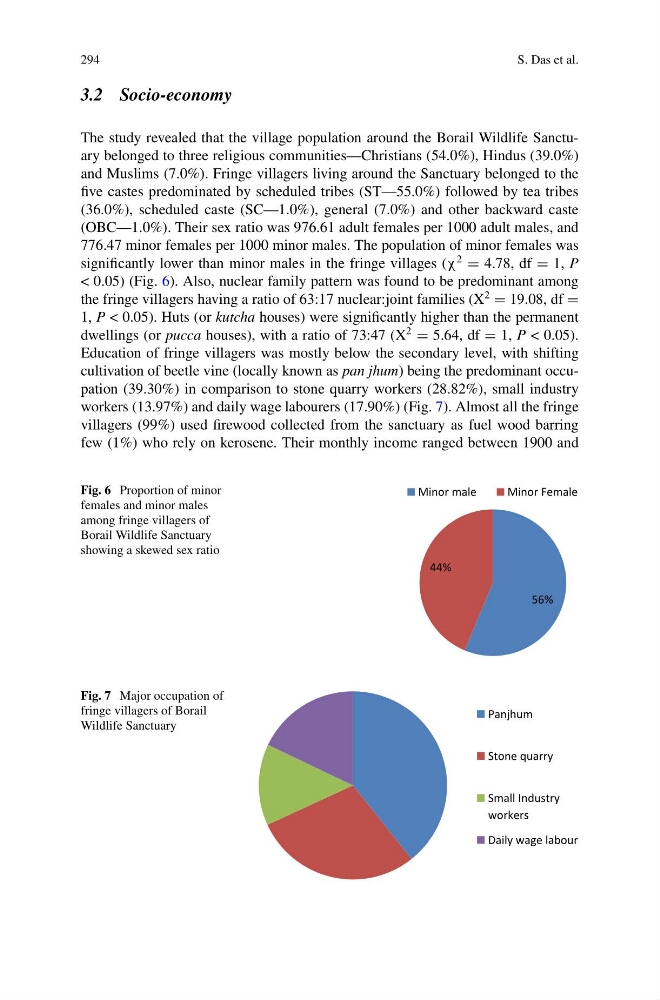
(OBC—1.0%). Their sex ratio was 976.61 adult females per 1000 adult males, and
776.47 minor females per 1000 minor males. The population of minor females was
significantly lower than minor males in the fringe villages (χ
2
= 4.78, df = 1, P
< 0.05) (Fig. 6). Also, nuclear family pattern was found to be predominant among
the fringe villagers having a ratio of 63:17 nuclear:joint families (X
2
= 19.08, df =
1, P < 0.05). Huts (or kutcha houses) were significantly higher than the permanent
dwellings (or pucca houses), with a ratio of 73:47 (X
2
= 5.64, df = 1, P < 0.05).
Education of fringe villagers was mostly below the secondary level, with shifting
cultivation of beetle vine (locally known as pan jhum) being the predominant occupation (39.30%) in comparison to stone quarry workers (28.82%), small industry
workers (13.97%) and daily wage labourers (17.90%) (Fig. 7). Almost all the fringe
villagers (99%) used firewood collected from the sanctuary as fuel wood barring
few (1%) who rely on kerosene. Their monthly income ranged between 1900 and
Fig. 6 Proportion of minor
females and minor males
among fringe villagers of
Borail Wildlife Sanctuary
showing a skewed sex ratio
56%
44%
Minor male
Minor Female
Fig. 7 Major occupation of
fringe villagers of Borail
Wildlife Sanctuary
Panjhum
Stone quarry
Small Industry
workers
Daily wage labour
S. Das et al.
3.2 Socio-economy
The study revealed that the village population around the Borail Wildlife Sanctuary belonged to three religious communities—Christians (54.0%), Hindus (39.0%)
and Muslims (7.0%). Fringe villagers living around the Sanctuary belonged to the
five castes predominated by scheduled tribes (ST—55.0%) followed by tea tribes
(36.0%), scheduled caste (SC—1.0%), general (7.0%) and other backward caste
(OBC—1.0%). Their sex ratio was 976.61 adult females per 1000 adult males, and
776.47 minor females per 1000 minor males. The population of minor females was
significantly lower than minor males in the fringe villages (χ
2
= 4.78, df = 1, P
< 0.05) (Fig. 6). Also, nuclear family pattern was found to be predominant among
the fringe villagers having a ratio of 63:17 nuclear:joint families (X
2
= 19.08, df =
1, P < 0.05). Huts (or kutcha houses) were significantly higher than the permanent
dwellings (or pucca houses), with a ratio of 73:47 (X
2
= 5.64, df = 1, P < 0.05).
Education of fringe villagers was mostly below the secondary level, with shifting
cultivation of beetle vine (locally known as pan jhum) being the predominant occupation (39.30%) in comparison to stone quarry workers (28.82%), small industry
workers (13.97%) and daily wage labourers (17.90%) (Fig. 7). Almost all the fringe
villagers (99%) used firewood collected from the sanctuary as fuel wood barring
few (1%) who rely on kerosene. Their monthly income ranged between 1900 and
Fig. 6 Proportion of minor
females and minor males
among fringe villagers of
Borail Wildlife Sanctuary
showing a skewed sex ratio
56%
44%
Minor male
Minor Female
Fig. 7 Major occupation of
fringe villagers of Borail
Wildlife Sanctuary
Panjhum
Stone quarry
Small Industry
workers
Daily wage labour