

Medicinal Plant Biodiversity in India: Harnessing Opportunities …
145
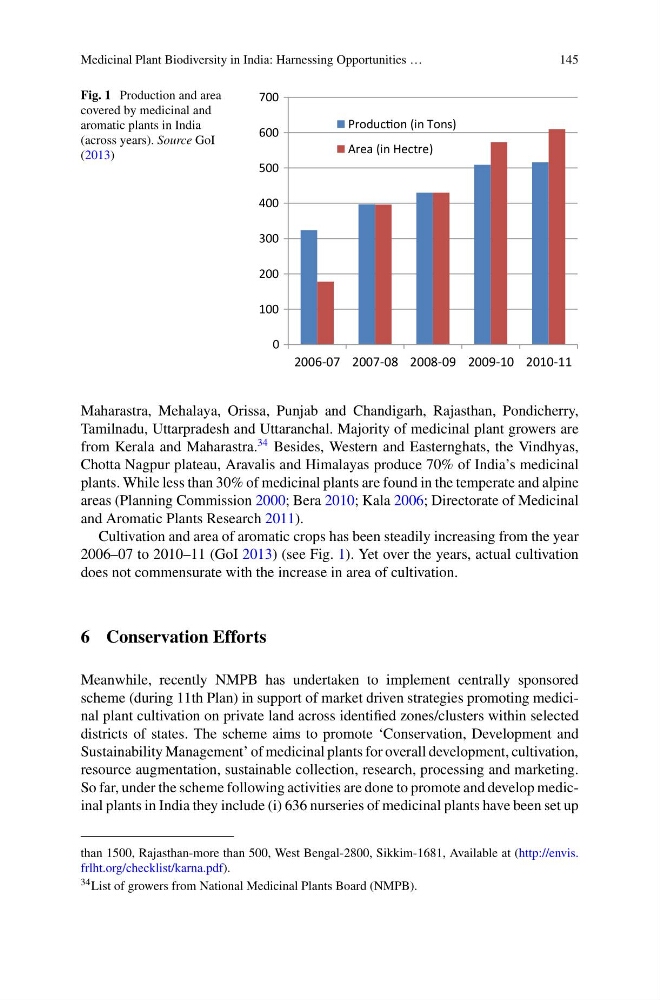
Fig. 1 Production and area
covered by medicinal and
aromatic plants in India
(across years). Source GoI
(2013)
0
100
200
300
400
500
600
700
2006-07 2007-08 2008-09 2009-10 2010-11
ProducƟon (in Tons)
Area (in Hectre)
Maharastra, Mehalaya, Orissa, Punjab and Chandigarh, Rajasthan, Pondicherry,
Tamilnadu, Uttarpradesh and Uttaranchal. Majority of medicinal plant growers are
from Kerala and Maharastra.
34 Besides, Western and Easternghats, the Vindhyas,
Chotta Nagpur plateau, Aravalis and Himalayas produce 70% of India’s medicinal
plants. While less than 30% of medicinal plants are found in the temperate and alpine
areas (Planning Commission 2000; Bera 2010; Kala 2006; Directorate of Medicinal
and Aromatic Plants Research 2011).
Cultivation and area of aromatic crops has been steadily increasing from the year
2006–07 to 2010–11 (GoI 2013) (see Fig. 1). Yet over the years, actual cultivation
does not commensurate with the increase in area of cultivation.
6 Conservation Efforts
Meanwhile, recently NMPB has undertaken to implement centrally sponsored
scheme (during 11th Plan) in support of market driven strategies promoting medicinal plant cultivation on private land across identified zones/clusters within selected
districts of states. The scheme aims to promote ‘Conservation, Development and
Sustainability Management’ of medicinal plants for overall development, cultivation,
resource augmentation, sustainable collection, research, processing and marketing.
So far, under the scheme following activities are done to promote and develop medicinal plants in India they include (i) 636 nurseries of medicinal plants have been set up
than 1500, Rajasthan-more than 500, West Bengal-2800, Sikkim-1681, Available at (http://envis.
frlht.org/checklist/karna.pdf).
34 List of growers from National Medicinal Plants Board (NMPB).
145
Fig. 1 Production and area
covered by medicinal and
aromatic plants in India
(across years). Source GoI
(2013)
0
100
200
300
400
500
600
700
2006-07 2007-08 2008-09 2009-10 2010-11
ProducƟon (in Tons)
Area (in Hectre)
Maharastra, Mehalaya, Orissa, Punjab and Chandigarh, Rajasthan, Pondicherry,
Tamilnadu, Uttarpradesh and Uttaranchal. Majority of medicinal plant growers are
from Kerala and Maharastra.
34 Besides, Western and Easternghats, the Vindhyas,
Chotta Nagpur plateau, Aravalis and Himalayas produce 70% of India’s medicinal
plants. While less than 30% of medicinal plants are found in the temperate and alpine
areas (Planning Commission 2000; Bera 2010; Kala 2006; Directorate of Medicinal
and Aromatic Plants Research 2011).
Cultivation and area of aromatic crops has been steadily increasing from the year
2006–07 to 2010–11 (GoI 2013) (see Fig. 1). Yet over the years, actual cultivation
does not commensurate with the increase in area of cultivation.
6 Conservation Efforts
Meanwhile, recently NMPB has undertaken to implement centrally sponsored
scheme (during 11th Plan) in support of market driven strategies promoting medicinal plant cultivation on private land across identified zones/clusters within selected
districts of states. The scheme aims to promote ‘Conservation, Development and
Sustainability Management’ of medicinal plants for overall development, cultivation,
resource augmentation, sustainable collection, research, processing and marketing.
So far, under the scheme following activities are done to promote and develop medicinal plants in India they include (i) 636 nurseries of medicinal plants have been set up
than 1500, Rajasthan-more than 500, West Bengal-2800, Sikkim-1681, Available at (http://envis.
frlht.org/checklist/karna.pdf).
34 List of growers from National Medicinal Plants Board (NMPB).