

94
R. Kumar and P. Saikia
Table 13 Quantity of
Bamboo as raw materialsfor
various bamboo
basedindustries from different
districts of Jharkhand
Sl. No. District
Type of forest
resource utilized
Quantity in
quintal (yearly)
1.
Ranchi
Bamboo
29,000
2.
Dhanbad
Bamboo
25,000
3.
Deoghar
Bamboo
23,000
4.
Sahebganj Bamboo
–
5.
Kodrma
Bamboo
16,000
Source Department of industries, district Industry Centers of the
concerning district
prasad and flowers carriers for temples, packing cases for vegetables and fruits, as
a fencing in the fields in order to protect the crops from grazing, hut making, roof
making, thatching etc. Bamboos are also used by Paneris (beetle leaf growers) as a
support system for the framework in the cultivation of battle leaves. Furthermore,
bamboo is broadly used as lathis (stick) by the villagers, common men as well as the
police personnel. Bamboo is found in abundance in Dumka, Gumla and East Singhbhum districts of Jharkhand. Across the state, mainly in Giridih, Goda, Dumka, Pakud,
Sahebganj and Jamtada, training-cum-production centres have provided livelihoods
for some 2000 families. The people of ‘Kalindi society’, a tribe engaged in making
bamboo items in East Singhbhum, and the Asur caste natives of Gumla district are
trained in making professional products. The appeal and charm of eco- friendly products have captured the international markets and across urban India. Laundry bins,
dustbins, decorative items, even furniture are created and readily available markets
in urban centres, metros. Rather than the Jharkraft, other small-scale industries (registered in DIC) utilized the bamboo or related with handicraft and handloom. The
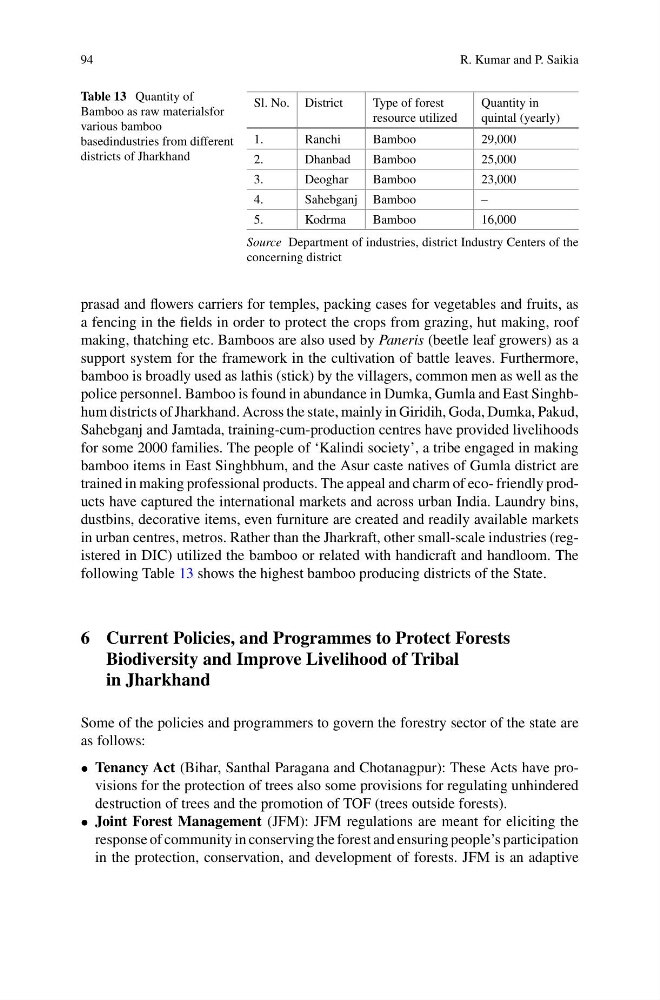
following Table 13 shows the highest bamboo producing districts of the State.
6 Current Policies, and Programmes to Protect Forests
Biodiversity and Improve Livelihood of Tribal
in Jharkhand
Some of the policies and programmers to govern the forestry sector of the state are
as follows:
• Tenancy Act (Bihar, Santhal Paragana and Chotanagpur): These Acts have provisions for the protection of trees also some provisions for regulating unhindered
destruction of trees and the promotion of TOF (trees outside forests).
• Joint Forest Management (JFM): JFM regulations are meant for eliciting the
response of community in conserving the forest and ensuring people’s participation
in the protection, conservation, and development of forests. JFM is an adaptive
R. Kumar and P. Saikia
Table 13 Quantity of
Bamboo as raw materialsfor
various bamboo
basedindustries from different
districts of Jharkhand
Sl. No. District
Type of forest
resource utilized
Quantity in
quintal (yearly)
1.
Ranchi
Bamboo
29,000
2.
Dhanbad
Bamboo
25,000
3.
Deoghar
Bamboo
23,000
4.
Sahebganj Bamboo
–
5.
Kodrma
Bamboo
16,000
Source Department of industries, district Industry Centers of the
concerning district
prasad and flowers carriers for temples, packing cases for vegetables and fruits, as
a fencing in the fields in order to protect the crops from grazing, hut making, roof
making, thatching etc. Bamboos are also used by Paneris (beetle leaf growers) as a
support system for the framework in the cultivation of battle leaves. Furthermore,
bamboo is broadly used as lathis (stick) by the villagers, common men as well as the
police personnel. Bamboo is found in abundance in Dumka, Gumla and East Singhbhum districts of Jharkhand. Across the state, mainly in Giridih, Goda, Dumka, Pakud,
Sahebganj and Jamtada, training-cum-production centres have provided livelihoods
for some 2000 families. The people of ‘Kalindi society’, a tribe engaged in making
bamboo items in East Singhbhum, and the Asur caste natives of Gumla district are
trained in making professional products. The appeal and charm of eco- friendly products have captured the international markets and across urban India. Laundry bins,
dustbins, decorative items, even furniture are created and readily available markets
in urban centres, metros. Rather than the Jharkraft, other small-scale industries (registered in DIC) utilized the bamboo or related with handicraft and handloom. The
following Table 13 shows the highest bamboo producing districts of the State.
6 Current Policies, and Programmes to Protect Forests
Biodiversity and Improve Livelihood of Tribal
in Jharkhand
Some of the policies and programmers to govern the forestry sector of the state are
as follows:
• Tenancy Act (Bihar, Santhal Paragana and Chotanagpur): These Acts have provisions for the protection of trees also some provisions for regulating unhindered
destruction of trees and the promotion of TOF (trees outside forests).
• Joint Forest Management (JFM): JFM regulations are meant for eliciting the
response of community in conserving the forest and ensuring people’s participation
in the protection, conservation, and development of forests. JFM is an adaptive