

Forest Resources of Jharkhand, Eastern India …
93
Table 12 Quantity of sal
leaves (ton) used for
manufacturing sal plates from
different districts of
Jharkhand
Sl. No.
District
Quantity (ton)
1.
Lohardaga
15,000
2.
Deoghar
83,500
3.
Sahebganj
44,500
4.
Bokaro
85,000
5.
Hazaribagh
425,000
Total
6,53,000
Source Department of industries, district industry center of
concerning district
of availability/access to the storage facilities compels them to sell it in the local haat
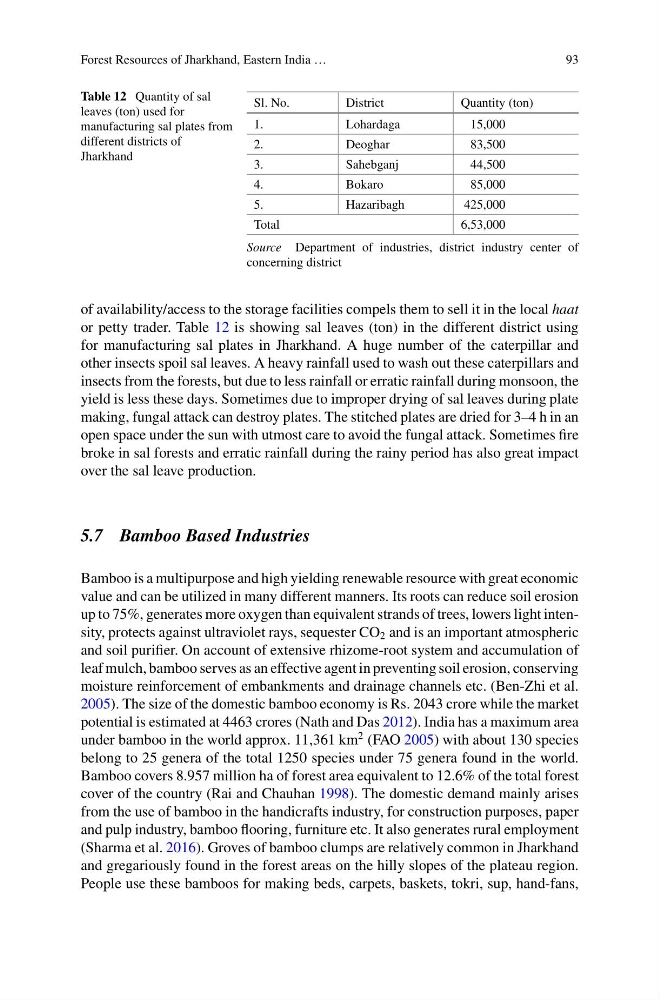
or petty trader. Table 12 is showing sal leaves (ton) in the different district using
for manufacturing sal plates in Jharkhand. A huge number of the caterpillar and
other insects spoil sal leaves. A heavy rainfall used to wash out these caterpillars and
insects from the forests, but due to less rainfall or erratic rainfall during monsoon, the
yield is less these days. Sometimes due to improper drying of sal leaves during plate
making, fungal attack can destroy plates. The stitched plates are dried for 3–4 h in an
open space under the sun with utmost care to avoid the fungal attack. Sometimes fire
broke in sal forests and erratic rainfall during the rainy period has also great impact
over the sal leave production.
5.7 Bamboo Based Industries
Bamboo is a multipurpose and high yielding renewable resource with great economic
value and can be utilized in many different manners. Its roots can reduce soil erosion
up to 75%, generates more oxygen than equivalent strands of trees, lowers light intensity, protects against ultraviolet rays, sequester CO 2 and is an important atmospheric
and soil purifier. On account of extensive rhizome-root system and accumulation of
leaf mulch, bamboo serves as an effective agent in preventing soil erosion, conserving
moisture reinforcement of embankments and drainage channels etc. (Ben-Zhi et al.
2005). The size of the domestic bamboo economy is Rs. 2043 crore while the market
potential is estimated at 4463 crores (Nath and Das 2012). India has a maximum area
under bamboo in the world approx. 11,361 km
2 (FAO 2005) with about 130 species
belong to 25 genera of the total 1250 species under 75 genera found in the world.
Bamboo covers 8.957 million ha of forest area equivalent to 12.6% of the total forest
cover of the country (Rai and Chauhan 1998). The domestic demand mainly arises
from the use of bamboo in the handicrafts industry, for construction purposes, paper
and pulp industry, bamboo flooring, furniture etc. It also generates rural employment
(Sharma et al. 2016). Groves of bamboo clumps are relatively common in Jharkhand
and gregariously found in the forest areas on the hilly slopes of the plateau region.
People use these bamboos for making beds, carpets, baskets, tokri, sup, hand-fans,
93
Table 12 Quantity of sal
leaves (ton) used for
manufacturing sal plates from
different districts of
Jharkhand
Sl. No.
District
Quantity (ton)
1.
Lohardaga
15,000
2.
Deoghar
83,500
3.
Sahebganj
44,500
4.
Bokaro
85,000
5.
Hazaribagh
425,000
Total
6,53,000
Source Department of industries, district industry center of
concerning district
of availability/access to the storage facilities compels them to sell it in the local haat
or petty trader. Table 12 is showing sal leaves (ton) in the different district using
for manufacturing sal plates in Jharkhand. A huge number of the caterpillar and
other insects spoil sal leaves. A heavy rainfall used to wash out these caterpillars and
insects from the forests, but due to less rainfall or erratic rainfall during monsoon, the
yield is less these days. Sometimes due to improper drying of sal leaves during plate
making, fungal attack can destroy plates. The stitched plates are dried for 3–4 h in an
open space under the sun with utmost care to avoid the fungal attack. Sometimes fire
broke in sal forests and erratic rainfall during the rainy period has also great impact
over the sal leave production.
5.7 Bamboo Based Industries
Bamboo is a multipurpose and high yielding renewable resource with great economic
value and can be utilized in many different manners. Its roots can reduce soil erosion
up to 75%, generates more oxygen than equivalent strands of trees, lowers light intensity, protects against ultraviolet rays, sequester CO 2 and is an important atmospheric
and soil purifier. On account of extensive rhizome-root system and accumulation of
leaf mulch, bamboo serves as an effective agent in preventing soil erosion, conserving
moisture reinforcement of embankments and drainage channels etc. (Ben-Zhi et al.
2005). The size of the domestic bamboo economy is Rs. 2043 crore while the market
potential is estimated at 4463 crores (Nath and Das 2012). India has a maximum area
under bamboo in the world approx. 11,361 km
2 (FAO 2005) with about 130 species
belong to 25 genera of the total 1250 species under 75 genera found in the world.
Bamboo covers 8.957 million ha of forest area equivalent to 12.6% of the total forest
cover of the country (Rai and Chauhan 1998). The domestic demand mainly arises
from the use of bamboo in the handicrafts industry, for construction purposes, paper
and pulp industry, bamboo flooring, furniture etc. It also generates rural employment
(Sharma et al. 2016). Groves of bamboo clumps are relatively common in Jharkhand
and gregariously found in the forest areas on the hilly slopes of the plateau region.
People use these bamboos for making beds, carpets, baskets, tokri, sup, hand-fans,