

15
The system configuration for the 3 years is shown in the Table 2 below.
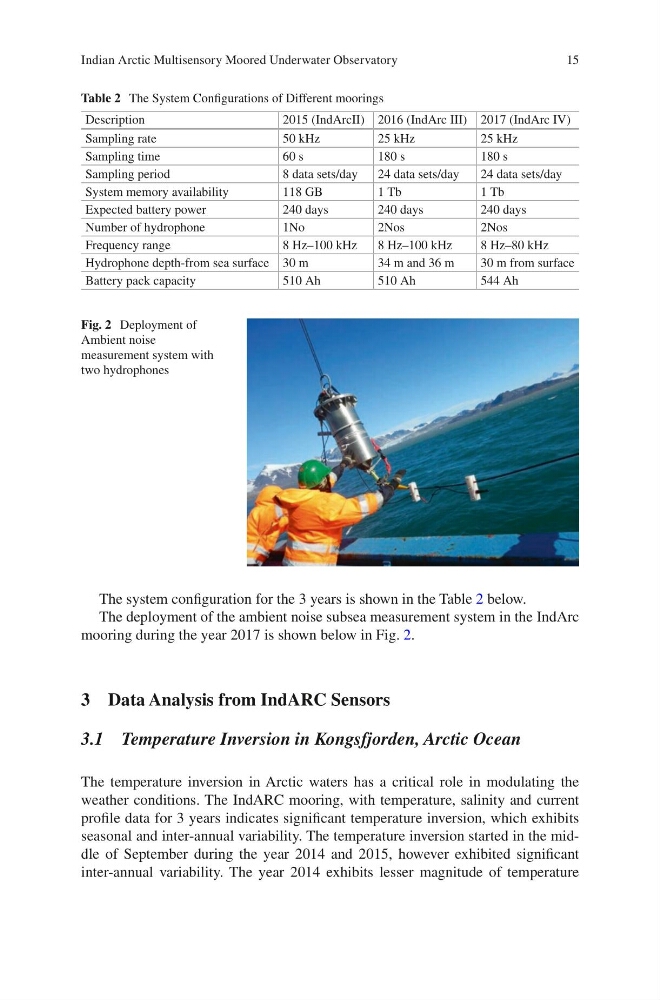
The deployment of the ambient noise subsea measurement system in the IndArc
mooring during the year 2017 is shown below in Fig. 2.
3 Data Analysis from IndARC Sensors
3.1 Temperature Inversion in Kongsfjorden, Arctic Ocean
The temperature inversion in Arctic waters has a critical role in modulating the
weather conditions. The IndARC mooring, with temperature, salinity and current
profile data for 3 years indicates significant temperature inversion, which exhibits
seasonal and inter-annual variability. The temperature inversion started in the middle of September during the year 2014 and 2015, however exhibited significant
inter-annual variability. The year 2014 exhibits lesser magnitude of temperature
Table 2 The System Configurations of Different moorings
Description
2015 (IndArcII) 2016 (IndArc III) 2017 (IndArc IV)
Sampling rate
50 kHz
25 kHz
25 kHz
Sampling time
60 s
180 s
180 s
Sampling period
8 data sets/day
24 data sets/day
24 data sets/day
System memory availability
118 GB
1 Tb
1 Tb
Expected battery power
240 days
240 days
240 days
Number of hydrophone
1No
2Nos
2Nos
Frequency range
8 Hz–100 kHz
8 Hz–100 kHz
8 Hz–80 kHz
Hydrophone depth-from sea surface 30 m
34 m and 36 m
30 m from surface
Battery pack capacity
510 Ah
510 Ah
544 Ah
Fig. 2 Deployment of
Ambient noise
measurement system with
two hydrophones
Indian Arctic Multisensory Moored Underwater Observatory
The system configuration for the 3 years is shown in the Table 2 below.
The deployment of the ambient noise subsea measurement system in the IndArc
mooring during the year 2017 is shown below in Fig. 2.
3 Data Analysis from IndARC Sensors
3.1 Temperature Inversion in Kongsfjorden, Arctic Ocean
The temperature inversion in Arctic waters has a critical role in modulating the
weather conditions. The IndARC mooring, with temperature, salinity and current
profile data for 3 years indicates significant temperature inversion, which exhibits
seasonal and inter-annual variability. The temperature inversion started in the middle of September during the year 2014 and 2015, however exhibited significant
inter-annual variability. The year 2014 exhibits lesser magnitude of temperature
Table 2 The System Configurations of Different moorings
Description
2015 (IndArcII) 2016 (IndArc III) 2017 (IndArc IV)
Sampling rate
50 kHz
25 kHz
25 kHz
Sampling time
60 s
180 s
180 s
Sampling period
8 data sets/day
24 data sets/day
24 data sets/day
System memory availability
118 GB
1 Tb
1 Tb
Expected battery power
240 days
240 days
240 days
Number of hydrophone
1No
2Nos
2Nos
Frequency range
8 Hz–100 kHz
8 Hz–100 kHz
8 Hz–80 kHz
Hydrophone depth-from sea surface 30 m
34 m and 36 m
30 m from surface
Battery pack capacity
510 Ah
510 Ah
544 Ah
Fig. 2 Deployment of
Ambient noise
measurement system with
two hydrophones
Indian Arctic Multisensory Moored Underwater Observatory