

233
during 2000–2015 which is in phase with cooling trend over GH during same period
reported by Negi et al. (2018). CRU-TS depicts maximum rate of warming over KH
which is in agreement to EDW. Prevalence of EDW over NWH was refuted by Negi
et al. (2018) as they reported highest rate of warming at intermediate elevations
(GH). Surprisingly, both datasets show warming trends (statistical significance at
α = 0.05) over KH during all three study periods which is out of phase of anticipations of cooling over KH resulting in stable/advancing state of few KH glaciers
(Bolch et al. 2012; Bhambri et al. 2013).
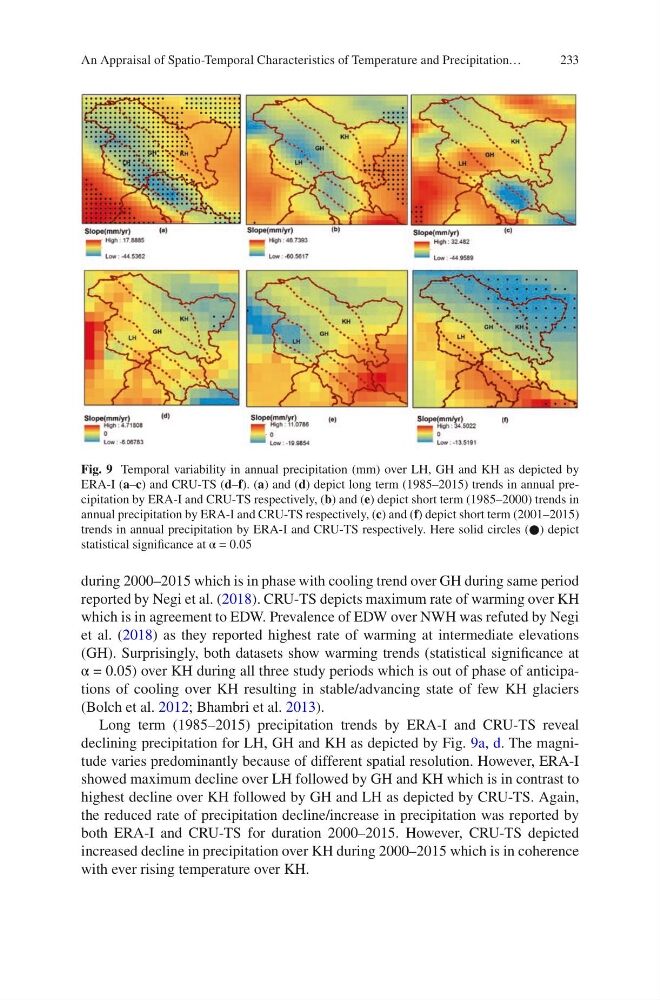
Long term (1985–2015) precipitation trends by ERA-I and CRU-TS reveal
declining precipitation for LH, GH and KH as depicted by Fig. 9a, d. The magnitude varies predominantly because of different spatial resolution. However, ERA-I
showed maximum decline over LH followed by GH and KH which is in contrast to
highest decline over KH followed by GH and LH as depicted by CRU-TS. Again,
the reduced rate of precipitation decline/increase in precipitation was reported by
both ERA-I and CRU-TS for duration 2000–2015. However, CRU-TS depicted
increased decline in precipitation over KH during 2000–2015 which is in coherence
with ever rising temperature over KH.
Fig. 9 Temporal variability in annual precipitation (mm) over LH, GH and KH as depicted by
ERA-I (a–c) and CRU-TS (d–f). (a) and (d) depict long term (1985–2015) trends in annual precipitation by ERA-I and CRU-TS respectively, (b) and (e) depict short term (1985–2000) trends in
annual precipitation by ERA-I and CRU-TS respectively, (c) and (f) depict short term (2001–2015)
trends in annual precipitation by ERA-I and CRU-TS respectively. Here solid circles (●) depict
statistical significance at α = 0.05
An Appraisal of Spatio-Temporal Characteristics of Temperature and Precipitation…
during 2000–2015 which is in phase with cooling trend over GH during same period
reported by Negi et al. (2018). CRU-TS depicts maximum rate of warming over KH
which is in agreement to EDW. Prevalence of EDW over NWH was refuted by Negi
et al. (2018) as they reported highest rate of warming at intermediate elevations
(GH). Surprisingly, both datasets show warming trends (statistical significance at
α = 0.05) over KH during all three study periods which is out of phase of anticipations of cooling over KH resulting in stable/advancing state of few KH glaciers
(Bolch et al. 2012; Bhambri et al. 2013).
Long term (1985–2015) precipitation trends by ERA-I and CRU-TS reveal
declining precipitation for LH, GH and KH as depicted by Fig. 9a, d. The magnitude varies predominantly because of different spatial resolution. However, ERA-I
showed maximum decline over LH followed by GH and KH which is in contrast to
highest decline over KH followed by GH and LH as depicted by CRU-TS. Again,
the reduced rate of precipitation decline/increase in precipitation was reported by
both ERA-I and CRU-TS for duration 2000–2015. However, CRU-TS depicted
increased decline in precipitation over KH during 2000–2015 which is in coherence
with ever rising temperature over KH.
Fig. 9 Temporal variability in annual precipitation (mm) over LH, GH and KH as depicted by
ERA-I (a–c) and CRU-TS (d–f). (a) and (d) depict long term (1985–2015) trends in annual precipitation by ERA-I and CRU-TS respectively, (b) and (e) depict short term (1985–2000) trends in
annual precipitation by ERA-I and CRU-TS respectively, (c) and (f) depict short term (2001–2015)
trends in annual precipitation by ERA-I and CRU-TS respectively. Here solid circles (●) depict
statistical significance at α = 0.05
An Appraisal of Spatio-Temporal Characteristics of Temperature and Precipitation…