

198
becomes narrow with V-Shaped valley. However, fluvial terraces are well preserved
in segments only. Alluvial fans are prominent along tributary channels. Besides,
slope deposits are also observed along valley flanks.
The present day river profile and trends of terraces in the river profile (Fig. 4a)
signify that the terrace staircases of the Yamuna Valley are paired fills preserved
along valley flanks and represent characteristic cut-and-fill history and its Late
Quaternary geomorphic evolution. The lateral continuity of terraces across major
tectonic zones (MBT and MCT; Fig. 4a, b) suggests that their origin is not related
to tectonically induced base level change. Even though the terrace sequences cut
across various structural discontinuities, which demarcate structural boundaries of
Higher to Lesser and Lesser to Sub-Himalaya no noticeable break in slope in palaeofloodplain along the downstream direction is observed (Fig. 4a, b). However,
noticeable nickpoint is observed across MBT but absence of dislocation and warping in palaeofloodplain (Fig. 4b) suggests that the sediment aggradation and incision is primarily controlled by post tectonic climatic amelioration and sediment
dispersal, accumulation and incision remained unaffected by hinterland tectonic
activity after their formation.
3.2 Sedimentary Facies of Quaternary Successions
and Depositional Environment
During Late Quaternary, surficial processes with variable intensities have led to
deposition of distinct sedimentary facies in space and time. These are preserved
along Yamuna River Valley and are indicative of palaeoclimatic fluctuations.
Geomorphological variation, river gradient and sediment-water ratio of trunk as
well as tributary streams governed the variable sedimentary facies in alluvial deposits. The facies character and field relations of these sediment facilitate a reliable
understanding of the palaeoclimatic conditions and geomorphic evolution of a river
valley during Late Quaternary. In the present study, seven sedimentary sub-facies
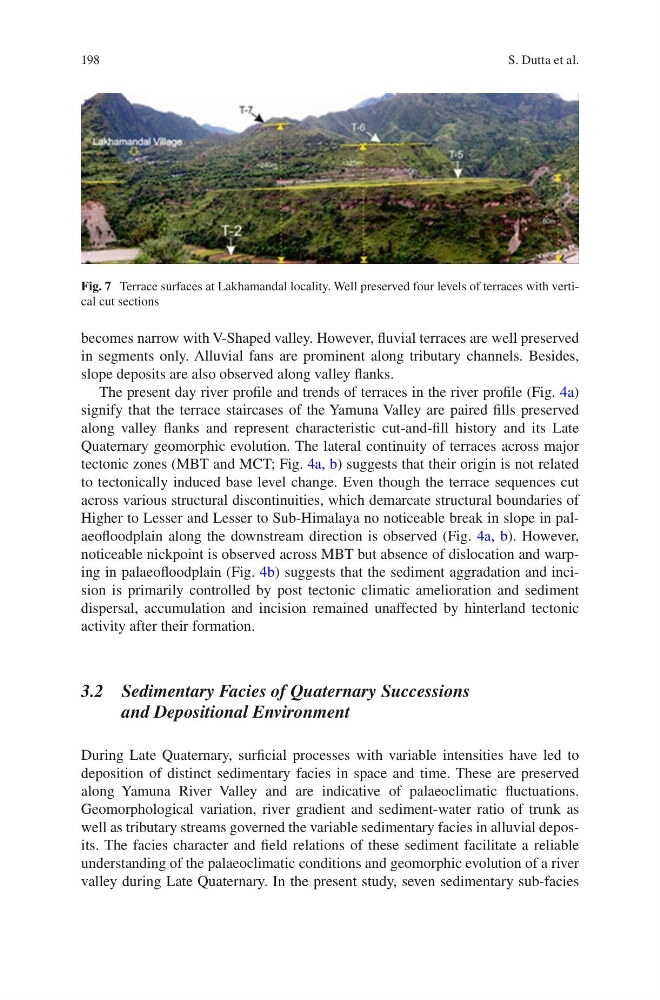
Fig. 7 Terrace surfaces at Lakhamandal locality. Well preserved four levels of terraces with vertical cut sections
S. Dutta et al.
becomes narrow with V-Shaped valley. However, fluvial terraces are well preserved
in segments only. Alluvial fans are prominent along tributary channels. Besides,
slope deposits are also observed along valley flanks.
The present day river profile and trends of terraces in the river profile (Fig. 4a)
signify that the terrace staircases of the Yamuna Valley are paired fills preserved
along valley flanks and represent characteristic cut-and-fill history and its Late
Quaternary geomorphic evolution. The lateral continuity of terraces across major
tectonic zones (MBT and MCT; Fig. 4a, b) suggests that their origin is not related
to tectonically induced base level change. Even though the terrace sequences cut
across various structural discontinuities, which demarcate structural boundaries of
Higher to Lesser and Lesser to Sub-Himalaya no noticeable break in slope in palaeofloodplain along the downstream direction is observed (Fig. 4a, b). However,
noticeable nickpoint is observed across MBT but absence of dislocation and warping in palaeofloodplain (Fig. 4b) suggests that the sediment aggradation and incision is primarily controlled by post tectonic climatic amelioration and sediment
dispersal, accumulation and incision remained unaffected by hinterland tectonic
activity after their formation.
3.2 Sedimentary Facies of Quaternary Successions
and Depositional Environment
During Late Quaternary, surficial processes with variable intensities have led to
deposition of distinct sedimentary facies in space and time. These are preserved
along Yamuna River Valley and are indicative of palaeoclimatic fluctuations.
Geomorphological variation, river gradient and sediment-water ratio of trunk as
well as tributary streams governed the variable sedimentary facies in alluvial deposits. The facies character and field relations of these sediment facilitate a reliable
understanding of the palaeoclimatic conditions and geomorphic evolution of a river
valley during Late Quaternary. In the present study, seven sedimentary sub-facies
Fig. 7 Terrace surfaces at Lakhamandal locality. Well preserved four levels of terraces with vertical cut sections
S. Dutta et al.