

191
The HF treatment was also for removal of any feldspar contaminations. The grains
were than treated with HCl (for about 30 min) and re-sieved. The purity of the
etched quartz (i.e. feldspar contaminations if any) was tested using infrared stimulated luminescence (IRSL) screening. The quartz grains were mounted as a mono
layer (about 3 mm diameter) on stainless steel disc (10 mm diameter) using silicon
oil for luminescence measurements. OSL measurements which include determination of radiation energy received by the sample after its burial, that is, palaeodose or
equivalent dose (ED) were carried out in Risoe TL/OSL Reader (model 15–20A)
fitted with Sr
90
radiation source. The single aliquot regeneration (SAR) protocol
(Murray and Wintle 2000) was followed for ED determination. The OSL measurements were carried out using 220 °C preheat for 10 s, 200 °C cut heat, laboratory
irradiation from a calibrated beta source (Sr/Yr 90) and 40 s blue light stimulation.
The ED values (Table 2) were calculated using the initial 0.8 s integral of the OSL
by Duller’s Analyst software.
For the annual dose rate estimation, concentrations of uranium and thorium were
measured by ICP-MS (Thermofisher Scientific X-series 2) at Geological Survey of
India, Faridabad, India using Standard Reference Materials (SRM) GSD-12 and
GSD-5. Uncertainties of 21.4 ± 1 ppb and 15.2 ± 1 ppb for U and 7.8 ± 1 ppb and
2.6 ± 0.5 ppb for Th, depending on the range of U and Th concentration in the
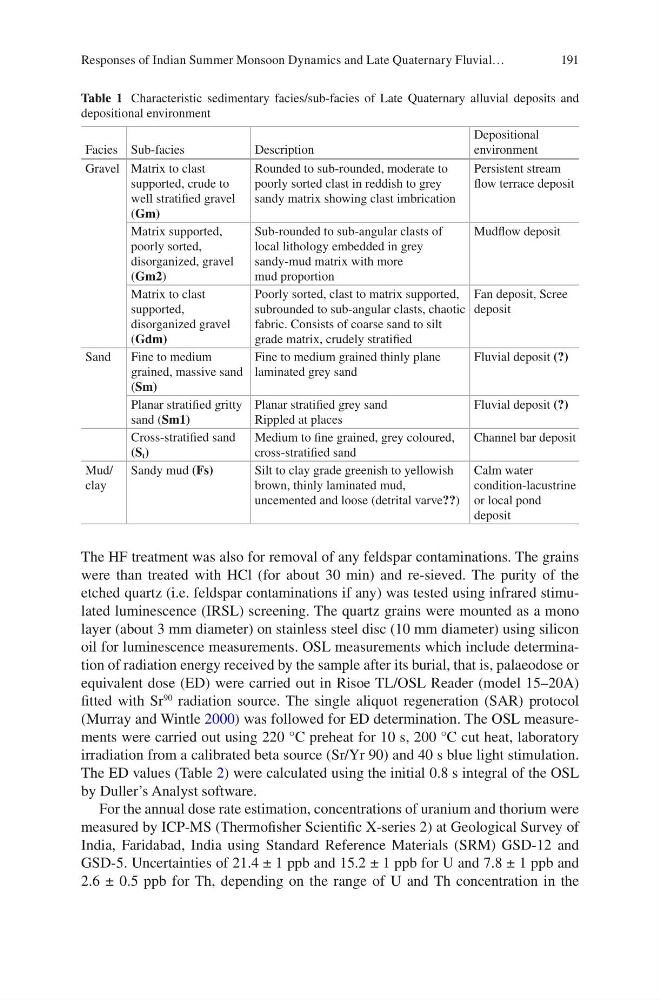
Table 1 Characteristic sedimentary facies/sub-facies of Late Quaternary alluvial deposits and
depositional environment
Facies Sub-facies
Description
Depositional
environment
Gravel Matrix to clast
supported, crude to
well stratified gravel
(Gm)
Rounded to sub-rounded, moderate to
poorly sorted clast in reddish to grey
sandy matrix showing clast imbrication
Persistent stream
flow terrace deposit
Matrix supported,
poorly sorted,
disorganized, gravel
(Gm2)
Sub-rounded to sub-angular clasts of
local lithology embedded in grey
sandy-mud matrix with more
mud proportion
Mudflow deposit
Matrix to clast
supported,
disorganized gravel
(Gdm)
Poorly sorted, clast to matrix supported,
subrounded to sub-angular clasts, chaotic
fabric. Consists of coarse sand to silt
grade matrix, crudely stratified
Fan deposit, Scree
deposit
Sand
Fine to medium
grained, massive sand
(Sm)
Fine to medium grained thinly plane
laminated grey sand
Fluvial deposit (?)
Planar stratified gritty
sand (Sm1)
Planar stratified grey sand
Rippled at places
Fluvial deposit (?)
Cross-stratified sand
(S t )
Medium to fine grained, grey coloured,
cross-stratified sand
Channel bar deposit
Mud/
clay
Sandy mud (Fs)
Silt to clay grade greenish to yellowish
brown, thinly laminated mud,
uncemented and loose (detrital varve??)
Calm water
condition-lacustrine
or local pond
deposit
Responses of Indian Summer Monsoon Dynamics and Late Quaternary Fluvial…
The HF treatment was also for removal of any feldspar contaminations. The grains
were than treated with HCl (for about 30 min) and re-sieved. The purity of the
etched quartz (i.e. feldspar contaminations if any) was tested using infrared stimulated luminescence (IRSL) screening. The quartz grains were mounted as a mono
layer (about 3 mm diameter) on stainless steel disc (10 mm diameter) using silicon
oil for luminescence measurements. OSL measurements which include determination of radiation energy received by the sample after its burial, that is, palaeodose or
equivalent dose (ED) were carried out in Risoe TL/OSL Reader (model 15–20A)
fitted with Sr
90
radiation source. The single aliquot regeneration (SAR) protocol
(Murray and Wintle 2000) was followed for ED determination. The OSL measurements were carried out using 220 °C preheat for 10 s, 200 °C cut heat, laboratory
irradiation from a calibrated beta source (Sr/Yr 90) and 40 s blue light stimulation.
The ED values (Table 2) were calculated using the initial 0.8 s integral of the OSL
by Duller’s Analyst software.
For the annual dose rate estimation, concentrations of uranium and thorium were
measured by ICP-MS (Thermofisher Scientific X-series 2) at Geological Survey of
India, Faridabad, India using Standard Reference Materials (SRM) GSD-12 and
GSD-5. Uncertainties of 21.4 ± 1 ppb and 15.2 ± 1 ppb for U and 7.8 ± 1 ppb and
2.6 ± 0.5 ppb for Th, depending on the range of U and Th concentration in the
Table 1 Characteristic sedimentary facies/sub-facies of Late Quaternary alluvial deposits and
depositional environment
Facies Sub-facies
Description
Depositional
environment
Gravel Matrix to clast
supported, crude to
well stratified gravel
(Gm)
Rounded to sub-rounded, moderate to
poorly sorted clast in reddish to grey
sandy matrix showing clast imbrication
Persistent stream
flow terrace deposit
Matrix supported,
poorly sorted,
disorganized, gravel
(Gm2)
Sub-rounded to sub-angular clasts of
local lithology embedded in grey
sandy-mud matrix with more
mud proportion
Mudflow deposit
Matrix to clast
supported,
disorganized gravel
(Gdm)
Poorly sorted, clast to matrix supported,
subrounded to sub-angular clasts, chaotic
fabric. Consists of coarse sand to silt
grade matrix, crudely stratified
Fan deposit, Scree
deposit
Sand
Fine to medium
grained, massive sand
(Sm)
Fine to medium grained thinly plane
laminated grey sand
Fluvial deposit (?)
Planar stratified gritty
sand (Sm1)
Planar stratified grey sand
Rippled at places
Fluvial deposit (?)
Cross-stratified sand
(S t )
Medium to fine grained, grey coloured,
cross-stratified sand
Channel bar deposit
Mud/
clay
Sandy mud (Fs)
Silt to clay grade greenish to yellowish
brown, thinly laminated mud,
uncemented and loose (detrital varve??)
Calm water
condition-lacustrine
or local pond
deposit
Responses of Indian Summer Monsoon Dynamics and Late Quaternary Fluvial…