

189
alluvium. So far very few studies have concentrated in the Lesser and Higher
Himalayan transect of the Yamuna River Valley, however, in the Sub Himalayan
part, the studies inferred either climatic (Dutta et al. 2012) or tectonic control
for terrace genesis (Singh et al. 2001). Moreover, the studies in Yamuna catchment
reveal consistency in the rock uplift pattern and spatial gradients in paleo erosion
rates supporting the tectonic control of sediment erosion (Scherler et al. 2014). In
the transect between MBT and north of MCT, staircase of fluvial and fan-cut terraces are ubiquitous which offers an opportunity to understand the intricate feedback mechanism of Glacial-Interglacial cycles to ISM dynamics and tectonics in
resultant fluvial development and/or geomorphic evolution on account of Late
Quaternary Palaeoclimatic changes on 10
4
–10
5
years scale.
2 Material and Methods
The outcome of the study is based on two components. The first is systematic field
studies and section measurement (recording lateral as well as vertical variations in
sedimentary facies) from representative sections and secondly the laboratory studies which include data compilation, sedimentary facies analysis, dating of samples
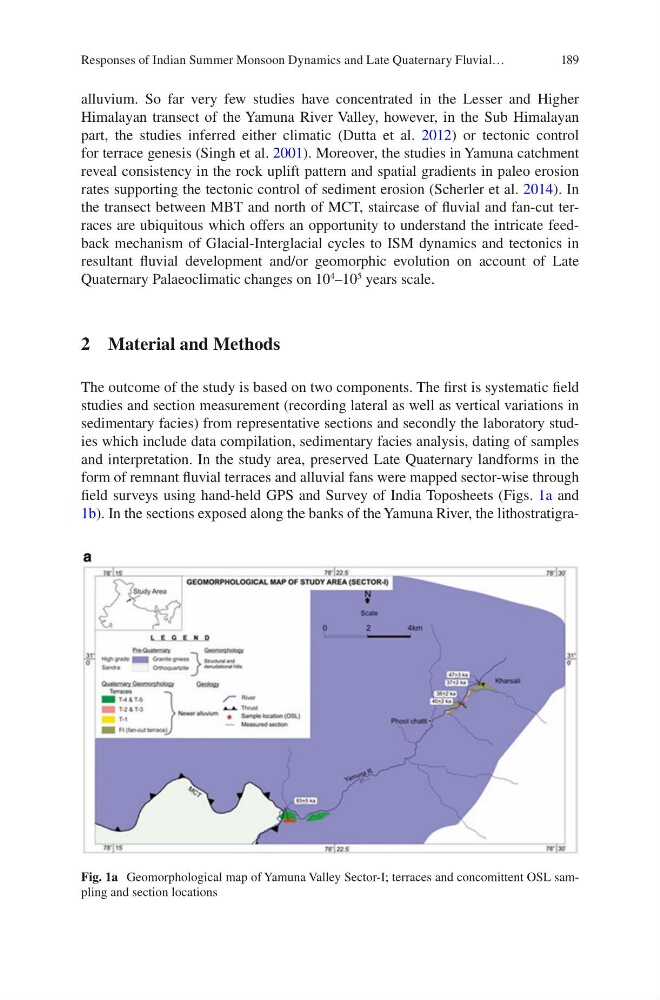
and interpretation. In the study area, preserved Late Quaternary landforms in the
form of remnant fluvial terraces and alluvial fans were mapped sector-wise through
field surveys using hand-held GPS and Survey of India Toposheets (Figs. 1a and
1b). In the sections exposed along the banks of the Yamuna River, the lithostratigraFig. 1a Geomorphological map of Yamuna Valley Sector-I; terraces and concomittent OSL sampling and section locations
Responses of Indian Summer Monsoon Dynamics and Late Quaternary Fluvial…
alluvium. So far very few studies have concentrated in the Lesser and Higher
Himalayan transect of the Yamuna River Valley, however, in the Sub Himalayan
part, the studies inferred either climatic (Dutta et al. 2012) or tectonic control
for terrace genesis (Singh et al. 2001). Moreover, the studies in Yamuna catchment
reveal consistency in the rock uplift pattern and spatial gradients in paleo erosion
rates supporting the tectonic control of sediment erosion (Scherler et al. 2014). In
the transect between MBT and north of MCT, staircase of fluvial and fan-cut terraces are ubiquitous which offers an opportunity to understand the intricate feedback mechanism of Glacial-Interglacial cycles to ISM dynamics and tectonics in
resultant fluvial development and/or geomorphic evolution on account of Late
Quaternary Palaeoclimatic changes on 10
4
–10
5
years scale.
2 Material and Methods
The outcome of the study is based on two components. The first is systematic field
studies and section measurement (recording lateral as well as vertical variations in
sedimentary facies) from representative sections and secondly the laboratory studies which include data compilation, sedimentary facies analysis, dating of samples
and interpretation. In the study area, preserved Late Quaternary landforms in the
form of remnant fluvial terraces and alluvial fans were mapped sector-wise through
field surveys using hand-held GPS and Survey of India Toposheets (Figs. 1a and
1b). In the sections exposed along the banks of the Yamuna River, the lithostratigraFig. 1a Geomorphological map of Yamuna Valley Sector-I; terraces and concomittent OSL sampling and section locations
Responses of Indian Summer Monsoon Dynamics and Late Quaternary Fluvial…