

133
5 Discussions
Under the impending climate change, three types of scenarios may arise. These are
as given below:
1. Climate change towards a cooling phase.
2. Climate change towards a warming phase.
3. Climate change in a no-change scenario.
5.1 Climate Change Towards a Cooling Phase
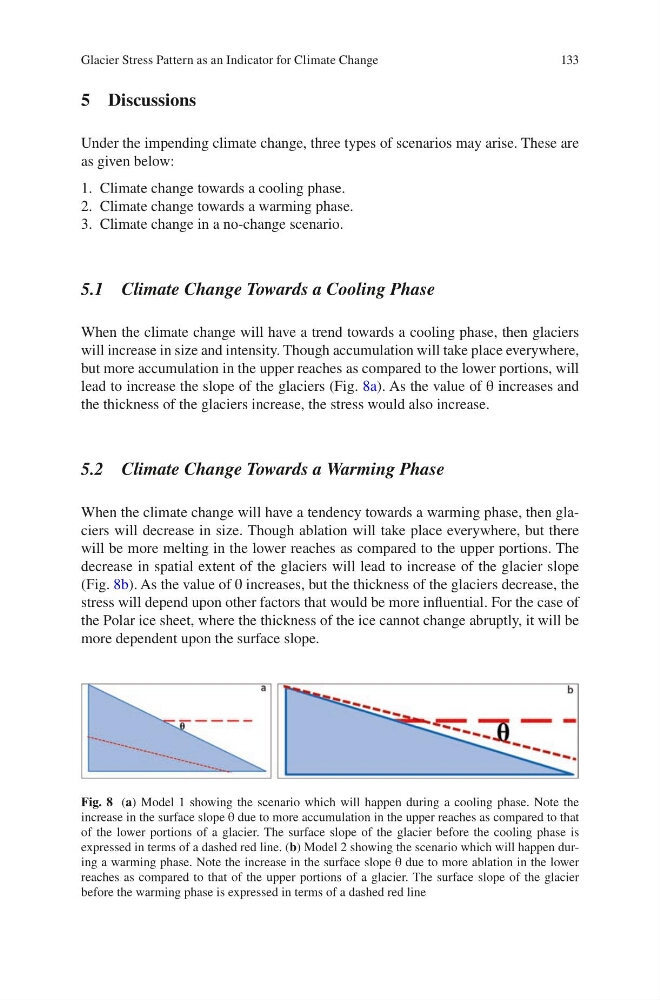
When the climate change will have a trend towards a cooling phase, then glaciers
will increase in size and intensity. Though accumulation will take place everywhere,
but more accumulation in the upper reaches as compared to the lower portions, will
lead to increase the slope of the glaciers (Fig. 8a). As the value of θ increases and
the thickness of the glaciers increase, the stress would also increase.
5.2 Climate Change Towards a Warming Phase
When the climate change will have a tendency towards a warming phase, then glaciers will decrease in size. Though ablation will take place everywhere, but there
will be more melting in the lower reaches as compared to the upper portions. The
decrease in spatial extent of the glaciers will lead to increase of the glacier slope
(Fig. 8b). As the value of θ increases, but the thickness of the glaciers decrease, the
stress will depend upon other factors that would be more influential. For the case of
the Polar ice sheet, where the thickness of the ice cannot change abruptly, it will be
more dependent upon the surface slope.
Fig. 8 (a) Model 1 showing the scenario which will happen during a cooling phase. Note the
increase in the surface slope θ due to more accumulation in the upper reaches as compared to that
of the lower portions of a glacier. The surface slope of the glacier before the cooling phase is
expressed in terms of a dashed red line. (b) Model 2 showing the scenario which will happen during a warming phase. Note the increase in the surface slope θ due to more ablation in the lower
reaches as compared to that of the upper portions of a glacier. The surface slope of the glacier
before the warming phase is expressed in terms of a dashed red line
Glacier Stress Pattern as an Indicator for Climate Change
5 Discussions
Under the impending climate change, three types of scenarios may arise. These are
as given below:
1. Climate change towards a cooling phase.
2. Climate change towards a warming phase.
3. Climate change in a no-change scenario.
5.1 Climate Change Towards a Cooling Phase
When the climate change will have a trend towards a cooling phase, then glaciers
will increase in size and intensity. Though accumulation will take place everywhere,
but more accumulation in the upper reaches as compared to the lower portions, will
lead to increase the slope of the glaciers (Fig. 8a). As the value of θ increases and
the thickness of the glaciers increase, the stress would also increase.
5.2 Climate Change Towards a Warming Phase
When the climate change will have a tendency towards a warming phase, then glaciers will decrease in size. Though ablation will take place everywhere, but there
will be more melting in the lower reaches as compared to the upper portions. The
decrease in spatial extent of the glaciers will lead to increase of the glacier slope
(Fig. 8b). As the value of θ increases, but the thickness of the glaciers decrease, the
stress will depend upon other factors that would be more influential. For the case of
the Polar ice sheet, where the thickness of the ice cannot change abruptly, it will be
more dependent upon the surface slope.
Fig. 8 (a) Model 1 showing the scenario which will happen during a cooling phase. Note the
increase in the surface slope θ due to more accumulation in the upper reaches as compared to that
of the lower portions of a glacier. The surface slope of the glacier before the cooling phase is
expressed in terms of a dashed red line. (b) Model 2 showing the scenario which will happen during a warming phase. Note the increase in the surface slope θ due to more ablation in the lower
reaches as compared to that of the upper portions of a glacier. The surface slope of the glacier
before the warming phase is expressed in terms of a dashed red line
Glacier Stress Pattern as an Indicator for Climate Change