

132
and lying close to the Veteheia nunatak shows a zone of moderate stress of about
150 kPa, where the stress is increasing within a short geographic distance.
4.7 Crevasse Orientation and Intensity Map
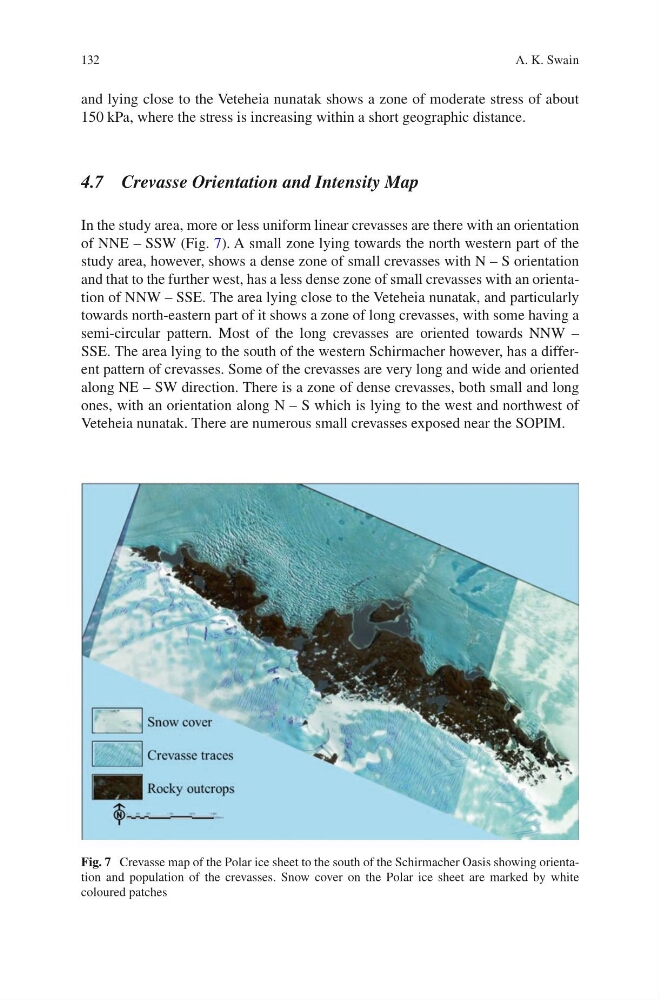
In the study area, more or less uniform linear crevasses are there with an orientation
of NNE – SSW (Fig. 7). A small zone lying towards the north western part of the
study area, however, shows a dense zone of small crevasses with N – S orientation
and that to the further west, has a less dense zone of small crevasses with an orientation of NNW – SSE. The area lying close to the Veteheia nunatak, and particularly
towards north-eastern part of it shows a zone of long crevasses, with some having a
semi-circular pattern. Most of the long crevasses are oriented towards NNW –
SSE. The area lying to the south of the western Schirmacher however, has a different pattern of crevasses. Some of the crevasses are very long and wide and oriented
along NE – SW direction. There is a zone of dense crevasses, both small and long
ones, with an orientation along N – S which is lying to the west and northwest of
Veteheia nunatak. There are numerous small crevasses exposed near the SOPIM.
Fig. 7 Crevasse map of the Polar ice sheet to the south of the Schirmacher Oasis showing orientation and population of the crevasses. Snow cover on the Polar ice sheet are marked by white
coloured patches
A. K. Swain
and lying close to the Veteheia nunatak shows a zone of moderate stress of about
150 kPa, where the stress is increasing within a short geographic distance.
4.7 Crevasse Orientation and Intensity Map
In the study area, more or less uniform linear crevasses are there with an orientation
of NNE – SSW (Fig. 7). A small zone lying towards the north western part of the
study area, however, shows a dense zone of small crevasses with N – S orientation
and that to the further west, has a less dense zone of small crevasses with an orientation of NNW – SSE. The area lying close to the Veteheia nunatak, and particularly
towards north-eastern part of it shows a zone of long crevasses, with some having a
semi-circular pattern. Most of the long crevasses are oriented towards NNW –
SSE. The area lying to the south of the western Schirmacher however, has a different pattern of crevasses. Some of the crevasses are very long and wide and oriented
along NE – SW direction. There is a zone of dense crevasses, both small and long
ones, with an orientation along N – S which is lying to the west and northwest of
Veteheia nunatak. There are numerous small crevasses exposed near the SOPIM.
Fig. 7 Crevasse map of the Polar ice sheet to the south of the Schirmacher Oasis showing orientation and population of the crevasses. Snow cover on the Polar ice sheet are marked by white
coloured patches
A. K. Swain