

116
4 Conclusions
Snowfall and snowmelt over the Himalaya exhibit considerable interannual variability. Observed climate data are few over the inaccessible regions of the Himalaya
(especially western Himalaya). Dynamic downscaling method provides a dynamically consistent way to obtain high-resolution climate information over the
Himalaya. In this study, dynamic downscaling simulations have been described that
were obtained using a regional climate model (RegCM4) and the high-resolution
WRF model. While the WRF model was used to downscale observed coarseresolution ERA-I data, the RegCM4 used the hindcasts from a coarse resolution
GCM. It is found that the models have been successful in simulating the essential
features of climate and its variability over the Himalaya. Snowfall contributes to
about 80% or more amount of total precipitation over the western Himalaya.
Detailed vertical structure of circulation and temperature could be deciphered using
the WRF model, especially during excess and deficit years of precipitation. A zone
of high-correlation was identified where precipitation over the Karakoram co-varies
over the western Himalaya. The cloud microphysical processes are studied using
the mixing ratios of cloud liquid water, rain water snow and ice. It is seen that while
the rain water confines to only lower levels, snow has maximum magnitude among
all te hydrometeors during excess precipitation years. The RegCM4 model could
simulate better skill in precipitation hindcasts than the GCM used to force it. The
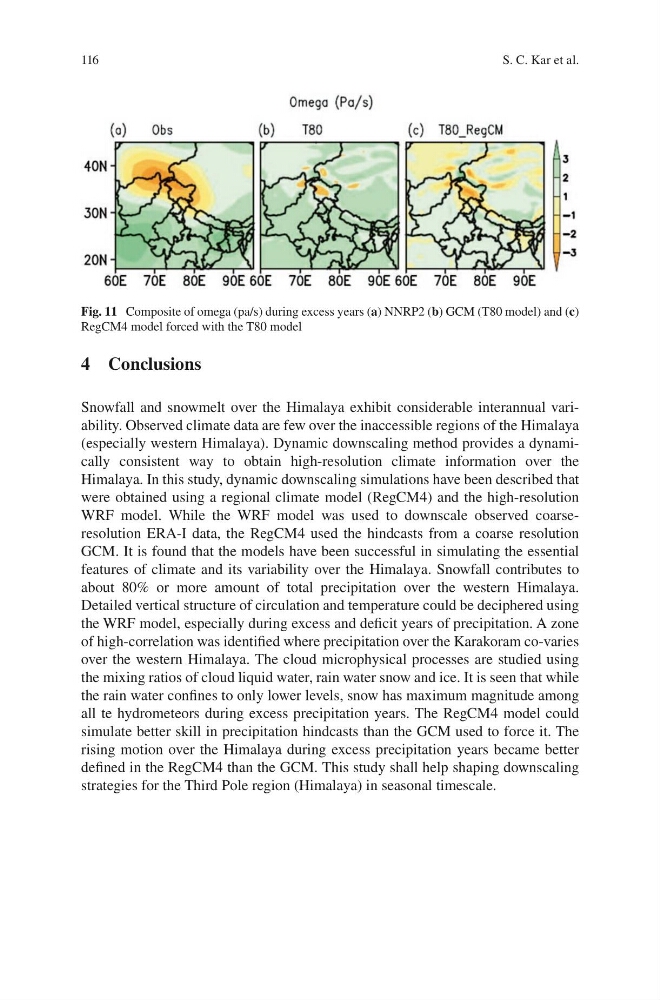
rising motion over the Himalaya during excess precipitation years became better
defined in the RegCM4 than the GCM. This study shall help shaping downscaling
strategies for the Third Pole region (Himalaya) in seasonal timescale.
Fig. 11 Composite of omega (pa/s) during excess years (a) NNRP2 (b) GCM (T80 model) and (c)
RegCM4 model forced with the T80 model
S. C. Kar et al.
4 Conclusions
Snowfall and snowmelt over the Himalaya exhibit considerable interannual variability. Observed climate data are few over the inaccessible regions of the Himalaya
(especially western Himalaya). Dynamic downscaling method provides a dynamically consistent way to obtain high-resolution climate information over the
Himalaya. In this study, dynamic downscaling simulations have been described that
were obtained using a regional climate model (RegCM4) and the high-resolution
WRF model. While the WRF model was used to downscale observed coarseresolution ERA-I data, the RegCM4 used the hindcasts from a coarse resolution
GCM. It is found that the models have been successful in simulating the essential
features of climate and its variability over the Himalaya. Snowfall contributes to
about 80% or more amount of total precipitation over the western Himalaya.
Detailed vertical structure of circulation and temperature could be deciphered using
the WRF model, especially during excess and deficit years of precipitation. A zone
of high-correlation was identified where precipitation over the Karakoram co-varies
over the western Himalaya. The cloud microphysical processes are studied using
the mixing ratios of cloud liquid water, rain water snow and ice. It is seen that while
the rain water confines to only lower levels, snow has maximum magnitude among
all te hydrometeors during excess precipitation years. The RegCM4 model could
simulate better skill in precipitation hindcasts than the GCM used to force it. The
rising motion over the Himalaya during excess precipitation years became better
defined in the RegCM4 than the GCM. This study shall help shaping downscaling
strategies for the Third Pole region (Himalaya) in seasonal timescale.
Fig. 11 Composite of omega (pa/s) during excess years (a) NNRP2 (b) GCM (T80 model) and (c)
RegCM4 model forced with the T80 model
S. C. Kar et al.