

110
domain, entire western and northern Himalayan regions experience warm temperatures in the model simulations (Fig. 6a). The warming is more than 3–4 °C over
many parts. At the same time, northern parts of India also has higher temperature
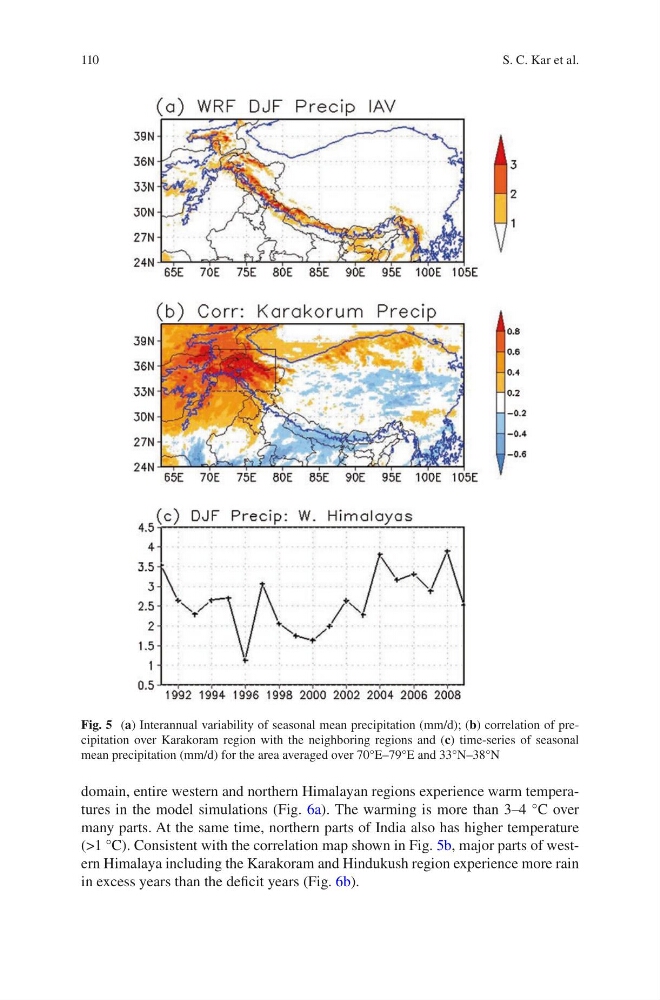
(>1 °C). Consistent with the correlation map shown in Fig. 5b, major parts of western Himalaya including the Karakoram and Hindukush region experience more rain
in excess years than the deficit years (Fig. 6b).
Fig. 5 (a) Interannual variability of seasonal mean precipitation (mm/d); (b) correlation of precipitation over Karakoram region with the neighboring regions and (c) time-series of seasonal
mean precipitation (mm/d) for the area averaged over 70°E–79°E and 33°N–38°N
S. C. Kar et al.
domain, entire western and northern Himalayan regions experience warm temperatures in the model simulations (Fig. 6a). The warming is more than 3–4 °C over
many parts. At the same time, northern parts of India also has higher temperature
(>1 °C). Consistent with the correlation map shown in Fig. 5b, major parts of western Himalaya including the Karakoram and Hindukush region experience more rain
in excess years than the deficit years (Fig. 6b).
Fig. 5 (a) Interannual variability of seasonal mean precipitation (mm/d); (b) correlation of precipitation over Karakoram region with the neighboring regions and (c) time-series of seasonal
mean precipitation (mm/d) for the area averaged over 70°E–79°E and 33°N–38°N
S. C. Kar et al.