

82
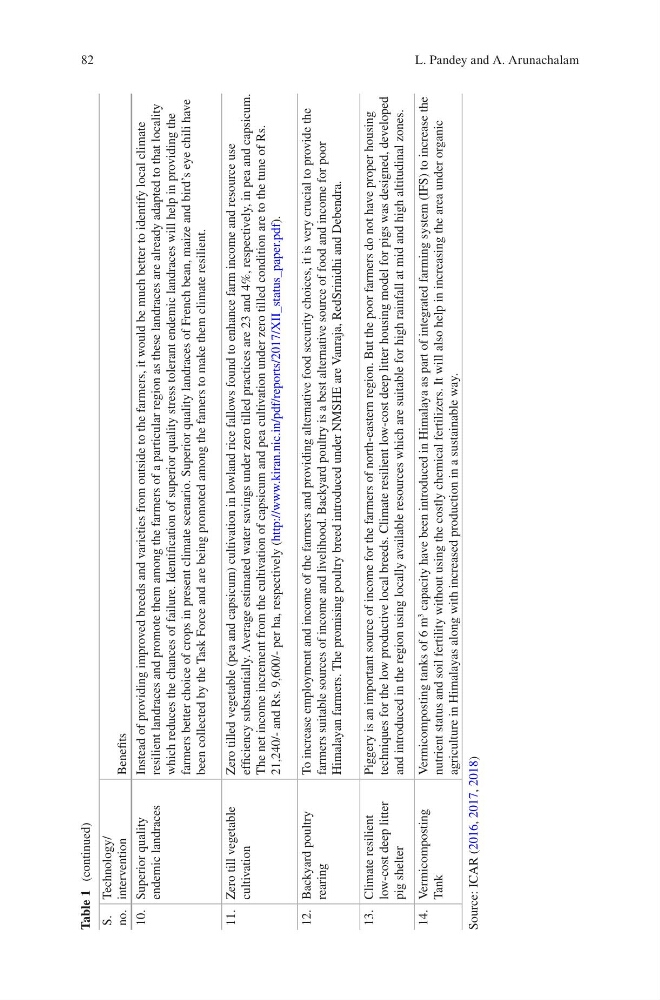
Table 1 (continued)
S.
no.
Technology/
intervention
Benefits
10. Superior quality
endemic landraces
Instead of providing improved breeds and varieties from outside to the farmers, it would be much better to identify local climate
resilient landraces and promote them among the farmers of a particular region as these landraces are already adapted to that locality
which reduces the chances of failure. Identification of superior quality stress tolerant endemic landraces will help in providing the
farmers better choice of crops in present climate scenario. Superior quality landraces of French bean, maize and bird’s eye chili have
been collected by the Task Force and are being promoted among the famers to make them climate resilient.
11. Zero till vegetable
cultivation
Zero tilled vegetable (pea and capsicum) cultivation in lowland rice fallows found to enhance farm income and resource use
efficiency substantially. Average estimated water savings under zero tilled practices are 23 and 4%, respectively, in pea and capsicum.
The net income increment from the cultivation of capsicum and pea cultivation under zero tilled condition are to the tune of Rs.
21,240/- and Rs. 9,600/- per ha, respectively (http://www.kiran.nic.in/pdf/reports/2017/XII_status_paper.pdf).
12. Backyard poultry
rearing
To increase employment and income of the farmers and providing alternative food security choices, it is very crucial to provide the
farmers suitable sources of income and livelihood. Backyard poultry is a best alternative source of food and income for poor
Himalayan farmers. The promising poultry breed introduced under NMSHE are Vanraja, RedSrinidhi and Debendra.
13. Climate resilient
low-cost deep litter
pig shelter
Piggery is an important source of income for the farmers of north-eastern region. But the poor farmers do not have proper housing
techniques for the low productive local breeds. Climate resilient low-cost deep litter housing model for pigs was designed, developed
and introduced in the region using locally available resources which are suitable for high rainfall at mid and high altitudinal zones.
14. Vermicomposting
Tank
Vermicomposting tanks of 6 m
3
capacity have been introduced in Himalaya as part of integrated farming system (IFS) to increase the
nutrient status and soil fertility without using the costly chemical fertilizers. It will also help in increasing the area under organic
agriculture in Himalayas along with increased production in a sustainable way.
Source: ICAR (2016, 2017, 2018)
L. Pandey and A. Arunachalam
Table 1 (continued)
S.
no.
Technology/
intervention
Benefits
10. Superior quality
endemic landraces
Instead of providing improved breeds and varieties from outside to the farmers, it would be much better to identify local climate
resilient landraces and promote them among the farmers of a particular region as these landraces are already adapted to that locality
which reduces the chances of failure. Identification of superior quality stress tolerant endemic landraces will help in providing the
farmers better choice of crops in present climate scenario. Superior quality landraces of French bean, maize and bird’s eye chili have
been collected by the Task Force and are being promoted among the famers to make them climate resilient.
11. Zero till vegetable
cultivation
Zero tilled vegetable (pea and capsicum) cultivation in lowland rice fallows found to enhance farm income and resource use
efficiency substantially. Average estimated water savings under zero tilled practices are 23 and 4%, respectively, in pea and capsicum.
The net income increment from the cultivation of capsicum and pea cultivation under zero tilled condition are to the tune of Rs.
21,240/- and Rs. 9,600/- per ha, respectively (http://www.kiran.nic.in/pdf/reports/2017/XII_status_paper.pdf).
12. Backyard poultry
rearing
To increase employment and income of the farmers and providing alternative food security choices, it is very crucial to provide the
farmers suitable sources of income and livelihood. Backyard poultry is a best alternative source of food and income for poor
Himalayan farmers. The promising poultry breed introduced under NMSHE are Vanraja, RedSrinidhi and Debendra.
13. Climate resilient
low-cost deep litter
pig shelter
Piggery is an important source of income for the farmers of north-eastern region. But the poor farmers do not have proper housing
techniques for the low productive local breeds. Climate resilient low-cost deep litter housing model for pigs was designed, developed
and introduced in the region using locally available resources which are suitable for high rainfall at mid and high altitudinal zones.
14. Vermicomposting
Tank
Vermicomposting tanks of 6 m
3
capacity have been introduced in Himalaya as part of integrated farming system (IFS) to increase the
nutrient status and soil fertility without using the costly chemical fertilizers. It will also help in increasing the area under organic
agriculture in Himalayas along with increased production in a sustainable way.
Source: ICAR (2016, 2017, 2018)
L. Pandey and A. Arunachalam