

AT least 4–5 specimens were tested for the reproducibility of the elasticity behaviour. Spring back behaviour was observed
in regular way on the test specimens after the bending operation. Spring back values are variable between 3–8% for two
different composition depending on the Nb and TiB 2 values.
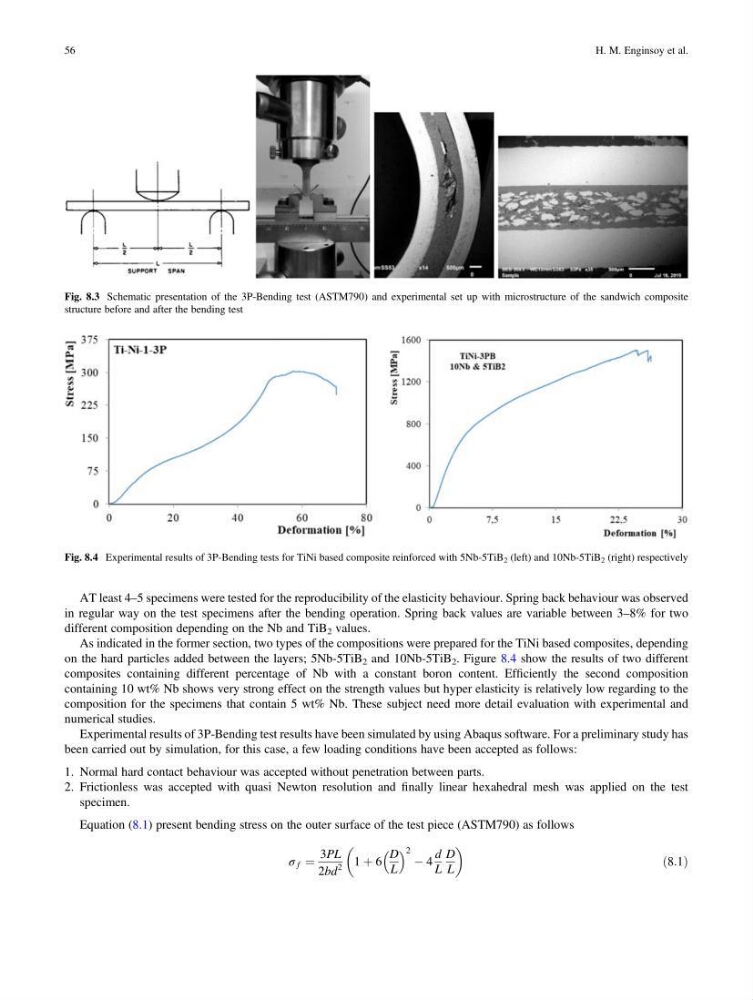
As indicated in the former section, two types of the compositions were prepared for the TiNi based composites, depending
on the hard particles added between the layers; 5Nb-5TiB 2 and 10Nb-5TiB 2 . Figure 8.4 show the results of two different
composites containing different percentage of Nb with a constant boron content. Efficiently the second composition
containing 10 wt% Nb shows very strong effect on the strength values but hyper elasticity is relatively low regarding to the
composition for the specimens that contain 5 wt% Nb. These subject need more detail evaluation with experimental and
numerical studies.
Experimental results of 3P-Bending test results have been simulated by using Abaqus software. For a preliminary study has
been carried out by simulation, for this case, a few loading conditions have been accepted as follows:
1. Normal hard contact behaviour was accepted without penetration between parts.
2. Frictionless was accepted with quasi Newton resolution and finally linear hexahedral mesh was applied on the test
specimen.
Equation (8.1) present bending stress on the outer surface of the test piece (ASTM790) as follows
σ f ¼
3PL
2bd
2
1 þ 6
D
L
2
À 4
d
L
D
L
ð8:1Þ
Fig. 8.3 Schematic presentation of the 3P-Bending test (ASTM790) and experimental set up with microstructure of the sandwich composite
structure before and after the bending test
Fig. 8.4 Experimental results of 3P-Bending tests for TiNi based composite reinforced with 5Nb-5TiB 2 (left) and 10Nb-5TiB 2 (right) respectively
56
H. M. Enginsoy et al.
in regular way on the test specimens after the bending operation. Spring back values are variable between 3–8% for two
different composition depending on the Nb and TiB 2 values.
As indicated in the former section, two types of the compositions were prepared for the TiNi based composites, depending
on the hard particles added between the layers; 5Nb-5TiB 2 and 10Nb-5TiB 2 . Figure 8.4 show the results of two different
composites containing different percentage of Nb with a constant boron content. Efficiently the second composition
containing 10 wt% Nb shows very strong effect on the strength values but hyper elasticity is relatively low regarding to the
composition for the specimens that contain 5 wt% Nb. These subject need more detail evaluation with experimental and
numerical studies.
Experimental results of 3P-Bending test results have been simulated by using Abaqus software. For a preliminary study has
been carried out by simulation, for this case, a few loading conditions have been accepted as follows:
1. Normal hard contact behaviour was accepted without penetration between parts.
2. Frictionless was accepted with quasi Newton resolution and finally linear hexahedral mesh was applied on the test
specimen.
Equation (8.1) present bending stress on the outer surface of the test piece (ASTM790) as follows
σ f ¼
3PL
2bd
2
1 þ 6
D
L
2
À 4
d
L
D
L
ð8:1Þ
Fig. 8.3 Schematic presentation of the 3P-Bending test (ASTM790) and experimental set up with microstructure of the sandwich composite
structure before and after the bending test
Fig. 8.4 Experimental results of 3P-Bending tests for TiNi based composite reinforced with 5Nb-5TiB 2 (left) and 10Nb-5TiB 2 (right) respectively
56
H. M. Enginsoy et al.