

test device as explained in detail in second the section (experimental conditions). Three or four specimens were tested for each
composition to obtain average values.
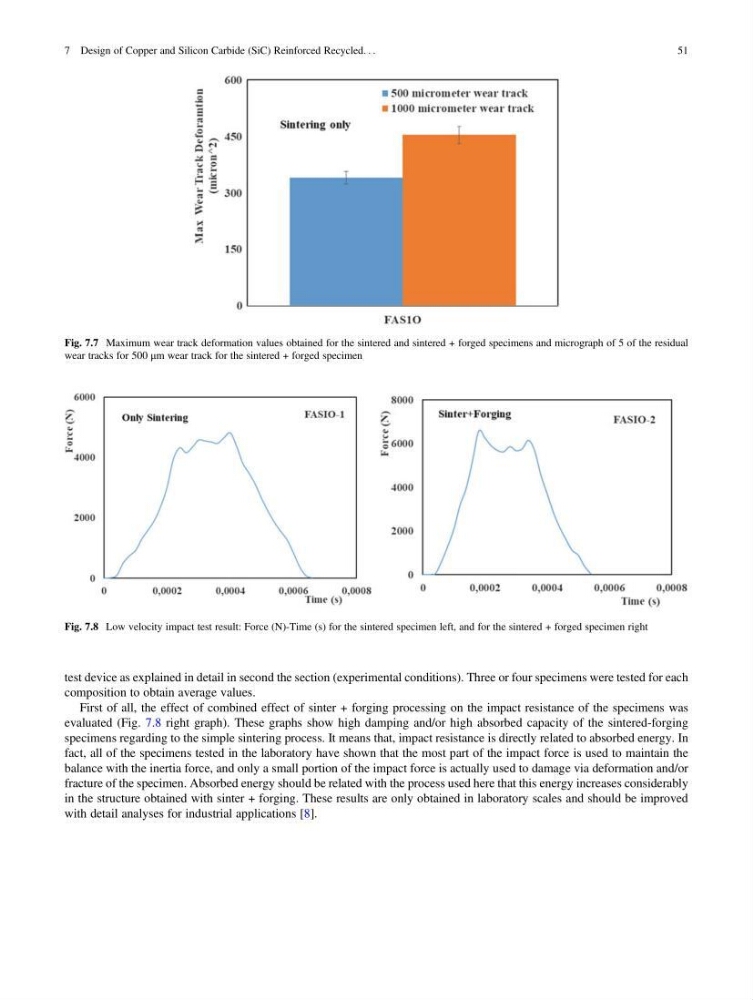
First of all, the effect of combined effect of sinter + forging processing on the impact resistance of the specimens was
evaluated (Fig. 7.8 right graph). These graphs show high damping and/or high absorbed capacity of the sintered-forging
specimens regarding to the simple sintering process. It means that, impact resistance is directly related to absorbed energy. In
fact, all of the specimens tested in the laboratory have shown that the most part of the impact force is used to maintain the
balance with the inertia force, and only a small portion of the impact force is actually used to damage via deformation and/or
fracture of the specimen. Absorbed energy should be related with the process used here that this energy increases considerably
in the structure obtained with sinter + forging. These results are only obtained in laboratory scales and should be improved
with detail analyses for industrial applications [8].
Fig. 7.7 Maximum wear track deformation values obtained for the sintered and sintered + forged specimens and micrograph of 5 of the residual
wear tracks for 500 μm wear track for the sintered + forged specimen
Fig. 7.8 Low velocity impact test result: Force (N)-Time (s) for the sintered specimen left, and for the sintered + forged specimen right
7 Design of Copper and Silicon Carbide (SiC) Reinforced Recycled. . .
51
composition to obtain average values.
First of all, the effect of combined effect of sinter + forging processing on the impact resistance of the specimens was
evaluated (Fig. 7.8 right graph). These graphs show high damping and/or high absorbed capacity of the sintered-forging
specimens regarding to the simple sintering process. It means that, impact resistance is directly related to absorbed energy. In
fact, all of the specimens tested in the laboratory have shown that the most part of the impact force is used to maintain the
balance with the inertia force, and only a small portion of the impact force is actually used to damage via deformation and/or
fracture of the specimen. Absorbed energy should be related with the process used here that this energy increases considerably
in the structure obtained with sinter + forging. These results are only obtained in laboratory scales and should be improved
with detail analyses for industrial applications [8].
Fig. 7.7 Maximum wear track deformation values obtained for the sintered and sintered + forged specimens and micrograph of 5 of the residual
wear tracks for 500 μm wear track for the sintered + forged specimen
Fig. 7.8 Low velocity impact test result: Force (N)-Time (s) for the sintered specimen left, and for the sintered + forged specimen right
7 Design of Copper and Silicon Carbide (SiC) Reinforced Recycled. . .
51