

The idea for composite design from fresh scrap recycled constituents can be applied very well on the industrial parts in an
economic way as low cost and efficient manufacturing. Actually, sintered forging process is a process mainly called as nearnet shape process for the manufacturing of the pieces processed from fresh scrap materials.
Mainly, this process is used for bulk materials in industrial applications. In fact, low-cost sinter-forging approach for the
processing of the fine particle-reinforced metal matrix composites gives always high performance applications of the
industrial pieces (fatigue-creep, static and impact compression, 3P-bending, etc.). This process could be applied to other
composites to produce in the industrial scale to obtain very tough and strong pieces with this combined process but at a lower
cost than the other manufacturing processes that generally were proposed in the literature.
In the frame of the common research project, a new aluminium matrix composite was designed from fresh scrap Alumix
431 and for the production of this composite a typical process called “sinter + forging” and fine Silicon Carbide (SiC) and
copper particles were used as the major reinforcing elements. In addition, static compression, three point bending (3 PB) test,
impact test and nano-scratch damage tests were performed for this composite. Microhardness values were measured as
HV. Microstructural analyses was carried out with Scanning Electron Microscopy (SEM).
7.2 Experimental Conditions
In this study, an alternative low cost aluminium matrix composite (AMCs) was designed from the fresh scrap recycled chips of
two aluminium series Alumix-431 (50 wt %) and AA1050 (50 wt %) provided by French aeronautic company. The two
aluminium series (after atomization) were mixed by high energy milling with planetary ball mill for 1 h and doped with
copper/Silicon Carbide (SiC). The final composition was homogenized by ball milling for 4 h. To obtain a homogenous
mixture with good wettability of the reinforcements with the matrix, pure nano aluminium (5 wt %) powder was added in the
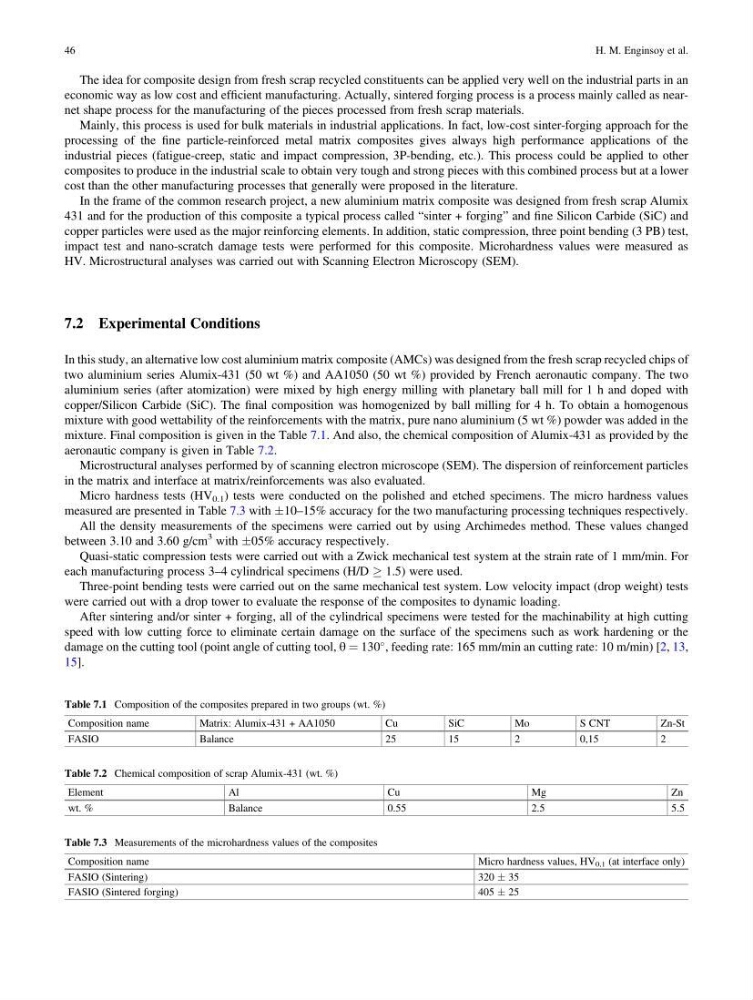
mixture. Final composition is given in the Table 7.1. And also, the chemical composition of Alumix-431 as provided by the
aeronautic company is given in Table 7.2.
Microstructural analyses performed by of scanning electron microscope (SEM). The dispersion of reinforcement particles
in the matrix and interface at matrix/reinforcements was also evaluated.
Micro hardness tests (HV 0.1 ) tests were conducted on the polished and etched specimens. The micro hardness values
measured are presented in Table 7.3 with Æ10–15% accuracy for the two manufacturing processing techniques respectively.
All the density measurements of the specimens were carried out by using Archimedes method. These values changed
between 3.10 and 3.60 g/cm
3 with Æ05% accuracy respectively.
Quasi-static compression tests were carried out with a Zwick mechanical test system at the strain rate of 1 mm/min. For
each manufacturing process 3–4 cylindrical specimens (H/D ! 1.5) were used.
Three-point bending tests were carried out on the same mechanical test system. Low velocity impact (drop weight) tests
were carried out with a drop tower to evaluate the response of the composites to dynamic loading.
After sintering and/or sinter + forging, all of the cylindrical specimens were tested for the machinability at high cutting
speed with low cutting force to eliminate certain damage on the surface of the specimens such as work hardening or the
damage on the cutting tool (point angle of cutting tool, θ ¼ 130
, feeding rate: 165 mm/min an cutting rate: 10 m/min) [2, 13,
15].
Table 7.1 Composition of the composites prepared in two groups (wt. %)
Composition name
Matrix: Alumix-431 + AA1050
Cu
SiC
Mo
S CNT
Zn-St
FASIO
Balance
25
15
2
0,15
2
Table 7.2 Chemical composition of scrap Alumix-431 (wt. %)
Element
Al
Cu
Mg
Zn
wt. %
Balance
0.55
2.5
5.5
Table 7.3 Measurements of the microhardness values of the composites
Composition name
Micro hardness values, HV 0,1 (at interface only)
FASIO (Sintering)
320 Æ 35
FASIO (Sintered forging)
405 Æ 25
46
H. M. Enginsoy et al.
economic way as low cost and efficient manufacturing. Actually, sintered forging process is a process mainly called as nearnet shape process for the manufacturing of the pieces processed from fresh scrap materials.
Mainly, this process is used for bulk materials in industrial applications. In fact, low-cost sinter-forging approach for the
processing of the fine particle-reinforced metal matrix composites gives always high performance applications of the
industrial pieces (fatigue-creep, static and impact compression, 3P-bending, etc.). This process could be applied to other
composites to produce in the industrial scale to obtain very tough and strong pieces with this combined process but at a lower
cost than the other manufacturing processes that generally were proposed in the literature.
In the frame of the common research project, a new aluminium matrix composite was designed from fresh scrap Alumix
431 and for the production of this composite a typical process called “sinter + forging” and fine Silicon Carbide (SiC) and
copper particles were used as the major reinforcing elements. In addition, static compression, three point bending (3 PB) test,
impact test and nano-scratch damage tests were performed for this composite. Microhardness values were measured as
HV. Microstructural analyses was carried out with Scanning Electron Microscopy (SEM).
7.2 Experimental Conditions
In this study, an alternative low cost aluminium matrix composite (AMCs) was designed from the fresh scrap recycled chips of
two aluminium series Alumix-431 (50 wt %) and AA1050 (50 wt %) provided by French aeronautic company. The two
aluminium series (after atomization) were mixed by high energy milling with planetary ball mill for 1 h and doped with
copper/Silicon Carbide (SiC). The final composition was homogenized by ball milling for 4 h. To obtain a homogenous
mixture with good wettability of the reinforcements with the matrix, pure nano aluminium (5 wt %) powder was added in the
mixture. Final composition is given in the Table 7.1. And also, the chemical composition of Alumix-431 as provided by the
aeronautic company is given in Table 7.2.
Microstructural analyses performed by of scanning electron microscope (SEM). The dispersion of reinforcement particles
in the matrix and interface at matrix/reinforcements was also evaluated.
Micro hardness tests (HV 0.1 ) tests were conducted on the polished and etched specimens. The micro hardness values
measured are presented in Table 7.3 with Æ10–15% accuracy for the two manufacturing processing techniques respectively.
All the density measurements of the specimens were carried out by using Archimedes method. These values changed
between 3.10 and 3.60 g/cm
3 with Æ05% accuracy respectively.
Quasi-static compression tests were carried out with a Zwick mechanical test system at the strain rate of 1 mm/min. For
each manufacturing process 3–4 cylindrical specimens (H/D ! 1.5) were used.
Three-point bending tests were carried out on the same mechanical test system. Low velocity impact (drop weight) tests
were carried out with a drop tower to evaluate the response of the composites to dynamic loading.
After sintering and/or sinter + forging, all of the cylindrical specimens were tested for the machinability at high cutting
speed with low cutting force to eliminate certain damage on the surface of the specimens such as work hardening or the
damage on the cutting tool (point angle of cutting tool, θ ¼ 130
, feeding rate: 165 mm/min an cutting rate: 10 m/min) [2, 13,
15].
Table 7.1 Composition of the composites prepared in two groups (wt. %)
Composition name
Matrix: Alumix-431 + AA1050
Cu
SiC
Mo
S CNT
Zn-St
FASIO
Balance
25
15
2
0,15
2
Table 7.2 Chemical composition of scrap Alumix-431 (wt. %)
Element
Al
Cu
Mg
Zn
wt. %
Balance
0.55
2.5
5.5
Table 7.3 Measurements of the microhardness values of the composites
Composition name
Micro hardness values, HV 0,1 (at interface only)
FASIO (Sintering)
320 Æ 35
FASIO (Sintered forging)
405 Æ 25
46
H. M. Enginsoy et al.