

6.4 Conclusions
A new aluminium matrix composite was designed from fresh scrap aluminium with recycled chips of AA 7075 for the
manufacturing of high resistant components for the tribological applications as a low cost and high toughness - alternative
composite. Low cost production of these composites have been successfully managed through the combined method of
“sintering” and also “sinter + forging”.
Microstructural analysis has shown that a good chemical bonding diffusion at interface of matrix-reinforcement essentially
in the specimens with a homogeneous distribution. These composites show a tough and sound microstructure generally
without porosity. Wear resistance and ductility should be absolutely improved with doping process and good powder mixture
preparation conditions; ball milling in longer time is needed for helping the fine and homogeneous distribution of the particles
in the matrix.
Good cohesion at the interface can only be achieved at high sintering temperatures, i.e. between 660 and 680
C and is
recommended strongly followed forging operation for obtaining a healthy and sound microstructure.
By this way, a very stable vibrational chemical bond between the matrix and intermetallic particles can be provided.
Increasing the sintering temperature can provide easily vibrational chemical bonding under the effect of thermal diffusion.
Therefore, reaction phases at the matrix/reinforcements interface can be caused by a stable interface.
Optimizations of the operational parameters need much more experimental work to create real parts in the industrial scales.
Acknowledgements This work has been carried out on the frame of research collaboration between Supmeca/Paris-FRANCE and UNICAMPFEM/Campinas-SP/BRAZIL and Michigan Technical University/Houghton-MI-USA. Authors want to thank financial support from CNPq –
Conselho Nacional de Desenvolvimento Científico e Tecnológico (Brazil); Program French Catedra UNICAMP/French Embassy in Brazil.
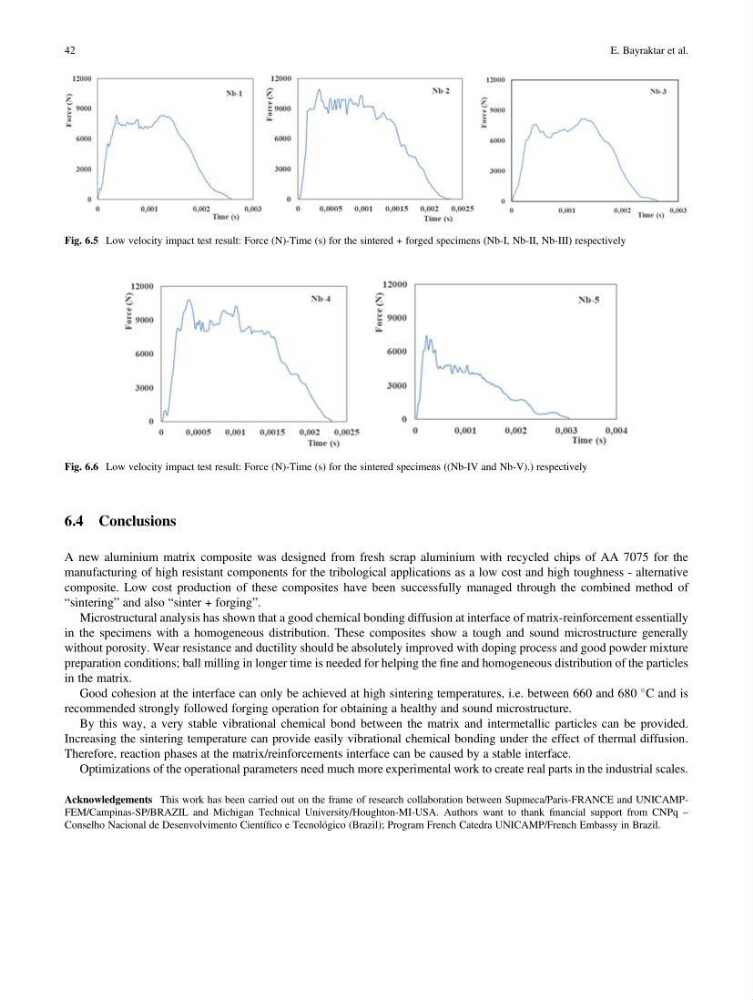
Fig. 6.5 Low velocity impact test result: Force (N)-Time (s) for the sintered + forged specimens (Nb-I, Nb-II, Nb-III) respectively
Fig. 6.6 Low velocity impact test result: Force (N)-Time (s) for the sintered specimens ((Nb-IV and Nb-V).) respectively
42
E. Bayraktar et al.
A new aluminium matrix composite was designed from fresh scrap aluminium with recycled chips of AA 7075 for the
manufacturing of high resistant components for the tribological applications as a low cost and high toughness - alternative
composite. Low cost production of these composites have been successfully managed through the combined method of
“sintering” and also “sinter + forging”.
Microstructural analysis has shown that a good chemical bonding diffusion at interface of matrix-reinforcement essentially
in the specimens with a homogeneous distribution. These composites show a tough and sound microstructure generally
without porosity. Wear resistance and ductility should be absolutely improved with doping process and good powder mixture
preparation conditions; ball milling in longer time is needed for helping the fine and homogeneous distribution of the particles
in the matrix.
Good cohesion at the interface can only be achieved at high sintering temperatures, i.e. between 660 and 680
C and is
recommended strongly followed forging operation for obtaining a healthy and sound microstructure.
By this way, a very stable vibrational chemical bond between the matrix and intermetallic particles can be provided.
Increasing the sintering temperature can provide easily vibrational chemical bonding under the effect of thermal diffusion.
Therefore, reaction phases at the matrix/reinforcements interface can be caused by a stable interface.
Optimizations of the operational parameters need much more experimental work to create real parts in the industrial scales.
Acknowledgements This work has been carried out on the frame of research collaboration between Supmeca/Paris-FRANCE and UNICAMPFEM/Campinas-SP/BRAZIL and Michigan Technical University/Houghton-MI-USA. Authors want to thank financial support from CNPq –
Conselho Nacional de Desenvolvimento Científico e Tecnológico (Brazil); Program French Catedra UNICAMP/French Embassy in Brazil.
Fig. 6.5 Low velocity impact test result: Force (N)-Time (s) for the sintered + forged specimens (Nb-I, Nb-II, Nb-III) respectively
Fig. 6.6 Low velocity impact test result: Force (N)-Time (s) for the sintered specimens ((Nb-IV and Nb-V).) respectively
42
E. Bayraktar et al.