

6.3.2 Static Compression Test Results
In the frame of this present work, a simple static compression tests were carried out under the laboratory scales to evaluate the
mechanical behaviour of these novel composites produced with sintering and also sinter + forging processes.
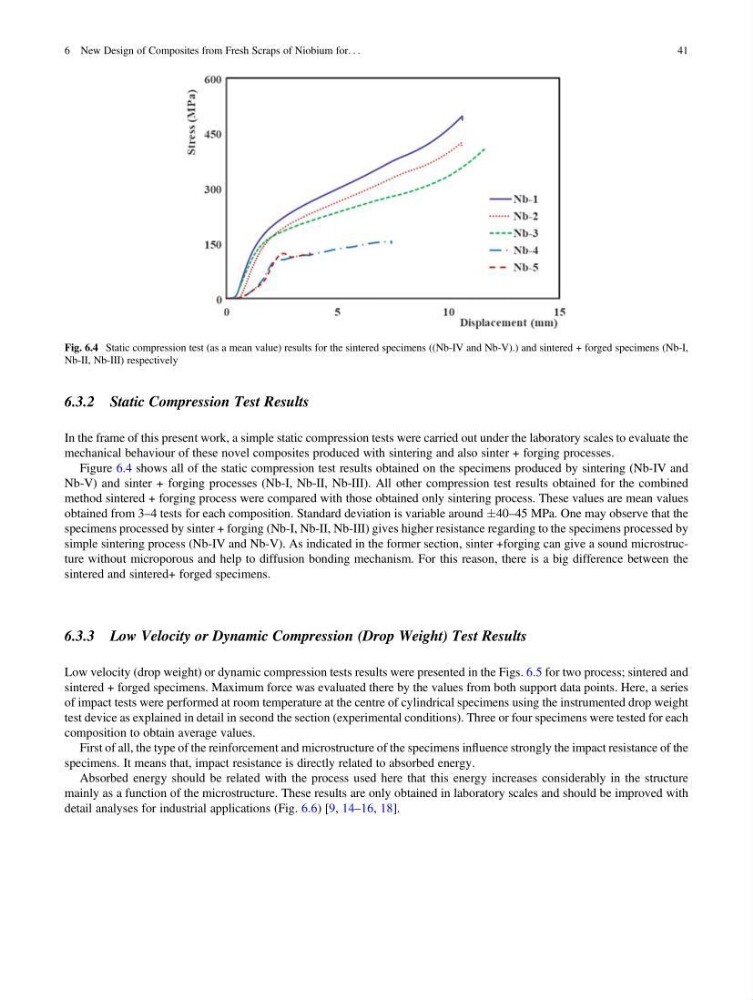
Figure 6.4 shows all of the static compression test results obtained on the specimens produced by sintering (Nb-IV and
Nb-V) and sinter + forging processes (Nb-I, Nb-II, Nb-III). All other compression test results obtained for the combined
method sintered + forging process were compared with those obtained only sintering process. These values are mean values
obtained from 3–4 tests for each composition. Standard deviation is variable around Æ40–45 MPa. One may observe that the
specimens processed by sinter + forging (Nb-I, Nb-II, Nb-III) gives higher resistance regarding to the specimens processed by
simple sintering process (Nb-IV and Nb-V). As indicated in the former section, sinter +forging can give a sound microstructure without microporous and help to diffusion bonding mechanism. For this reason, there is a big difference between the
sintered and sintered+ forged specimens.
6.3.3 Low Velocity or Dynamic Compression (Drop Weight) Test Results
Low velocity (drop weight) or dynamic compression tests results were presented in the Figs. 6.5 for two process; sintered and
sintered + forged specimens. Maximum force was evaluated there by the values from both support data points. Here, a series
of impact tests were performed at room temperature at the centre of cylindrical specimens using the instrumented drop weight
test device as explained in detail in second the section (experimental conditions). Three or four specimens were tested for each
composition to obtain average values.
First of all, the type of the reinforcement and microstructure of the specimens influence strongly the impact resistance of the
specimens. It means that, impact resistance is directly related to absorbed energy.
Absorbed energy should be related with the process used here that this energy increases considerably in the structure
mainly as a function of the microstructure. These results are only obtained in laboratory scales and should be improved with
detail analyses for industrial applications (Fig. 6.6) [9, 14–16, 18].
Fig. 6.4 Static compression test (as a mean value) results for the sintered specimens ((Nb-IV and Nb-V).) and sintered + forged specimens (Nb-I,
Nb-II, Nb-III) respectively
6 New Design of Composites from Fresh Scraps of Niobium for. . .
41
In the frame of this present work, a simple static compression tests were carried out under the laboratory scales to evaluate the
mechanical behaviour of these novel composites produced with sintering and also sinter + forging processes.
Figure 6.4 shows all of the static compression test results obtained on the specimens produced by sintering (Nb-IV and
Nb-V) and sinter + forging processes (Nb-I, Nb-II, Nb-III). All other compression test results obtained for the combined
method sintered + forging process were compared with those obtained only sintering process. These values are mean values
obtained from 3–4 tests for each composition. Standard deviation is variable around Æ40–45 MPa. One may observe that the
specimens processed by sinter + forging (Nb-I, Nb-II, Nb-III) gives higher resistance regarding to the specimens processed by
simple sintering process (Nb-IV and Nb-V). As indicated in the former section, sinter +forging can give a sound microstructure without microporous and help to diffusion bonding mechanism. For this reason, there is a big difference between the
sintered and sintered+ forged specimens.
6.3.3 Low Velocity or Dynamic Compression (Drop Weight) Test Results
Low velocity (drop weight) or dynamic compression tests results were presented in the Figs. 6.5 for two process; sintered and
sintered + forged specimens. Maximum force was evaluated there by the values from both support data points. Here, a series
of impact tests were performed at room temperature at the centre of cylindrical specimens using the instrumented drop weight
test device as explained in detail in second the section (experimental conditions). Three or four specimens were tested for each
composition to obtain average values.
First of all, the type of the reinforcement and microstructure of the specimens influence strongly the impact resistance of the
specimens. It means that, impact resistance is directly related to absorbed energy.
Absorbed energy should be related with the process used here that this energy increases considerably in the structure
mainly as a function of the microstructure. These results are only obtained in laboratory scales and should be improved with
detail analyses for industrial applications (Fig. 6.6) [9, 14–16, 18].
Fig. 6.4 Static compression test (as a mean value) results for the sintered specimens ((Nb-IV and Nb-V).) and sintered + forged specimens (Nb-I,
Nb-II, Nb-III) respectively
6 New Design of Composites from Fresh Scraps of Niobium for. . .
41