

transformation temperature. The deformation is then reversed when the twinned structure reverts upon heating to the parent
phase [2, 7–13].
In the frame of the common research project, production of the scrap thin sheet copper based composite reinforced with
pure nano aluminium (~5 wt %) and fine particle zinc (d ¼ 1–5 μm) have been produced with addition of small amount of fine
particles as secondary reinforcements. This is an alternative low cost shape memory composite produced through the
combined method, sinter-forging process This composite will be used for the applications of the coupling and actuators in
the aeronautical area. For mechanical essentially for the tailor behaviour of this composite, three point bending (3 PB) and
impact tests were performed. Microhardness values were measured as HVN. Microstructural analyses was carried out with
Scanning Electron Microscopy (SEM).
5.2 Experimental Conditions
In this study, an alternative low cost copper matrix composite reinforced with pure nano aluminium and fine particle zinc was
designed low cost Cu-Al-Zn-1X based composites. Powder metallurgy route applied following sinter + hot forging process
was performed. The final mixture of the composition was homogenized by ball milling for 4 h. To obtain a homogenous
mixture with good wettability of the reinforcements with the matrix, pure nano aluminium (5 wt %) powder was used in the
mixture. 2–3 wt % Zinc Stearate was used during the milling to eliminate the oxidation. 550 and 650
C sinter + Forging
process have been carried after that slow quenching and final cooling operation has been applied to eliminate a possible
artefacts that can hinder the transition temperature. A final post treatment was done by slow heating and slow cooling at the
temperature variable between 0
C and 100
C.
Some of the specimens were tested at the laboratory of ENS-Cachan-Paris-Saclay in order to determine the transformation
temperature by using Dynamic Scanning Calorimetry (DSC) with 10
C/min under inert atmosphere Experimental results
under the laboratory conditions are.
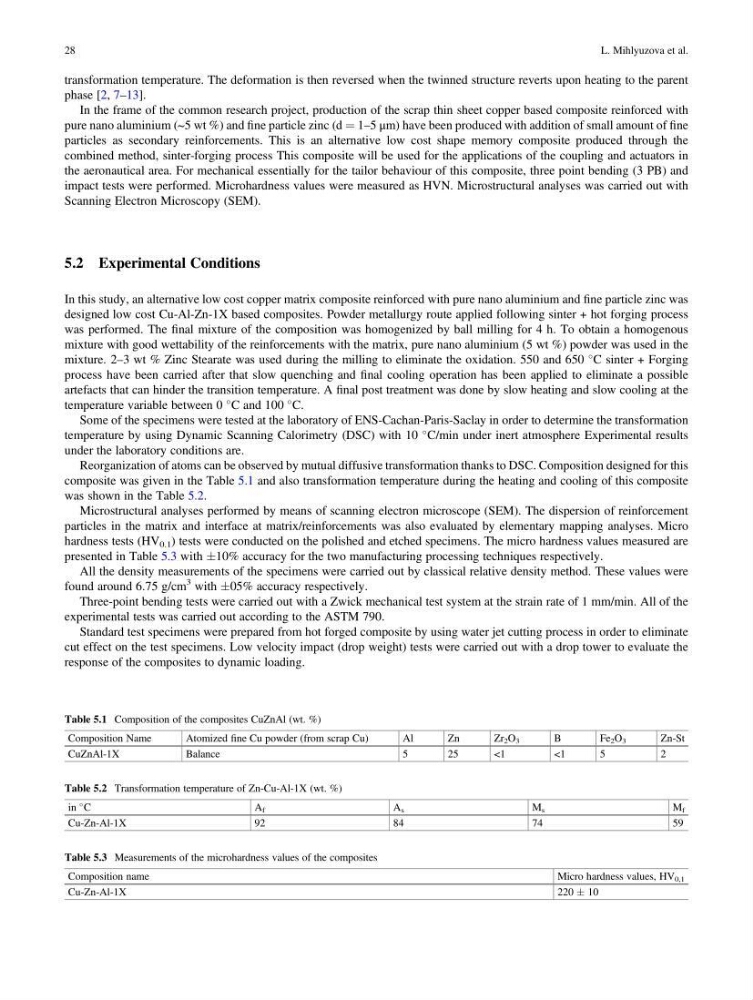
Reorganization of atoms can be observed by mutual diffusive transformation thanks to DSC. Composition designed for this
composite was given in the Table 5.1 and also transformation temperature during the heating and cooling of this composite
was shown in the Table 5.2.
Microstructural analyses performed by means of scanning electron microscope (SEM). The dispersion of reinforcement
particles in the matrix and interface at matrix/reinforcements was also evaluated by elementary mapping analyses. Micro
hardness tests (HV 0.1 ) tests were conducted on the polished and etched specimens. The micro hardness values measured are
presented in Table 5.3 with Æ10% accuracy for the two manufacturing processing techniques respectively.
All the density measurements of the specimens were carried out by classical relative density method. These values were
found around 6.75 g/cm
3 with Æ05% accuracy respectively.
Three-point bending tests were carried out with a Zwick mechanical test system at the strain rate of 1 mm/min. All of the
experimental tests was carried out according to the ASTM 790.
Standard test specimens were prepared from hot forged composite by using water jet cutting process in order to eliminate
cut effect on the test specimens. Low velocity impact (drop weight) tests were carried out with a drop tower to evaluate the
response of the composites to dynamic loading.
Table 5.1 Composition of the composites CuZnAl (wt. %)
Composition Name
Atomized fine Cu powder (from scrap Cu)
Al
Zn
Zr 2 O 3
B
F e 2 O 3
Zn-St
CuZnAl-1X
Balance
5
25
<1
<1
5
2
Table 5.2 Transformation temperature of Zn-Cu-Al-1X (wt. %)
in
C
A f
A s
M s
M f
Cu-Zn-Al-1X
92
84
74
59
Table 5.3 Measurements of the microhardness values of the composites
Composition name
Micro hardness values, HV 0,1
Cu-Zn-Al-1X
220 Æ 10
28
L. Mihlyuzova et al.
phase [2, 7–13].
In the frame of the common research project, production of the scrap thin sheet copper based composite reinforced with
pure nano aluminium (~5 wt %) and fine particle zinc (d ¼ 1–5 μm) have been produced with addition of small amount of fine
particles as secondary reinforcements. This is an alternative low cost shape memory composite produced through the
combined method, sinter-forging process This composite will be used for the applications of the coupling and actuators in
the aeronautical area. For mechanical essentially for the tailor behaviour of this composite, three point bending (3 PB) and
impact tests were performed. Microhardness values were measured as HVN. Microstructural analyses was carried out with
Scanning Electron Microscopy (SEM).
5.2 Experimental Conditions
In this study, an alternative low cost copper matrix composite reinforced with pure nano aluminium and fine particle zinc was
designed low cost Cu-Al-Zn-1X based composites. Powder metallurgy route applied following sinter + hot forging process
was performed. The final mixture of the composition was homogenized by ball milling for 4 h. To obtain a homogenous
mixture with good wettability of the reinforcements with the matrix, pure nano aluminium (5 wt %) powder was used in the
mixture. 2–3 wt % Zinc Stearate was used during the milling to eliminate the oxidation. 550 and 650
C sinter + Forging
process have been carried after that slow quenching and final cooling operation has been applied to eliminate a possible
artefacts that can hinder the transition temperature. A final post treatment was done by slow heating and slow cooling at the
temperature variable between 0
C and 100
C.
Some of the specimens were tested at the laboratory of ENS-Cachan-Paris-Saclay in order to determine the transformation
temperature by using Dynamic Scanning Calorimetry (DSC) with 10
C/min under inert atmosphere Experimental results
under the laboratory conditions are.
Reorganization of atoms can be observed by mutual diffusive transformation thanks to DSC. Composition designed for this
composite was given in the Table 5.1 and also transformation temperature during the heating and cooling of this composite
was shown in the Table 5.2.
Microstructural analyses performed by means of scanning electron microscope (SEM). The dispersion of reinforcement
particles in the matrix and interface at matrix/reinforcements was also evaluated by elementary mapping analyses. Micro
hardness tests (HV 0.1 ) tests were conducted on the polished and etched specimens. The micro hardness values measured are
presented in Table 5.3 with Æ10% accuracy for the two manufacturing processing techniques respectively.
All the density measurements of the specimens were carried out by classical relative density method. These values were
found around 6.75 g/cm
3 with Æ05% accuracy respectively.
Three-point bending tests were carried out with a Zwick mechanical test system at the strain rate of 1 mm/min. All of the
experimental tests was carried out according to the ASTM 790.
Standard test specimens were prepared from hot forged composite by using water jet cutting process in order to eliminate
cut effect on the test specimens. Low velocity impact (drop weight) tests were carried out with a drop tower to evaluate the
response of the composites to dynamic loading.
Table 5.1 Composition of the composites CuZnAl (wt. %)
Composition Name
Atomized fine Cu powder (from scrap Cu)
Al
Zn
Zr 2 O 3
B
F e 2 O 3
Zn-St
CuZnAl-1X
Balance
5
25
<1
<1
5
2
Table 5.2 Transformation temperature of Zn-Cu-Al-1X (wt. %)
in
C
A f
A s
M s
M f
Cu-Zn-Al-1X
92
84
74
59
Table 5.3 Measurements of the microhardness values of the composites
Composition name
Micro hardness values, HV 0,1
Cu-Zn-Al-1X
220 Æ 10
28
L. Mihlyuzova et al.