

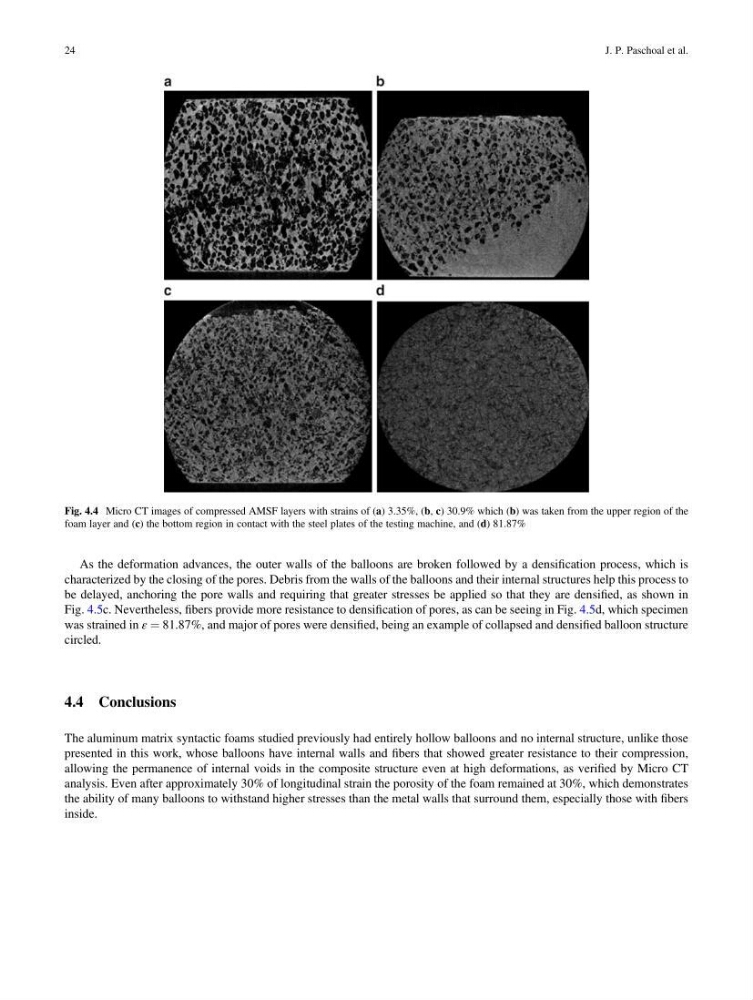
As the deformation advances, the outer walls of the balloons are broken followed by a densification process, which is
characterized by the closing of the pores. Debris from the walls of the balloons and their internal structures help this process to
be delayed, anchoring the pore walls and requiring that greater stresses be applied so that they are densified, as shown in
Fig. 4.5c. Nevertheless, fibers provide more resistance to densification of pores, as can be seeing in Fig. 4.5d, which specimen
was strained in ε ¼ 81.87%, and major of pores were densified, being an example of collapsed and densified balloon structure
circled.
4.4 Conclusions
The aluminum matrix syntactic foams studied previously had entirely hollow balloons and no internal structure, unlike those
presented in this work, whose balloons have internal walls and fibers that showed greater resistance to their compression,
allowing the permanence of internal voids in the composite structure even at high deformations, as verified by Micro CT
analysis. Even after approximately 30% of longitudinal strain the porosity of the foam remained at 30%, which demonstrates
the ability of many balloons to withstand higher stresses than the metal walls that surround them, especially those with fibers
inside.
Fig. 4.4 Micro CT images of compressed AMSF layers with strains of (a) 3.35%, (b, c) 30.9% which (b) was taken from the upper region of the
foam layer and (c) the bottom region in contact with the steel plates of the testing machine, and (d) 81.87%
24
J. P. Paschoal et al.
characterized by the closing of the pores. Debris from the walls of the balloons and their internal structures help this process to
be delayed, anchoring the pore walls and requiring that greater stresses be applied so that they are densified, as shown in
Fig. 4.5c. Nevertheless, fibers provide more resistance to densification of pores, as can be seeing in Fig. 4.5d, which specimen
was strained in ε ¼ 81.87%, and major of pores were densified, being an example of collapsed and densified balloon structure
circled.
4.4 Conclusions
The aluminum matrix syntactic foams studied previously had entirely hollow balloons and no internal structure, unlike those
presented in this work, whose balloons have internal walls and fibers that showed greater resistance to their compression,
allowing the permanence of internal voids in the composite structure even at high deformations, as verified by Micro CT
analysis. Even after approximately 30% of longitudinal strain the porosity of the foam remained at 30%, which demonstrates
the ability of many balloons to withstand higher stresses than the metal walls that surround them, especially those with fibers
inside.
Fig. 4.4 Micro CT images of compressed AMSF layers with strains of (a) 3.35%, (b, c) 30.9% which (b) was taken from the upper region of the
foam layer and (c) the bottom region in contact with the steel plates of the testing machine, and (d) 81.87%
24
J. P. Paschoal et al.