

60
3 Dynamic Tensile Mechanical Properties of UHPCC
superposition of the initial incident compressive wave and the reflected tensile wave.
If the initial compressive wave is lower than the compressive strength but its absolute
value exceeds the dynamic tensile strength of material, the specimen will fail during
the reflection process. In actual experiments, the tensile stresses produced in the
reflection will not emerge abruptly in the specimen. The compressive wave will
decrease gradually while the tensile stress is growing up to the dynamic tensile
strength of material. When this critical value is reached, the material is fractured.
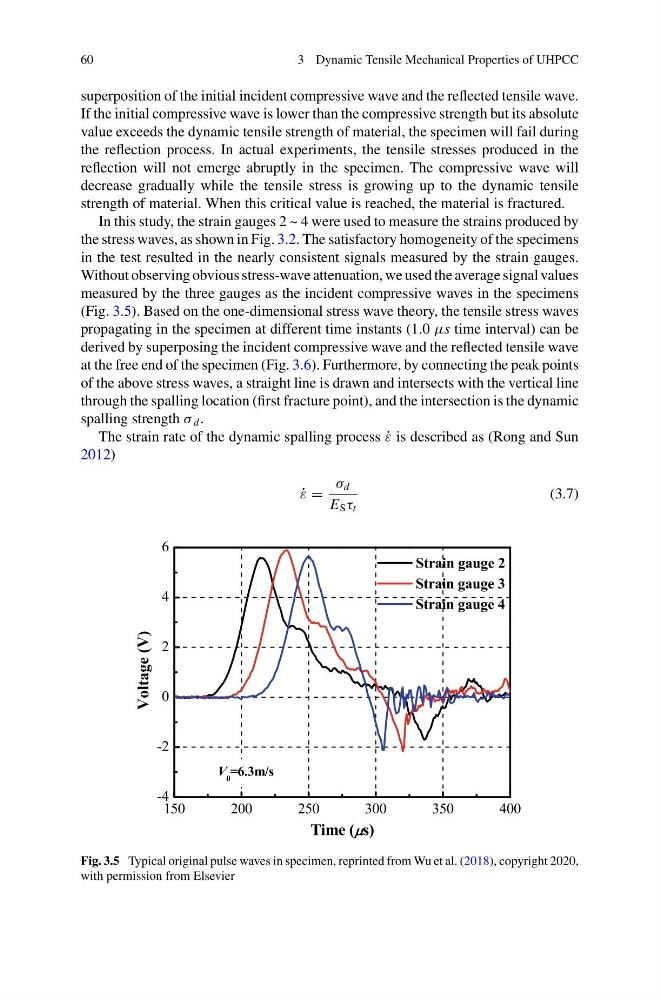
In this study, the strain gauges 2 ~ 4 were used to measure the strains produced by
the stress waves, as shown in Fig. 3.2. The satisfactory homogeneity of the specimens
in the test resulted in the nearly consistent signals measured by the strain gauges.
Without observing obvious stress-wave attenuation, we used the average signal values
measured by the three gauges as the incident compressive waves in the specimens
(Fig. 3.5). Based on the one-dimensional stress wave theory, the tensile stress waves
propagating in the specimen at different time instants (1.0 μs time interval) can be
derived by superposing the incident compressive wave and the reflected tensile wave
at the free end of the specimen (Fig. 3.6). Furthermore, by connecting the peak points
of the above stress waves, a straight line is drawn and intersects with the vertical line
through the spalling location (first fracture point), and the intersection is the dynamic
spalling strength σ d .
The strain rate of the dynamic spalling process ˙
ε is described as (Rong and Sun
2012)
˙
ε =
σ d
E S τ t
(3.7)
Fig. 3.5 Typical original pulse waves in specimen, reprinted from Wu et al. (2018), copyright 2020,
with permission from Elsevier
3 Dynamic Tensile Mechanical Properties of UHPCC
superposition of the initial incident compressive wave and the reflected tensile wave.
If the initial compressive wave is lower than the compressive strength but its absolute
value exceeds the dynamic tensile strength of material, the specimen will fail during
the reflection process. In actual experiments, the tensile stresses produced in the
reflection will not emerge abruptly in the specimen. The compressive wave will
decrease gradually while the tensile stress is growing up to the dynamic tensile
strength of material. When this critical value is reached, the material is fractured.
In this study, the strain gauges 2 ~ 4 were used to measure the strains produced by
the stress waves, as shown in Fig. 3.2. The satisfactory homogeneity of the specimens
in the test resulted in the nearly consistent signals measured by the strain gauges.
Without observing obvious stress-wave attenuation, we used the average signal values
measured by the three gauges as the incident compressive waves in the specimens
(Fig. 3.5). Based on the one-dimensional stress wave theory, the tensile stress waves
propagating in the specimen at different time instants (1.0 μs time interval) can be
derived by superposing the incident compressive wave and the reflected tensile wave
at the free end of the specimen (Fig. 3.6). Furthermore, by connecting the peak points
of the above stress waves, a straight line is drawn and intersects with the vertical line
through the spalling location (first fracture point), and the intersection is the dynamic
spalling strength σ d .
The strain rate of the dynamic spalling process ˙
ε is described as (Rong and Sun
2012)
˙
ε =
σ d
E S τ t
(3.7)
Fig. 3.5 Typical original pulse waves in specimen, reprinted from Wu et al. (2018), copyright 2020,
with permission from Elsevier