

56
3 Dynamic Tensile Mechanical Properties of UHPCC
strength. Rong and Sun (2012) studied the effect of steel fiber content (0, 3.0 and
4.0% by volume) on the dynamic tensile properties of UHPCC at different strain rates
(21 ~ 66 s
−1 ) by conducting the dynamic spalling test and found that both the fiber
volume fraction and strain rate exerted significant enhancing effect on the dynamic
spalling strength. Thaomas and Sorensen (2017) collected the thirteen previously
published studies about the strain rate sensitivity of Ultra-high performance concrete
(UHPC) in tension. The comparisons were conducted between the reported dynamic
increase factors (DIFs) for the dynamic tensile strength, first cracking tensile strength,
modulus of elasticity, modulus of rupture, strain capacity and energy absorption of
UHPC with the existing DIF formulae for conventional concrete or UHPC. The
results showed that, (i) UHPC is much more strain rate-sensitive than the conventional concrete at high strain rate; (ii) the strain rate sensitivity of UHPC does not
depend on the fiber volume fraction, fiber type, fiber orientation and compressive
strength of the matrix; (iii) the existing DIF formulae could not well estimate the
DIFs for UHPC and an improved DIF formulae are further proposed.
Generally, the existing experimental assessment for the steel fiber content and
type on the dynamic tensile behavior of UHPCC is far from sufficient. There is no
systematical assessment for the effects of steel fiber content and type on the dynamic
spalling strength of UHPCC under a wider range of strain rate, and the corresponding
predictions for the dynamic tensile strength of UHPCC are practically needed. At
present, the dynamic spalling test on 48mm × 400 mm cylindrical UHPCC specimen was performed by using a 50 mm-diameter SHPB device at the strain rate
ranging from 14.3 s
−1 to 214.8 s
−1 , in which two typical steel fibers (micro-straight
and hooked) and three volume fractions (0%, 1.0% and 2.0%) were considered. The
dynamic spalling strengths under different strain rates were derived and the effects
of steel fiber content and type as well as the strain rate were experimentally assessed.
3.2 Specimen Preparation
For the present two steel fibers types and three volume fractions, 40 cylindrical
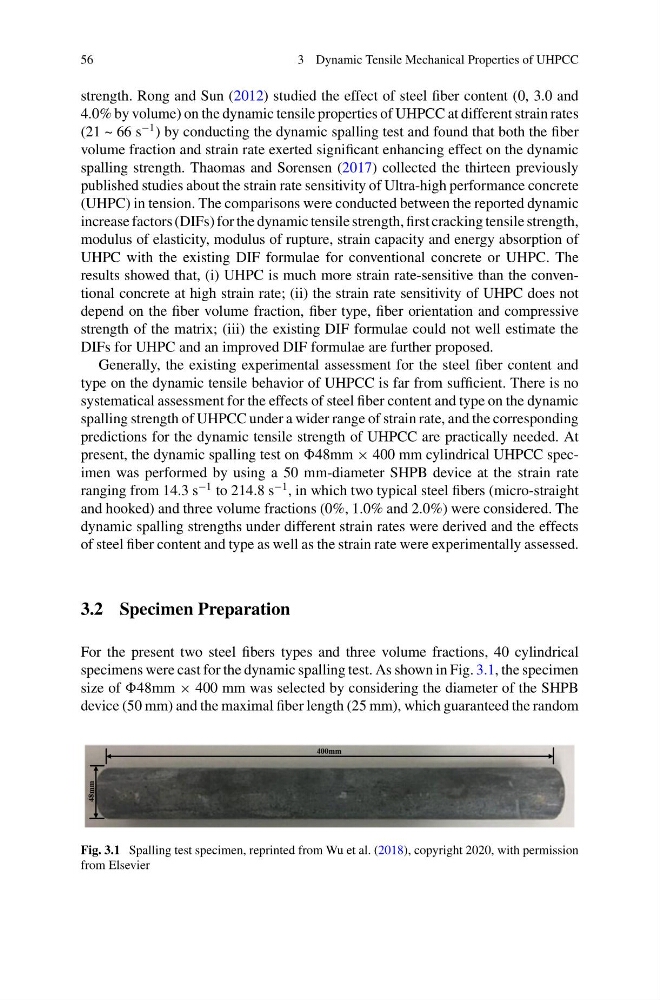
specimens were cast for the dynamic spalling test. As shown in Fig. 3.1, the specimen
size of 48mm × 400 mm was selected by considering the diameter of the SHPB
device (50 mm) and the maximal fiber length (25 mm), which guaranteed the random
400mm
48mm
Fig. 3.1 Spalling test specimen, reprinted from Wu et al. (2018), copyright 2020, with permission
from Elsevier
3 Dynamic Tensile Mechanical Properties of UHPCC
strength. Rong and Sun (2012) studied the effect of steel fiber content (0, 3.0 and
4.0% by volume) on the dynamic tensile properties of UHPCC at different strain rates
(21 ~ 66 s
−1 ) by conducting the dynamic spalling test and found that both the fiber
volume fraction and strain rate exerted significant enhancing effect on the dynamic
spalling strength. Thaomas and Sorensen (2017) collected the thirteen previously
published studies about the strain rate sensitivity of Ultra-high performance concrete
(UHPC) in tension. The comparisons were conducted between the reported dynamic
increase factors (DIFs) for the dynamic tensile strength, first cracking tensile strength,
modulus of elasticity, modulus of rupture, strain capacity and energy absorption of
UHPC with the existing DIF formulae for conventional concrete or UHPC. The
results showed that, (i) UHPC is much more strain rate-sensitive than the conventional concrete at high strain rate; (ii) the strain rate sensitivity of UHPC does not
depend on the fiber volume fraction, fiber type, fiber orientation and compressive
strength of the matrix; (iii) the existing DIF formulae could not well estimate the
DIFs for UHPC and an improved DIF formulae are further proposed.
Generally, the existing experimental assessment for the steel fiber content and
type on the dynamic tensile behavior of UHPCC is far from sufficient. There is no
systematical assessment for the effects of steel fiber content and type on the dynamic
spalling strength of UHPCC under a wider range of strain rate, and the corresponding
predictions for the dynamic tensile strength of UHPCC are practically needed. At
present, the dynamic spalling test on 48mm × 400 mm cylindrical UHPCC specimen was performed by using a 50 mm-diameter SHPB device at the strain rate
ranging from 14.3 s
−1 to 214.8 s
−1 , in which two typical steel fibers (micro-straight
and hooked) and three volume fractions (0%, 1.0% and 2.0%) were considered. The
dynamic spalling strengths under different strain rates were derived and the effects
of steel fiber content and type as well as the strain rate were experimentally assessed.
3.2 Specimen Preparation
For the present two steel fibers types and three volume fractions, 40 cylindrical
specimens were cast for the dynamic spalling test. As shown in Fig. 3.1, the specimen
size of 48mm × 400 mm was selected by considering the diameter of the SHPB
device (50 mm) and the maximal fiber length (25 mm), which guaranteed the random
400mm
48mm
Fig. 3.1 Spalling test specimen, reprinted from Wu et al. (2018), copyright 2020, with permission
from Elsevier