

34
2 Dynamic Compressive Mechanical Properties of UHPCC
Gas Gun
r
a
b
d
e
t
t
i
m
s
n
a
r
T
r
a
b
t
n
e
d
i
c
n
I
r
a
b
e
k
i
r
t
S
Damper
Specimen
Amplifier
Strain gauges
Digital
oscilloscope
Computer
Pulse shaper
1400
2400
400
37
50
550
900
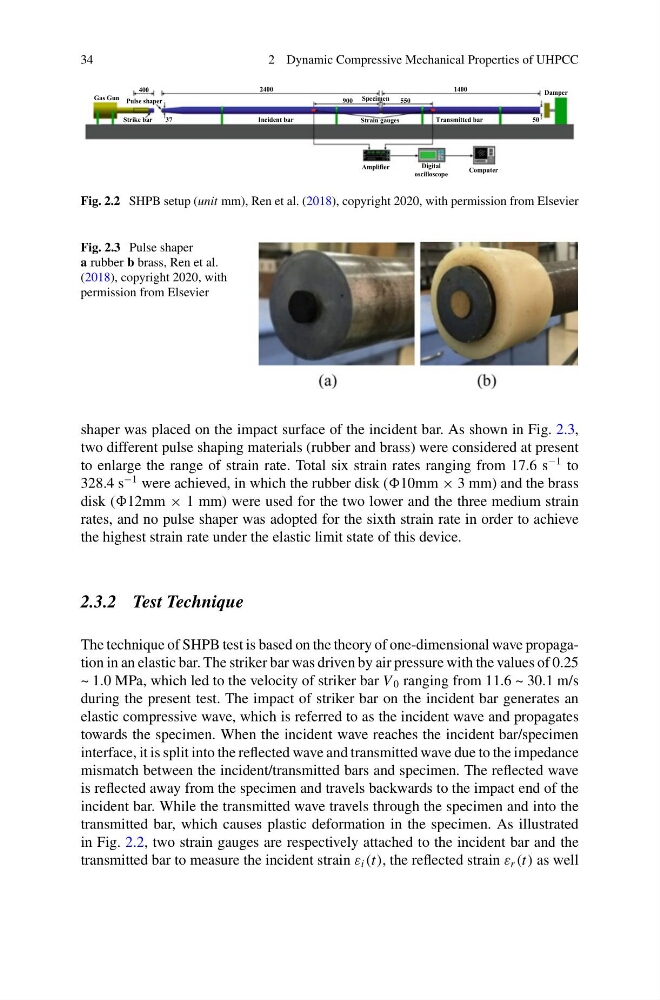
Fig. 2.2 SHPB setup (unit mm), Ren et al. (2018), copyright 2020, with permission from Elsevier
Fig. 2.3 Pulse shaper
a rubber b brass, Ren et al.
(2018), copyright 2020, with
permission from Elsevier
shaper was placed on the impact surface of the incident bar. As shown in Fig. 2.3,
two different pulse shaping materials (rubber and brass) were considered at present
to enlarge the range of strain rate. Total six strain rates ranging from 17.6 s
−1 to
328.4 s
−1 were achieved, in which the rubber disk (10mm × 3 mm) and the brass
disk (12mm × 1 mm) were used for the two lower and the three medium strain
rates, and no pulse shaper was adopted for the sixth strain rate in order to achieve
the highest strain rate under the elastic limit state of this device.
2.3.2 Test Technique
The technique of SHPB test is based on the theory of one-dimensional wave propagation in an elastic bar. The striker bar was driven by air pressure with the values of 0.25
~ 1.0 MPa, which led to the velocity of striker bar V 0 ranging from 11.6 ~ 30.1 m/s
during the present test. The impact of striker bar on the incident bar generates an
elastic compressive wave, which is referred to as the incident wave and propagates
towards the specimen. When the incident wave reaches the incident bar/specimen
interface, it is split into the reflected wave and transmitted wave due to the impedance
mismatch between the incident/transmitted bars and specimen. The reflected wave
is reflected away from the specimen and travels backwards to the impact end of the
incident bar. While the transmitted wave travels through the specimen and into the
transmitted bar, which causes plastic deformation in the specimen. As illustrated
in Fig. 2.2, two strain gauges are respectively attached to the incident bar and the
transmitted bar to measure the incident strain ε i (t), the reflected strain ε r (t) as well
2 Dynamic Compressive Mechanical Properties of UHPCC
Gas Gun
r
a
b
d
e
t
t
i
m
s
n
a
r
T
r
a
b
t
n
e
d
i
c
n
I
r
a
b
e
k
i
r
t
S
Damper
Specimen
Amplifier
Strain gauges
Digital
oscilloscope
Computer
Pulse shaper
1400
2400
400
37
50
550
900
Fig. 2.2 SHPB setup (unit mm), Ren et al. (2018), copyright 2020, with permission from Elsevier
Fig. 2.3 Pulse shaper
a rubber b brass, Ren et al.
(2018), copyright 2020, with
permission from Elsevier
shaper was placed on the impact surface of the incident bar. As shown in Fig. 2.3,
two different pulse shaping materials (rubber and brass) were considered at present
to enlarge the range of strain rate. Total six strain rates ranging from 17.6 s
−1 to
328.4 s
−1 were achieved, in which the rubber disk (10mm × 3 mm) and the brass
disk (12mm × 1 mm) were used for the two lower and the three medium strain
rates, and no pulse shaper was adopted for the sixth strain rate in order to achieve
the highest strain rate under the elastic limit state of this device.
2.3.2 Test Technique
The technique of SHPB test is based on the theory of one-dimensional wave propagation in an elastic bar. The striker bar was driven by air pressure with the values of 0.25
~ 1.0 MPa, which led to the velocity of striker bar V 0 ranging from 11.6 ~ 30.1 m/s
during the present test. The impact of striker bar on the incident bar generates an
elastic compressive wave, which is referred to as the incident wave and propagates
towards the specimen. When the incident wave reaches the incident bar/specimen
interface, it is split into the reflected wave and transmitted wave due to the impedance
mismatch between the incident/transmitted bars and specimen. The reflected wave
is reflected away from the specimen and travels backwards to the impact end of the
incident bar. While the transmitted wave travels through the specimen and into the
transmitted bar, which causes plastic deformation in the specimen. As illustrated
in Fig. 2.2, two strain gauges are respectively attached to the incident bar and the
transmitted bar to measure the incident strain ε i (t), the reflected strain ε r (t) as well