

500
14 Constitutive Modelling of UHPCC Material Under Impact …
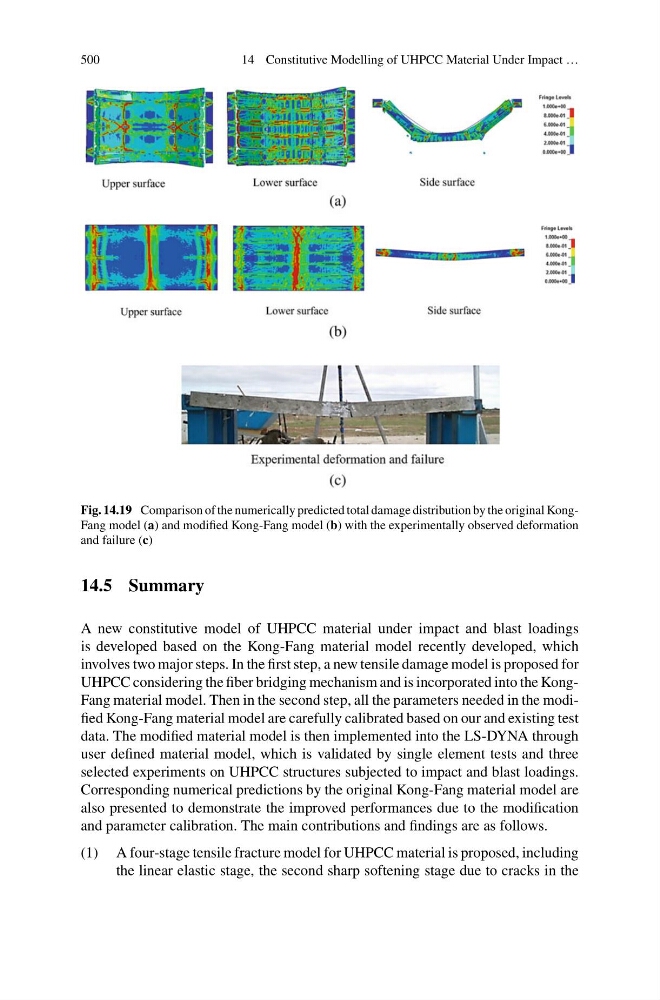
Fig. 14.19 Comparison of the numerically predicted total damage distribution by the original KongFang model (a) and modified Kong-Fang model (b) with the experimentally observed deformation
and failure (c)
14.5 Summary
A new constitutive model of UHPCC material under impact and blast loadings
is developed based on the Kong-Fang material model recently developed, which
involves two major steps. In the first step, a new tensile damage model is proposed for
UHPCC considering the fiber bridging mechanism and is incorporated into the KongFang material model. Then in the second step, all the parameters needed in the modified Kong-Fang material model are carefully calibrated based on our and existing test
data. The modified material model is then implemented into the LS-DYNA through
user defined material model, which is validated by single element tests and three
selected experiments on UHPCC structures subjected to impact and blast loadings.
Corresponding numerical predictions by the original Kong-Fang material model are
also presented to demonstrate the improved performances due to the modification
and parameter calibration. The main contributions and findings are as follows.
(1) A four-stage tensile fracture model for UHPCC material is proposed, including
the linear elastic stage, the second sharp softening stage due to cracks in the
14 Constitutive Modelling of UHPCC Material Under Impact …
Fig. 14.19 Comparison of the numerically predicted total damage distribution by the original KongFang model (a) and modified Kong-Fang model (b) with the experimentally observed deformation
and failure (c)
14.5 Summary
A new constitutive model of UHPCC material under impact and blast loadings
is developed based on the Kong-Fang material model recently developed, which
involves two major steps. In the first step, a new tensile damage model is proposed for
UHPCC considering the fiber bridging mechanism and is incorporated into the KongFang material model. Then in the second step, all the parameters needed in the modified Kong-Fang material model are carefully calibrated based on our and existing test
data. The modified material model is then implemented into the LS-DYNA through
user defined material model, which is validated by single element tests and three
selected experiments on UHPCC structures subjected to impact and blast loadings.
Corresponding numerical predictions by the original Kong-Fang material model are
also presented to demonstrate the improved performances due to the modification
and parameter calibration. The main contributions and findings are as follows.
(1) A four-stage tensile fracture model for UHPCC material is proposed, including
the linear elastic stage, the second sharp softening stage due to cracks in the