

418
12 Experimental Study on the Residual Seismic Resistance of UHPCC …
It can be seen that the peak and ultimate loads of C-11 column was almost the same
as that of intact II-2 column, while the peak and ultimate loads of C-12 specimen
was lower than that of II-2 specimen, indicating that the cyclic loading direction has
significantly effect on the lateral load-carrying capacity of the post-blast column.
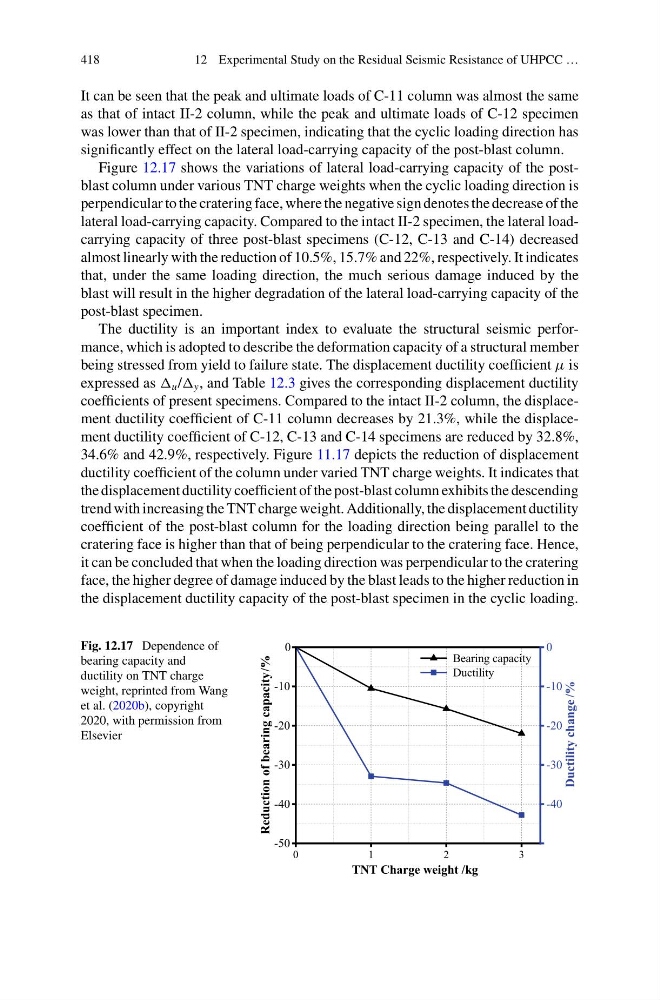
Figure 12.17 shows the variations of lateral load-carrying capacity of the postblast column under various TNT charge weights when the cyclic loading direction is
perpendicular to the cratering face, where the negative sign denotes the decrease of the
lateral load-carrying capacity. Compared to the intact II-2 specimen, the lateral loadcarrying capacity of three post-blast specimens (C-12, C-13 and C-14) decreased
almost linearly with the reduction of 10.5%, 15.7% and 22%, respectively. It indicates
that, under the same loading direction, the much serious damage induced by the
blast will result in the higher degradation of the lateral load-carrying capacity of the
post-blast specimen.
The ductility is an important index to evaluate the structural seismic performance, which is adopted to describe the deformation capacity of a structural member
being stressed from yield to failure state. The displacement ductility coefficient μ is
expressed as u / y , and Table 12.3 gives the corresponding displacement ductility
coefficients of present specimens. Compared to the intact II-2 column, the displacement ductility coefficient of C-11 column decreases by 21.3%, while the displacement ductility coefficient of C-12, C-13 and C-14 specimens are reduced by 32.8%,
34.6% and 42.9%, respectively. Figure 11.17 depicts the reduction of displacement
ductility coefficient of the column under varied TNT charge weights. It indicates that
the displacement ductility coefficient of the post-blast column exhibits the descending
trend with increasing the TNT charge weight. Additionally, the displacement ductility
coefficient of the post-blast column for the loading direction being parallel to the
cratering face is higher than that of being perpendicular to the cratering face. Hence,
it can be concluded that when the loading direction was perpendicular to the cratering
face, the higher degree of damage induced by the blast leads to the higher reduction in
the displacement ductility capacity of the post-blast specimen in the cyclic loading.
Fig. 12.17 Dependence of
bearing capacity and
ductility on TNT charge
weight, reprinted from Wang
et al. (2020b), copyright
2020, with permission from
Elsevier
0
1
2
3
-50
-40
-30
-20
-10
0
Bearing capacity
Ductility
TNT Charge weight /kg
Reduction of bearing capacity /%
-40
-30
-20
-10
0
Ductility change
/%
12 Experimental Study on the Residual Seismic Resistance of UHPCC …
It can be seen that the peak and ultimate loads of C-11 column was almost the same
as that of intact II-2 column, while the peak and ultimate loads of C-12 specimen
was lower than that of II-2 specimen, indicating that the cyclic loading direction has
significantly effect on the lateral load-carrying capacity of the post-blast column.
Figure 12.17 shows the variations of lateral load-carrying capacity of the postblast column under various TNT charge weights when the cyclic loading direction is
perpendicular to the cratering face, where the negative sign denotes the decrease of the
lateral load-carrying capacity. Compared to the intact II-2 specimen, the lateral loadcarrying capacity of three post-blast specimens (C-12, C-13 and C-14) decreased
almost linearly with the reduction of 10.5%, 15.7% and 22%, respectively. It indicates
that, under the same loading direction, the much serious damage induced by the
blast will result in the higher degradation of the lateral load-carrying capacity of the
post-blast specimen.
The ductility is an important index to evaluate the structural seismic performance, which is adopted to describe the deformation capacity of a structural member
being stressed from yield to failure state. The displacement ductility coefficient μ is
expressed as u / y , and Table 12.3 gives the corresponding displacement ductility
coefficients of present specimens. Compared to the intact II-2 column, the displacement ductility coefficient of C-11 column decreases by 21.3%, while the displacement ductility coefficient of C-12, C-13 and C-14 specimens are reduced by 32.8%,
34.6% and 42.9%, respectively. Figure 11.17 depicts the reduction of displacement
ductility coefficient of the column under varied TNT charge weights. It indicates that
the displacement ductility coefficient of the post-blast column exhibits the descending
trend with increasing the TNT charge weight. Additionally, the displacement ductility
coefficient of the post-blast column for the loading direction being parallel to the
cratering face is higher than that of being perpendicular to the cratering face. Hence,
it can be concluded that when the loading direction was perpendicular to the cratering
face, the higher degree of damage induced by the blast leads to the higher reduction in
the displacement ductility capacity of the post-blast specimen in the cyclic loading.
Fig. 12.17 Dependence of
bearing capacity and
ductility on TNT charge
weight, reprinted from Wang
et al. (2020b), copyright
2020, with permission from
Elsevier
0
1
2
3
-50
-40
-30
-20
-10
0
Bearing capacity
Ductility
TNT Charge weight /kg
Reduction of bearing capacity /%
-40
-30
-20
-10
0
Ductility change
/%