

12.3 Contact Explosion Test
407
energy. From Fig. 12.9b, it is found that the crater center was 248 mm away from
the bottom of the column, which was slightly smaller than 250 mm. The concrete
base located behind the column was partially crushed and peeled off due to the high
magnitude of the compressive pressure from the explosive.
12.3.2.4 C-14 Specimen
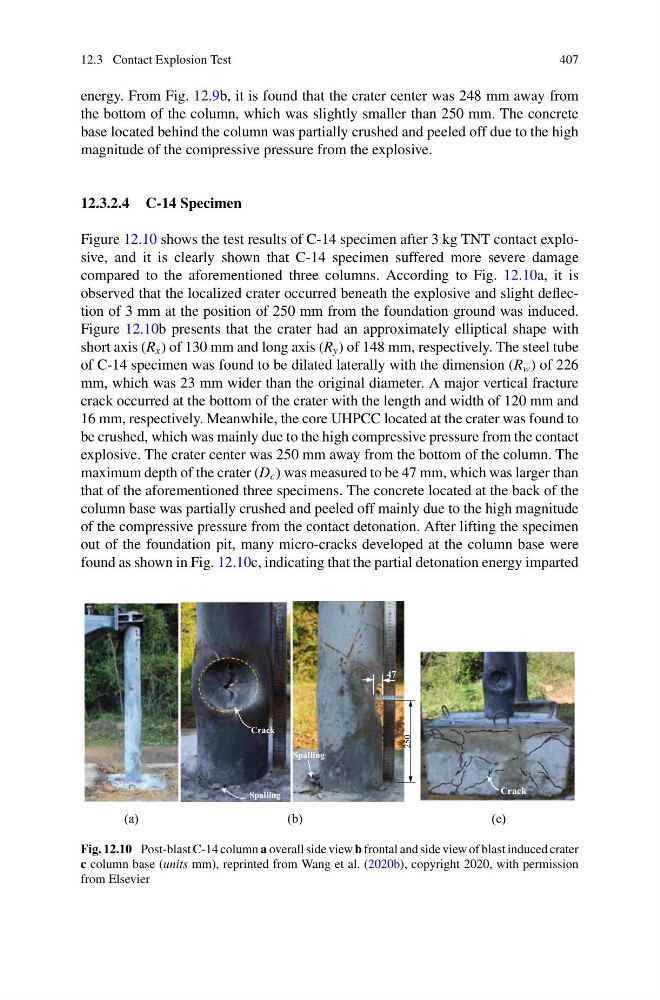
Figure 12.10 shows the test results of C-14 specimen after 3 kg TNT contact explosive, and it is clearly shown that C-14 specimen suffered more severe damage
compared to the aforementioned three columns. According to Fig. 12.10a, it is
observed that the localized crater occurred beneath the explosive and slight deflection of 3 mm at the position of 250 mm from the foundation ground was induced.
Figure 12.10b presents that the crater had an approximately elliptical shape with
short axis (R x ) of 130 mm and long axis (R y ) of 148 mm, respectively. The steel tube
of C-14 specimen was found to be dilated laterally with the dimension (R w ) of 226
mm, which was 23 mm wider than the original diameter. A major vertical fracture
crack occurred at the bottom of the crater with the length and width of 120 mm and
16 mm, respectively. Meanwhile, the core UHPCC located at the crater was found to
be crushed, which was mainly due to the high compressive pressure from the contact
explosive. The crater center was 250 mm away from the bottom of the column. The
maximum depth of the crater (D c ) was measured to be 47 mm, which was larger than
that of the aforementioned three specimens. The concrete located at the back of the
column base was partially crushed and peeled off mainly due to the high magnitude
of the compressive pressure from the contact detonation. After lifting the specimen
out of the foundation pit, many micro-cracks developed at the column base were
found as shown in Fig. 12.10c, indicating that the partial detonation energy imparted
Crack
Spalling
250
Spalling
47
Crack
(a)
(b)
(c)
Fig. 12.10 Post-blast C-14 column a overall side view b frontal and side view of blast induced crater
c column base (units mm), reprinted from Wang et al. (2020b), copyright 2020, with permission
from Elsevier
407
energy. From Fig. 12.9b, it is found that the crater center was 248 mm away from
the bottom of the column, which was slightly smaller than 250 mm. The concrete
base located behind the column was partially crushed and peeled off due to the high
magnitude of the compressive pressure from the explosive.
12.3.2.4 C-14 Specimen
Figure 12.10 shows the test results of C-14 specimen after 3 kg TNT contact explosive, and it is clearly shown that C-14 specimen suffered more severe damage
compared to the aforementioned three columns. According to Fig. 12.10a, it is
observed that the localized crater occurred beneath the explosive and slight deflection of 3 mm at the position of 250 mm from the foundation ground was induced.
Figure 12.10b presents that the crater had an approximately elliptical shape with
short axis (R x ) of 130 mm and long axis (R y ) of 148 mm, respectively. The steel tube
of C-14 specimen was found to be dilated laterally with the dimension (R w ) of 226
mm, which was 23 mm wider than the original diameter. A major vertical fracture
crack occurred at the bottom of the crater with the length and width of 120 mm and
16 mm, respectively. Meanwhile, the core UHPCC located at the crater was found to
be crushed, which was mainly due to the high compressive pressure from the contact
explosive. The crater center was 250 mm away from the bottom of the column. The
maximum depth of the crater (D c ) was measured to be 47 mm, which was larger than
that of the aforementioned three specimens. The concrete located at the back of the
column base was partially crushed and peeled off mainly due to the high magnitude
of the compressive pressure from the contact detonation. After lifting the specimen
out of the foundation pit, many micro-cracks developed at the column base were
found as shown in Fig. 12.10c, indicating that the partial detonation energy imparted
Crack
Spalling
250
Spalling
47
Crack
(a)
(b)
(c)
Fig. 12.10 Post-blast C-14 column a overall side view b frontal and side view of blast induced crater
c column base (units mm), reprinted from Wang et al. (2020b), copyright 2020, with permission
from Elsevier