

384
11 Experimental and Numerical Study of UHPCC-FST Columns …
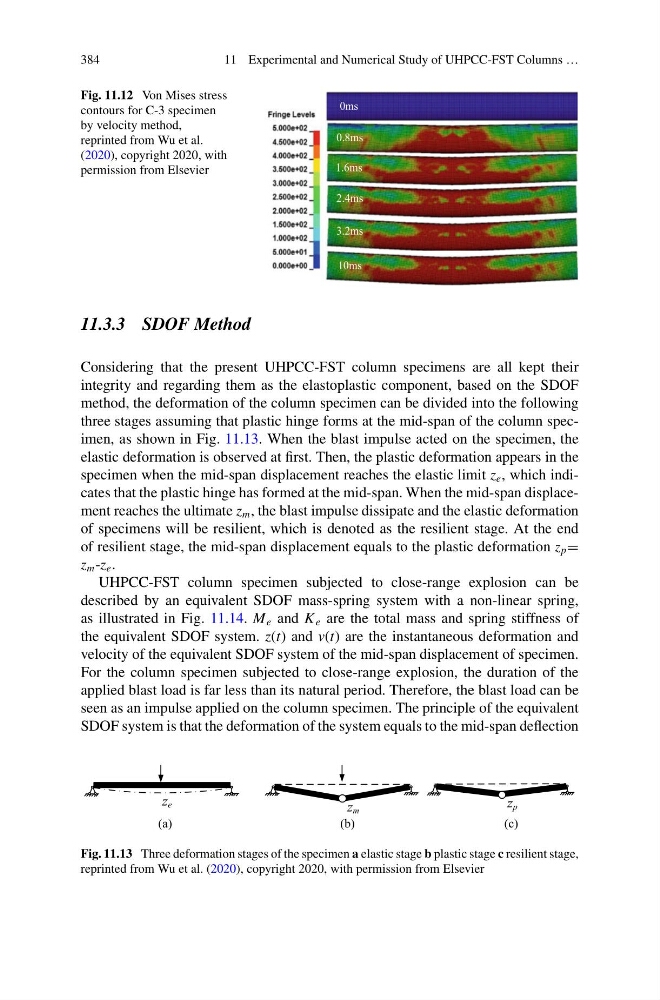
Fig. 11.12 Von Mises stress
contours for C-3 specimen
by velocity method,
reprinted from Wu et al.
(2020), copyright 2020, with
permission from Elsevier
0ms
0.8ms
1.6ms
3.2ms
2.4ms
10ms
11.3.3 SDOF Method
Considering that the present UHPCC-FST column specimens are all kept their
integrity and regarding them as the elastoplastic component, based on the SDOF
method, the deformation of the column specimen can be divided into the following
three stages assuming that plastic hinge forms at the mid-span of the column specimen, as shown in Fig. 11.13. When the blast impulse acted on the specimen, the
elastic deformation is observed at first. Then, the plastic deformation appears in the
specimen when the mid-span displacement reaches the elastic limit z e , which indicates that the plastic hinge has formed at the mid-span. When the mid-span displacement reaches the ultimate z m , the blast impulse dissipate and the elastic deformation
of specimens will be resilient, which is denoted as the resilient stage. At the end
of resilient stage, the mid-span displacement equals to the plastic deformation z p =
z m -z e .
UHPCC-FST column specimen subjected to close-range explosion can be
described by an equivalent SDOF mass-spring system with a non-linear spring,
as illustrated in Fig. 11.14. M e and K e are the total mass and spring stiffness of
the equivalent SDOF system. z(t) and v(t) are the instantaneous deformation and
velocity of the equivalent SDOF system of the mid-span displacement of specimen.
For the column specimen subjected to close-range explosion, the duration of the
applied blast load is far less than its natural period. Therefore, the blast load can be
seen as an impulse applied on the column specimen. The principle of the equivalent
SDOF system is that the deformation of the system equals to the mid-span deflection
z e
z m
z p
(a)
(b)
(c)
Fig. 11.13 Three deformation stages of the specimen a elastic stage b plastic stage c resilient stage,
reprinted from Wu et al. (2020), copyright 2020, with permission from Elsevier
11 Experimental and Numerical Study of UHPCC-FST Columns …
Fig. 11.12 Von Mises stress
contours for C-3 specimen
by velocity method,
reprinted from Wu et al.
(2020), copyright 2020, with
permission from Elsevier
0ms
0.8ms
1.6ms
3.2ms
2.4ms
10ms
11.3.3 SDOF Method
Considering that the present UHPCC-FST column specimens are all kept their
integrity and regarding them as the elastoplastic component, based on the SDOF
method, the deformation of the column specimen can be divided into the following
three stages assuming that plastic hinge forms at the mid-span of the column specimen, as shown in Fig. 11.13. When the blast impulse acted on the specimen, the
elastic deformation is observed at first. Then, the plastic deformation appears in the
specimen when the mid-span displacement reaches the elastic limit z e , which indicates that the plastic hinge has formed at the mid-span. When the mid-span displacement reaches the ultimate z m , the blast impulse dissipate and the elastic deformation
of specimens will be resilient, which is denoted as the resilient stage. At the end
of resilient stage, the mid-span displacement equals to the plastic deformation z p =
z m -z e .
UHPCC-FST column specimen subjected to close-range explosion can be
described by an equivalent SDOF mass-spring system with a non-linear spring,
as illustrated in Fig. 11.14. M e and K e are the total mass and spring stiffness of
the equivalent SDOF system. z(t) and v(t) are the instantaneous deformation and
velocity of the equivalent SDOF system of the mid-span displacement of specimen.
For the column specimen subjected to close-range explosion, the duration of the
applied blast load is far less than its natural period. Therefore, the blast load can be
seen as an impulse applied on the column specimen. The principle of the equivalent
SDOF system is that the deformation of the system equals to the mid-span deflection
z e
z m
z p
(a)
(b)
(c)
Fig. 11.13 Three deformation stages of the specimen a elastic stage b plastic stage c resilient stage,
reprinted from Wu et al. (2020), copyright 2020, with permission from Elsevier