

314
9 Dynamic Responses of Reinforced UHPCC Members Under …
0.003
0.006
0.009
0.012
0.015
0
300
600
900
1200
1500
1800
Time (s)
Impact force (kN)
Test data (Wang et al. 2019)
Numerical simulation
0.003
0.006
0.009
0.012
0.015
0
400
800
1200
1600
2000
2400
Test data (Wang et al. 2019)
Numerical simulation
Time (s)
Impact force (kN)
0.003
0.006
0.009
0.012
0.015
0
300
600
900
1200
1500
1800
Test data (Wang et al. 2019)
Numerical simulation
Time (s)
Impact force (kN)
(a)
(b)
(c)
0.003
0.006
0.009
0.012
0.015
0
400
800
1200
1600
Test data (Wang et al. 2019)
Numerical simulation
Time (s)
Impact force (kN)
0.003
0.006
0.009
0.012
0.015
0
400
800
1200
1600
2000
Test data (Wang et al. 2019)
Numerical simulation
Time (s)
Impact force (kN)
0.003
0.006
0.009
0.012
0.015
0
400
800
1200
1600
2000
Test data (Wang et al. 2019)
Numerical simulation
Time (s)
Impact force (kN)
(d)
(e)
(f)
0.003
0.006
0.009
0.012
0.015
0.018
0
400
800
1200
1600
2000
Test data (Wang et al. 2019)
Numerical simulation
Time (s)
Impact force (kN)
(g)
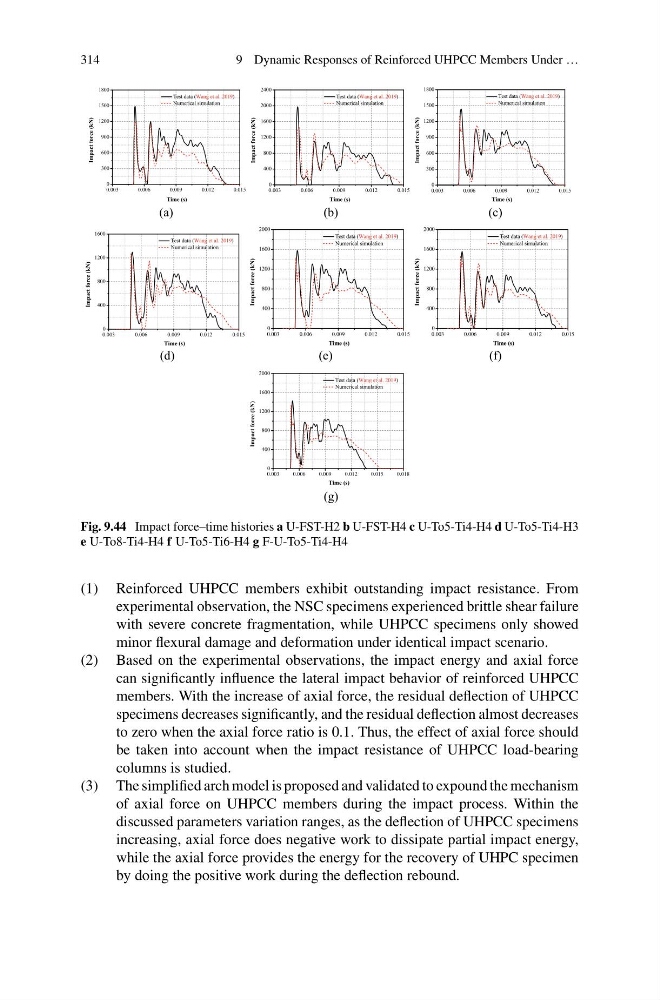
Fig. 9.44 Impact force–time histories a U-FST-H2 b U-FST-H4 c U-To5-Ti4-H4 d U-To5-Ti4-H3
e U-To8-Ti4-H4 f U-To5-Ti6-H4 g F-U-To5-Ti4-H4
(1) Reinforced UHPCC members exhibit outstanding impact resistance. From
experimental observation, the NSC specimens experienced brittle shear failure
with severe concrete fragmentation, while UHPCC specimens only showed
minor flexural damage and deformation under identical impact scenario.
(2) Based on the experimental observations, the impact energy and axial force
can significantly influence the lateral impact behavior of reinforced UHPCC
members. With the increase of axial force, the residual deflection of UHPCC
specimens decreases significantly, and the residual deflection almost decreases
to zero when the axial force ratio is 0.1. Thus, the effect of axial force should
be taken into account when the impact resistance of UHPCC load-bearing
columns is studied.
(3) The simplified arch model is proposed and validated to expound the mechanism
of axial force on UHPCC members during the impact process. Within the
discussed parameters variation ranges, as the deflection of UHPCC specimens
increasing, axial force does negative work to dissipate partial impact energy,
while the axial force provides the energy for the recovery of UHPC specimen
by doing the positive work during the deflection rebound.
9 Dynamic Responses of Reinforced UHPCC Members Under …
0.003
0.006
0.009
0.012
0.015
0
300
600
900
1200
1500
1800
Time (s)
Impact force (kN)
Test data (Wang et al. 2019)
Numerical simulation
0.003
0.006
0.009
0.012
0.015
0
400
800
1200
1600
2000
2400
Test data (Wang et al. 2019)
Numerical simulation
Time (s)
Impact force (kN)
0.003
0.006
0.009
0.012
0.015
0
300
600
900
1200
1500
1800
Test data (Wang et al. 2019)
Numerical simulation
Time (s)
Impact force (kN)
(a)
(b)
(c)
0.003
0.006
0.009
0.012
0.015
0
400
800
1200
1600
Test data (Wang et al. 2019)
Numerical simulation
Time (s)
Impact force (kN)
0.003
0.006
0.009
0.012
0.015
0
400
800
1200
1600
2000
Test data (Wang et al. 2019)
Numerical simulation
Time (s)
Impact force (kN)
0.003
0.006
0.009
0.012
0.015
0
400
800
1200
1600
2000
Test data (Wang et al. 2019)
Numerical simulation
Time (s)
Impact force (kN)
(d)
(e)
(f)
0.003
0.006
0.009
0.012
0.015
0.018
0
400
800
1200
1600
2000
Test data (Wang et al. 2019)
Numerical simulation
Time (s)
Impact force (kN)
(g)
Fig. 9.44 Impact force–time histories a U-FST-H2 b U-FST-H4 c U-To5-Ti4-H4 d U-To5-Ti4-H3
e U-To8-Ti4-H4 f U-To5-Ti6-H4 g F-U-To5-Ti4-H4
(1) Reinforced UHPCC members exhibit outstanding impact resistance. From
experimental observation, the NSC specimens experienced brittle shear failure
with severe concrete fragmentation, while UHPCC specimens only showed
minor flexural damage and deformation under identical impact scenario.
(2) Based on the experimental observations, the impact energy and axial force
can significantly influence the lateral impact behavior of reinforced UHPCC
members. With the increase of axial force, the residual deflection of UHPCC
specimens decreases significantly, and the residual deflection almost decreases
to zero when the axial force ratio is 0.1. Thus, the effect of axial force should
be taken into account when the impact resistance of UHPCC load-bearing
columns is studied.
(3) The simplified arch model is proposed and validated to expound the mechanism
of axial force on UHPCC members during the impact process. Within the
discussed parameters variation ranges, as the deflection of UHPCC specimens
increasing, axial force does negative work to dissipate partial impact energy,
while the axial force provides the energy for the recovery of UHPC specimen
by doing the positive work during the deflection rebound.