

296
9 Dynamic Responses of Reinforced UHPCC Members Under …
σ c d ε = 0.000296 × (f
c )
2
− 0.0553 × f
c + 2.812
(9.20)
The default values for the compressive fracture energy are set as 100 times
of tensile fracture energy (Murray 2007). Actually, the tensile fracture energy of
UHPCC is assumed to be 1/20 of the compressive fracture energy based on the
uniaxial tensile-compression test data (Ren et al. 2018a). The above assumption is
based on the UHPCC without obvious tensile hardening effect. The shear fracture
energy of CSC model is the same as that of uniaxial tensile fracture energy by default
(Murray 2007). The parameter repow is recommended as 1.0 to make the fracture
energy to increase with increasing the strain rate effect (Murray et al. 2007).
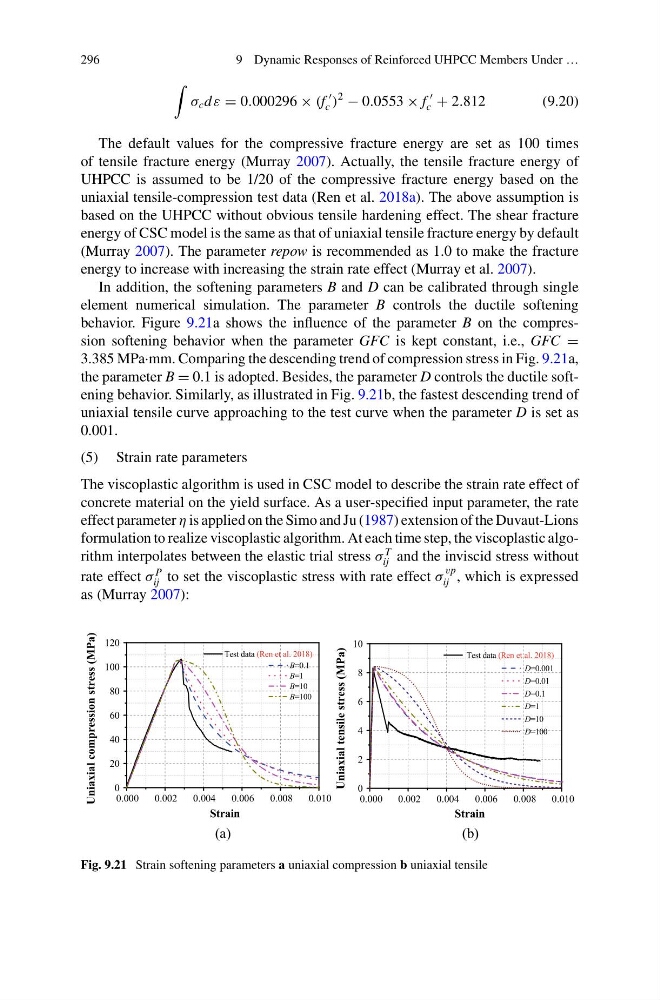
In addition, the softening parameters B and D can be calibrated through single
element numerical simulation. The parameter B controls the ductile softening
behavior. Figure 9.21a shows the influence of the parameter B on the compression softening behavior when the parameter GFC is kept constant, i.e., GFC =
3.385 MPa·mm. Comparing the descending trend of compression stress in Fig. 9.21a,
the parameter B = 0.1 is adopted. Besides, the parameter D controls the ductile softening behavior. Similarly, as illustrated in Fig. 9.21b, the fastest descending trend of
uniaxial tensile curve approaching to the test curve when the parameter D is set as
0.001.
(5) Strain rate parameters
The viscoplastic algorithm is used in CSC model to describe the strain rate effect of
concrete material on the yield surface. As a user-specified input parameter, the rate
effect parameter η is applied on the Simo and Ju (1987) extension of the Duvaut-Lions
formulation to realize viscoplastic algorithm. At each time step, the viscoplastic algorithm interpolates between the elastic trial stress σ
T
ij and the inviscid stress without
rate effect σ
P
ij to set the viscoplastic stress with rate effect σ
vp
ij , which is expressed
as (Murray 2007):
0.000
0.002
0.004
0.006
0.008
0.010
0
20
40
60
80
100
120
Test data (Ren et al. 2018)
B=0.1
B=1
B=10
B=100
Uniaxial compression stress (MPa)
Strain
0.000
0.002
0.004
0.006
0.008
0.010
0
2
4
6
8
10
Uniaxial tensile stress (MPa)
Strain
Test data (Ren et al. 2018)
D=0.001
D=0.01
D=0.1
D=1
D=10
D=100
(a)
(b)
Fig. 9.21 Strain softening parameters a uniaxial compression b uniaxial tensile
9 Dynamic Responses of Reinforced UHPCC Members Under …
σ c d ε = 0.000296 × (f
c )
2
− 0.0553 × f
c + 2.812
(9.20)
The default values for the compressive fracture energy are set as 100 times
of tensile fracture energy (Murray 2007). Actually, the tensile fracture energy of
UHPCC is assumed to be 1/20 of the compressive fracture energy based on the
uniaxial tensile-compression test data (Ren et al. 2018a). The above assumption is
based on the UHPCC without obvious tensile hardening effect. The shear fracture
energy of CSC model is the same as that of uniaxial tensile fracture energy by default
(Murray 2007). The parameter repow is recommended as 1.0 to make the fracture
energy to increase with increasing the strain rate effect (Murray et al. 2007).
In addition, the softening parameters B and D can be calibrated through single
element numerical simulation. The parameter B controls the ductile softening
behavior. Figure 9.21a shows the influence of the parameter B on the compression softening behavior when the parameter GFC is kept constant, i.e., GFC =
3.385 MPa·mm. Comparing the descending trend of compression stress in Fig. 9.21a,
the parameter B = 0.1 is adopted. Besides, the parameter D controls the ductile softening behavior. Similarly, as illustrated in Fig. 9.21b, the fastest descending trend of
uniaxial tensile curve approaching to the test curve when the parameter D is set as
0.001.
(5) Strain rate parameters
The viscoplastic algorithm is used in CSC model to describe the strain rate effect of
concrete material on the yield surface. As a user-specified input parameter, the rate
effect parameter η is applied on the Simo and Ju (1987) extension of the Duvaut-Lions
formulation to realize viscoplastic algorithm. At each time step, the viscoplastic algorithm interpolates between the elastic trial stress σ
T
ij and the inviscid stress without
rate effect σ
P
ij to set the viscoplastic stress with rate effect σ
vp
ij , which is expressed
as (Murray 2007):
0.000
0.002
0.004
0.006
0.008
0.010
0
20
40
60
80
100
120
Test data (Ren et al. 2018)
B=0.1
B=1
B=10
B=100
Uniaxial compression stress (MPa)
Strain
0.000
0.002
0.004
0.006
0.008
0.010
0
2
4
6
8
10
Uniaxial tensile stress (MPa)
Strain
Test data (Ren et al. 2018)
D=0.001
D=0.01
D=0.1
D=1
D=10
D=100
(a)
(b)
Fig. 9.21 Strain softening parameters a uniaxial compression b uniaxial tensile