

248
8 Response of UHPCC-FST Subjected to Low-Velocity Impact
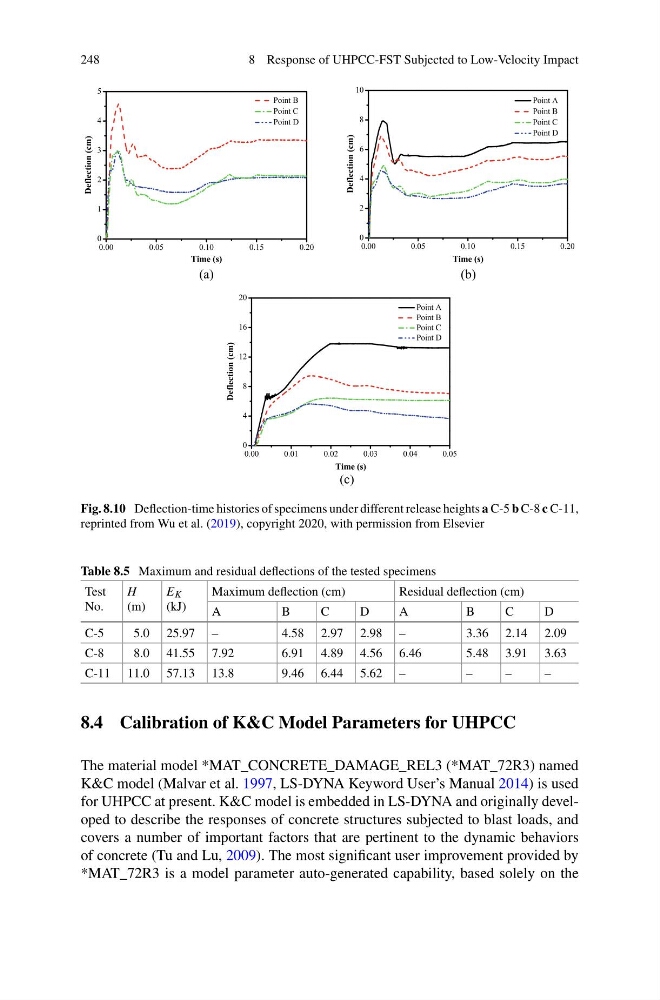
Fig. 8.10 Deflection-time histories of specimens under different release heights a C-5 b C-8 c C-11,
reprinted from Wu et al. (2019), copyright 2020, with permission from Elsevier
Table 8.5 Maximum and residual deflections of the tested specimens
Test
No.
H
(m)
E K
(kJ)
Maximum deflection (cm)
Residual deflection (cm)
A
B
C
D
A
B
C
D
C-5
5.0 25.97 –
4.58 2.97 2.98 –
3.36 2.14 2.09
C-8
8.0 41.55 7.92
6.91 4.89 4.56 6.46
5.48 3.91 3.63
C-11 11.0 57.13 13.8
9.46 6.44 5.62 –
–
–
–
8.4 Calibration of K&C Model Parameters for UHPCC
The material model *MAT_CONCRETE_DAMAGE_REL3 (*MAT_72R3) named
K&C model (Malvar et al. 1997, LS-DYNA Keyword User’s Manual 2014) is used
for UHPCC at present. K&C model is embedded in LS-DYNA and originally developed to describe the responses of concrete structures subjected to blast loads, and
covers a number of important factors that are pertinent to the dynamic behaviors
of concrete (Tu and Lu, 2009). The most significant user improvement provided by
*MAT_72R3 is a model parameter auto-generated capability, based solely on the
8 Response of UHPCC-FST Subjected to Low-Velocity Impact
Fig. 8.10 Deflection-time histories of specimens under different release heights a C-5 b C-8 c C-11,
reprinted from Wu et al. (2019), copyright 2020, with permission from Elsevier
Table 8.5 Maximum and residual deflections of the tested specimens
Test
No.
H
(m)
E K
(kJ)
Maximum deflection (cm)
Residual deflection (cm)
A
B
C
D
A
B
C
D
C-5
5.0 25.97 –
4.58 2.97 2.98 –
3.36 2.14 2.09
C-8
8.0 41.55 7.92
6.91 4.89 4.56 6.46
5.48 3.91 3.63
C-11 11.0 57.13 13.8
9.46 6.44 5.62 –
–
–
–
8.4 Calibration of K&C Model Parameters for UHPCC
The material model *MAT_CONCRETE_DAMAGE_REL3 (*MAT_72R3) named
K&C model (Malvar et al. 1997, LS-DYNA Keyword User’s Manual 2014) is used
for UHPCC at present. K&C model is embedded in LS-DYNA and originally developed to describe the responses of concrete structures subjected to blast loads, and
covers a number of important factors that are pertinent to the dynamic behaviors
of concrete (Tu and Lu, 2009). The most significant user improvement provided by
*MAT_72R3 is a model parameter auto-generated capability, based solely on the