

8.3 Test Results and Discussions
245
material inhomogeneity of the specimens. However, in terms of theirs axial load
capacities, such discrepancy can be neglected.
8.3.1.2 Constraining Factor
The confining effect is essential for the CFST members under different loading
conditions. The constraining factor ξ proposed by the Chinese Standard GB50936
(2014) is used to describe the composite action between the steel tube and the filled
concrete, which is expressed as
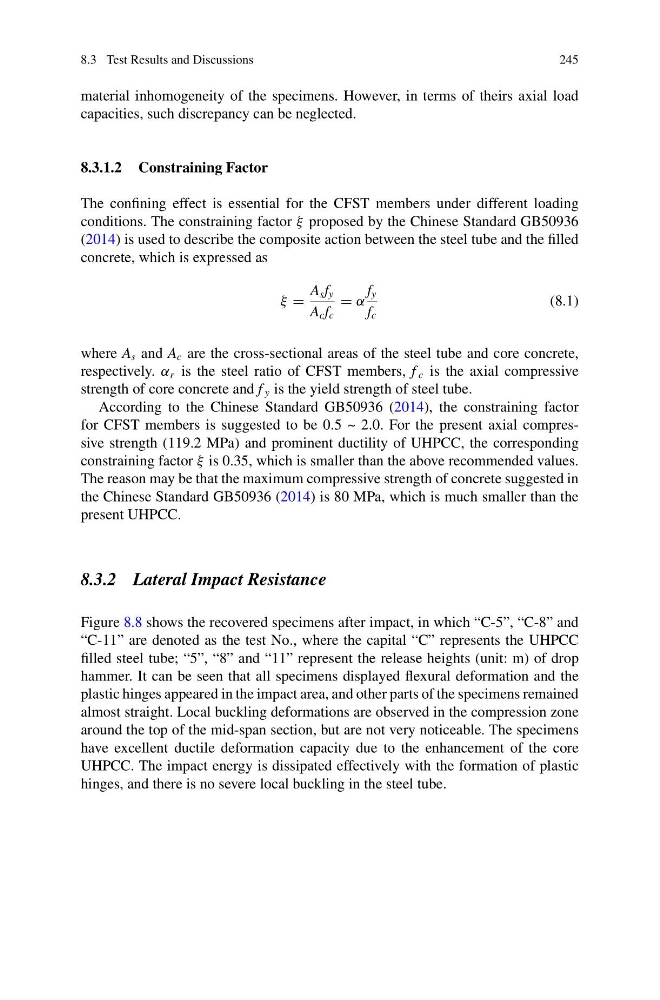
ξ =
A s f y
A c f c
= α
f y
f c
(8.1)
where A s and A c are the cross-sectional areas of the steel tube and core concrete,
respectively. α r is the steel ratio of CFST members, f c is the axial compressive
strength of core concrete and f y is the yield strength of steel tube.
According to the Chinese Standard GB50936 (2014), the constraining factor
for CFST members is suggested to be 0.5 ~ 2.0. For the present axial compressive strength (119.2 MPa) and prominent ductility of UHPCC, the corresponding
constraining factor ξ is 0.35, which is smaller than the above recommended values.
The reason may be that the maximum compressive strength of concrete suggested in
the Chinese Standard GB50936 (2014) is 80 MPa, which is much smaller than the
present UHPCC.
8.3.2 Lateral Impact Resistance
Figure 8.8 shows the recovered specimens after impact, in which “C-5”, “C-8” and
“C-11” are denoted as the test No., where the capital “C” represents the UHPCC
filled steel tube; “5”, “8” and “11” represent the release heights (unit: m) of drop
hammer. It can be seen that all specimens displayed flexural deformation and the
plastic hinges appeared in the impact area, and other parts of the specimens remained
almost straight. Local buckling deformations are observed in the compression zone
around the top of the mid-span section, but are not very noticeable. The specimens
have excellent ductile deformation capacity due to the enhancement of the core
UHPCC. The impact energy is dissipated effectively with the formation of plastic
hinges, and there is no severe local buckling in the steel tube.
245
material inhomogeneity of the specimens. However, in terms of theirs axial load
capacities, such discrepancy can be neglected.
8.3.1.2 Constraining Factor
The confining effect is essential for the CFST members under different loading
conditions. The constraining factor ξ proposed by the Chinese Standard GB50936
(2014) is used to describe the composite action between the steel tube and the filled
concrete, which is expressed as
ξ =
A s f y
A c f c
= α
f y
f c
(8.1)
where A s and A c are the cross-sectional areas of the steel tube and core concrete,
respectively. α r is the steel ratio of CFST members, f c is the axial compressive
strength of core concrete and f y is the yield strength of steel tube.
According to the Chinese Standard GB50936 (2014), the constraining factor
for CFST members is suggested to be 0.5 ~ 2.0. For the present axial compressive strength (119.2 MPa) and prominent ductility of UHPCC, the corresponding
constraining factor ξ is 0.35, which is smaller than the above recommended values.
The reason may be that the maximum compressive strength of concrete suggested in
the Chinese Standard GB50936 (2014) is 80 MPa, which is much smaller than the
present UHPCC.
8.3.2 Lateral Impact Resistance
Figure 8.8 shows the recovered specimens after impact, in which “C-5”, “C-8” and
“C-11” are denoted as the test No., where the capital “C” represents the UHPCC
filled steel tube; “5”, “8” and “11” represent the release heights (unit: m) of drop
hammer. It can be seen that all specimens displayed flexural deformation and the
plastic hinges appeared in the impact area, and other parts of the specimens remained
almost straight. Local buckling deformations are observed in the compression zone
around the top of the mid-span section, but are not very noticeable. The specimens
have excellent ductile deformation capacity due to the enhancement of the core
UHPCC. The impact energy is dissipated effectively with the formation of plastic
hinges, and there is no severe local buckling in the steel tube.