

212
7 Impact Resistance of Armor Steel/Ceramic/UHPCC Layered …
Equation (7.7) can be further transformed into the following expression by taking
the natural logarithm on both side to obtain the thermal softening effect parameter
m, as
m ln T
∗
= ln(1 − σ/A)
(7.8)
Substituting the values of A = 665 MPa, T 0 = 298 K and T m = 1765 K into
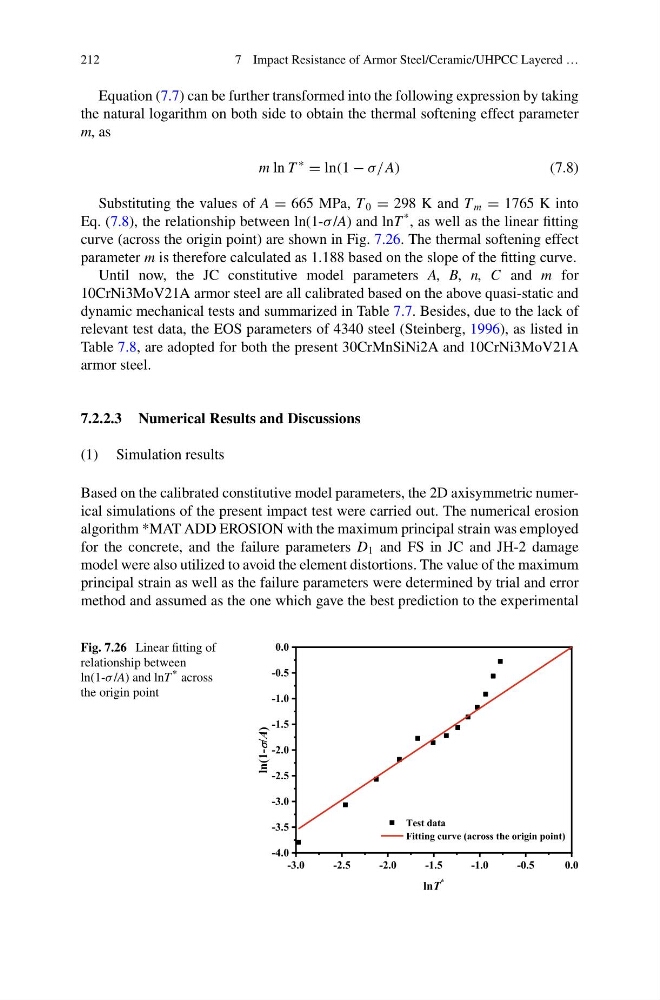
Eq. (7.8), the relationship between ln(1-σ /A) and lnT
* , as well as the linear fitting
curve (across the origin point) are shown in Fig. 7.26. The thermal softening effect
parameter m is therefore calculated as 1.188 based on the slope of the fitting curve.
Until now, the JC constitutive model parameters A, B, n, C and m for
10CrNi3MoV21A armor steel are all calibrated based on the above quasi-static and
dynamic mechanical tests and summarized in Table 7.7. Besides, due to the lack of
relevant test data, the EOS parameters of 4340 steel (Steinberg, 1996), as listed in
Table 7.8, are adopted for both the present 30CrMnSiNi2A and 10CrNi3MoV21A
armor steel.
7.2.2.3 Numerical Results and Discussions
(1) Simulation results
Based on the calibrated constitutive model parameters, the 2D axisymmetric numerical simulations of the present impact test were carried out. The numerical erosion
algorithm *MAT ADD EROSION with the maximum principal strain was employed
for the concrete, and the failure parameters D 1 and FS in JC and JH-2 damage
model were also utilized to avoid the element distortions. The value of the maximum
principal strain as well as the failure parameters were determined by trial and error
method and assumed as the one which gave the best prediction to the experimental
Fig. 7.26 Linear fitting of
relationship between
ln(1-σ /A) and lnT * across
the origin point
7 Impact Resistance of Armor Steel/Ceramic/UHPCC Layered …
Equation (7.7) can be further transformed into the following expression by taking
the natural logarithm on both side to obtain the thermal softening effect parameter
m, as
m ln T
∗
= ln(1 − σ/A)
(7.8)
Substituting the values of A = 665 MPa, T 0 = 298 K and T m = 1765 K into
Eq. (7.8), the relationship between ln(1-σ /A) and lnT
* , as well as the linear fitting
curve (across the origin point) are shown in Fig. 7.26. The thermal softening effect
parameter m is therefore calculated as 1.188 based on the slope of the fitting curve.
Until now, the JC constitutive model parameters A, B, n, C and m for
10CrNi3MoV21A armor steel are all calibrated based on the above quasi-static and
dynamic mechanical tests and summarized in Table 7.7. Besides, due to the lack of
relevant test data, the EOS parameters of 4340 steel (Steinberg, 1996), as listed in
Table 7.8, are adopted for both the present 30CrMnSiNi2A and 10CrNi3MoV21A
armor steel.
7.2.2.3 Numerical Results and Discussions
(1) Simulation results
Based on the calibrated constitutive model parameters, the 2D axisymmetric numerical simulations of the present impact test were carried out. The numerical erosion
algorithm *MAT ADD EROSION with the maximum principal strain was employed
for the concrete, and the failure parameters D 1 and FS in JC and JH-2 damage
model were also utilized to avoid the element distortions. The value of the maximum
principal strain as well as the failure parameters were determined by trial and error
method and assumed as the one which gave the best prediction to the experimental
Fig. 7.26 Linear fitting of
relationship between
ln(1-σ /A) and lnT * across
the origin point