

208
7 Impact Resistance of Armor Steel/Ceramic/UHPCC Layered …
Original
specimen
0.1MPa
0.2MPa
0.3MPa
Original
specimen
0.4MPa
0.5MPa
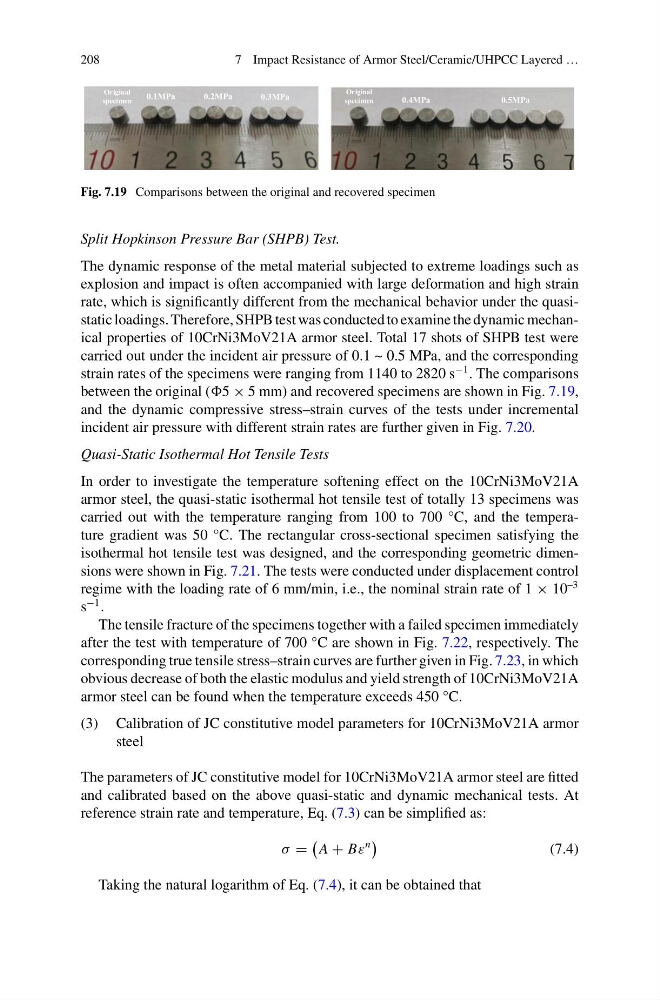
Fig. 7.19 Comparisons between the original and recovered specimen
Split Hopkinson Pressure Bar (SHPB) Test.
The dynamic response of the metal material subjected to extreme loadings such as
explosion and impact is often accompanied with large deformation and high strain
rate, which is significantly different from the mechanical behavior under the quasistatic loadings. Therefore, SHPB test was conducted to examine the dynamic mechanical properties of 10CrNi3MoV21A armor steel. Total 17 shots of SHPB test were
carried out under the incident air pressure of 0.1 ~ 0.5 MPa, and the corresponding
strain rates of the specimens were ranging from 1140 to 2820 s
−1 . The comparisons
between the original (5 × 5 mm) and recovered specimens are shown in Fig. 7.19,
and the dynamic compressive stress–strain curves of the tests under incremental
incident air pressure with different strain rates are further given in Fig. 7.20.
Quasi-Static Isothermal Hot Tensile Tests
In order to investigate the temperature softening effect on the 10CrNi3MoV21A
armor steel, the quasi-static isothermal hot tensile test of totally 13 specimens was
carried out with the temperature ranging from 100 to 700 °C, and the temperature gradient was 50 °C. The rectangular cross-sectional specimen satisfying the
isothermal hot tensile test was designed, and the corresponding geometric dimensions were shown in Fig. 7.21. The tests were conducted under displacement control
regime with the loading rate of 6 mm/min, i.e., the nominal strain rate of 1 × 10
–3
s
−1 .
The tensile fracture of the specimens together with a failed specimen immediately
after the test with temperature of 700 °C are shown in Fig. 7.22, respectively. The
corresponding true tensile stress–strain curves are further given in Fig. 7.23, in which
obvious decrease of both the elastic modulus and yield strength of 10CrNi3MoV21A
armor steel can be found when the temperature exceeds 450 °C.
(3) Calibration of JC constitutive model parameters for 10CrNi3MoV21A armor
steel
The parameters of JC constitutive model for 10CrNi3MoV21A armor steel are fitted
and calibrated based on the above quasi-static and dynamic mechanical tests. At
reference strain rate and temperature, Eq. (7.3) can be simplified as:
σ =
A + Bε
n
(7.4)
Taking the natural logarithm of Eq. (7.4), it can be obtained that
7 Impact Resistance of Armor Steel/Ceramic/UHPCC Layered …
Original
specimen
0.1MPa
0.2MPa
0.3MPa
Original
specimen
0.4MPa
0.5MPa
Fig. 7.19 Comparisons between the original and recovered specimen
Split Hopkinson Pressure Bar (SHPB) Test.
The dynamic response of the metal material subjected to extreme loadings such as
explosion and impact is often accompanied with large deformation and high strain
rate, which is significantly different from the mechanical behavior under the quasistatic loadings. Therefore, SHPB test was conducted to examine the dynamic mechanical properties of 10CrNi3MoV21A armor steel. Total 17 shots of SHPB test were
carried out under the incident air pressure of 0.1 ~ 0.5 MPa, and the corresponding
strain rates of the specimens were ranging from 1140 to 2820 s
−1 . The comparisons
between the original (5 × 5 mm) and recovered specimens are shown in Fig. 7.19,
and the dynamic compressive stress–strain curves of the tests under incremental
incident air pressure with different strain rates are further given in Fig. 7.20.
Quasi-Static Isothermal Hot Tensile Tests
In order to investigate the temperature softening effect on the 10CrNi3MoV21A
armor steel, the quasi-static isothermal hot tensile test of totally 13 specimens was
carried out with the temperature ranging from 100 to 700 °C, and the temperature gradient was 50 °C. The rectangular cross-sectional specimen satisfying the
isothermal hot tensile test was designed, and the corresponding geometric dimensions were shown in Fig. 7.21. The tests were conducted under displacement control
regime with the loading rate of 6 mm/min, i.e., the nominal strain rate of 1 × 10
–3
s
−1 .
The tensile fracture of the specimens together with a failed specimen immediately
after the test with temperature of 700 °C are shown in Fig. 7.22, respectively. The
corresponding true tensile stress–strain curves are further given in Fig. 7.23, in which
obvious decrease of both the elastic modulus and yield strength of 10CrNi3MoV21A
armor steel can be found when the temperature exceeds 450 °C.
(3) Calibration of JC constitutive model parameters for 10CrNi3MoV21A armor
steel
The parameters of JC constitutive model for 10CrNi3MoV21A armor steel are fitted
and calibrated based on the above quasi-static and dynamic mechanical tests. At
reference strain rate and temperature, Eq. (7.3) can be simplified as:
σ =
A + Bε
n
(7.4)
Taking the natural logarithm of Eq. (7.4), it can be obtained that