

7.2 Impact Test on 10CrNi3MoV21A Armor Steel/SiC Ceramic/UHPCC …
203
the SPH algorithm whereas the mushrooming deformation of projectile is not reproduced well. However, the defects of the 3D Lagrange-algorithm based finite element
and SPH algorithm can also be found as follows: (i) attributed to the relatively low
computational efficiency, the time cost is correspondingly increased; (ii) the erosion
criterion has to be added on the finite elements to obtain the eroded residual projectile.
However, unreasonable deletions and distortions of the finite elements are usually
occurred when a small and large values of erosion criterion are adopted, respectively.
In other words, the erosion criterion in Lagrange algorithm is in contradiction with
the reproduction of the mushrooming deformation of the projectile in the present
simulation.
By taking the axisymmetric characteristic of the projectile and target (except the
armor steel and ceramic plate) into consideration, the applicability of 2D axisymmetric model is further assessed at present. Besides, the ALE algorithm and adaptive remeshing method are the two practical numerical techniques to overcome the
severe element distortion scenarios. Therefore, both the ALE algorithm and adaptive
remeshing method (the element remeshing frequency was 2 μs and the minimum
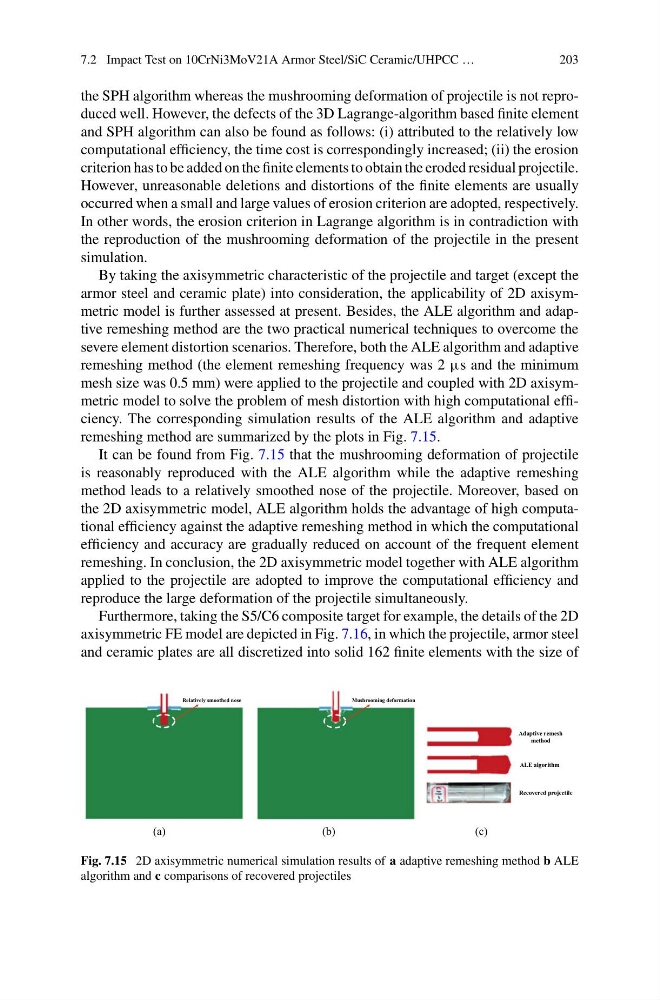
mesh size was 0.5 mm) were applied to the projectile and coupled with 2D axisymmetric model to solve the problem of mesh distortion with high computational efficiency. The corresponding simulation results of the ALE algorithm and adaptive
remeshing method are summarized by the plots in Fig. 7.15.
It can be found from Fig. 7.15 that the mushrooming deformation of projectile
is reasonably reproduced with the ALE algorithm while the adaptive remeshing
method leads to a relatively smoothed nose of the projectile. Moreover, based on
the 2D axisymmetric model, ALE algorithm holds the advantage of high computational efficiency against the adaptive remeshing method in which the computational
efficiency and accuracy are gradually reduced on account of the frequent element
remeshing. In conclusion, the 2D axisymmetric model together with ALE algorithm
applied to the projectile are adopted to improve the computational efficiency and
reproduce the large deformation of the projectile simultaneously.
Furthermore, taking the S5/C6 composite target for example, the details of the 2D
axisymmetric FE model are depicted in Fig. 7.16, in which the projectile, armor steel
and ceramic plates are all discretized into solid 162 finite elements with the size of
Mushrooming deformation
Relatively smoothed nose
Adaptive remesh
method
ALE algorithm
Recovered projectile
(a)
(b)
(c)
Fig. 7.15 2D axisymmetric numerical simulation results of a adaptive remeshing method b ALE
algorithm and c comparisons of recovered projectiles
203
the SPH algorithm whereas the mushrooming deformation of projectile is not reproduced well. However, the defects of the 3D Lagrange-algorithm based finite element
and SPH algorithm can also be found as follows: (i) attributed to the relatively low
computational efficiency, the time cost is correspondingly increased; (ii) the erosion
criterion has to be added on the finite elements to obtain the eroded residual projectile.
However, unreasonable deletions and distortions of the finite elements are usually
occurred when a small and large values of erosion criterion are adopted, respectively.
In other words, the erosion criterion in Lagrange algorithm is in contradiction with
the reproduction of the mushrooming deformation of the projectile in the present
simulation.
By taking the axisymmetric characteristic of the projectile and target (except the
armor steel and ceramic plate) into consideration, the applicability of 2D axisymmetric model is further assessed at present. Besides, the ALE algorithm and adaptive remeshing method are the two practical numerical techniques to overcome the
severe element distortion scenarios. Therefore, both the ALE algorithm and adaptive
remeshing method (the element remeshing frequency was 2 μs and the minimum
mesh size was 0.5 mm) were applied to the projectile and coupled with 2D axisymmetric model to solve the problem of mesh distortion with high computational efficiency. The corresponding simulation results of the ALE algorithm and adaptive
remeshing method are summarized by the plots in Fig. 7.15.
It can be found from Fig. 7.15 that the mushrooming deformation of projectile
is reasonably reproduced with the ALE algorithm while the adaptive remeshing
method leads to a relatively smoothed nose of the projectile. Moreover, based on
the 2D axisymmetric model, ALE algorithm holds the advantage of high computational efficiency against the adaptive remeshing method in which the computational
efficiency and accuracy are gradually reduced on account of the frequent element
remeshing. In conclusion, the 2D axisymmetric model together with ALE algorithm
applied to the projectile are adopted to improve the computational efficiency and
reproduce the large deformation of the projectile simultaneously.
Furthermore, taking the S5/C6 composite target for example, the details of the 2D
axisymmetric FE model are depicted in Fig. 7.16, in which the projectile, armor steel
and ceramic plates are all discretized into solid 162 finite elements with the size of
Mushrooming deformation
Relatively smoothed nose
Adaptive remesh
method
ALE algorithm
Recovered projectile
(a)
(b)
(c)
Fig. 7.15 2D axisymmetric numerical simulation results of a adaptive remeshing method b ALE
algorithm and c comparisons of recovered projectiles