

7.2 Impact Test on 10CrNi3MoV21A Armor Steel/SiC Ceramic/UHPCC …
197
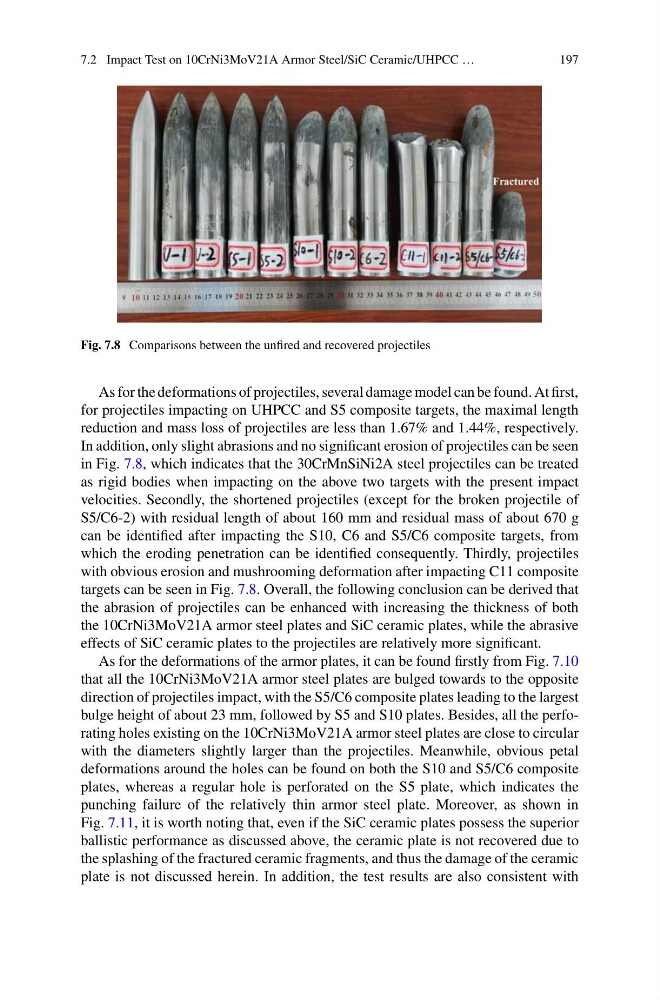
Fig. 7.8 Comparisons between the unfired and recovered projectiles
As for the deformations of projectiles, several damage model can be found. At first,
for projectiles impacting on UHPCC and S5 composite targets, the maximal length
reduction and mass loss of projectiles are less than 1.67% and 1.44%, respectively.
In addition, only slight abrasions and no significant erosion of projectiles can be seen
in Fig. 7.8, which indicates that the 30CrMnSiNi2A steel projectiles can be treated
as rigid bodies when impacting on the above two targets with the present impact
velocities. Secondly, the shortened projectiles (except for the broken projectile of
S5/C6-2) with residual length of about 160 mm and residual mass of about 670 g
can be identified after impacting the S10, C6 and S5/C6 composite targets, from
which the eroding penetration can be identified consequently. Thirdly, projectiles
with obvious erosion and mushrooming deformation after impacting C11 composite
targets can be seen in Fig. 7.8. Overall, the following conclusion can be derived that
the abrasion of projectiles can be enhanced with increasing the thickness of both
the 10CrNi3MoV21A armor steel plates and SiC ceramic plates, while the abrasive
effects of SiC ceramic plates to the projectiles are relatively more significant.
As for the deformations of the armor plates, it can be found firstly from Fig. 7.10
that all the 10CrNi3MoV21A armor steel plates are bulged towards to the opposite
direction of projectiles impact, with the S5/C6 composite plates leading to the largest
bulge height of about 23 mm, followed by S5 and S10 plates. Besides, all the perforating holes existing on the 10CrNi3MoV21A armor steel plates are close to circular
with the diameters slightly larger than the projectiles. Meanwhile, obvious petal
deformations around the holes can be found on both the S10 and S5/C6 composite
plates, whereas a regular hole is perforated on the S5 plate, which indicates the
punching failure of the relatively thin armor steel plate. Moreover, as shown in
Fig. 7.11, it is worth noting that, even if the SiC ceramic plates possess the superior
ballistic performance as discussed above, the ceramic plate is not recovered due to
the splashing of the fractured ceramic fragments, and thus the damage of the ceramic
plate is not discussed herein. In addition, the test results are also consistent with
197
Fig. 7.8 Comparisons between the unfired and recovered projectiles
As for the deformations of projectiles, several damage model can be found. At first,
for projectiles impacting on UHPCC and S5 composite targets, the maximal length
reduction and mass loss of projectiles are less than 1.67% and 1.44%, respectively.
In addition, only slight abrasions and no significant erosion of projectiles can be seen
in Fig. 7.8, which indicates that the 30CrMnSiNi2A steel projectiles can be treated
as rigid bodies when impacting on the above two targets with the present impact
velocities. Secondly, the shortened projectiles (except for the broken projectile of
S5/C6-2) with residual length of about 160 mm and residual mass of about 670 g
can be identified after impacting the S10, C6 and S5/C6 composite targets, from
which the eroding penetration can be identified consequently. Thirdly, projectiles
with obvious erosion and mushrooming deformation after impacting C11 composite
targets can be seen in Fig. 7.8. Overall, the following conclusion can be derived that
the abrasion of projectiles can be enhanced with increasing the thickness of both
the 10CrNi3MoV21A armor steel plates and SiC ceramic plates, while the abrasive
effects of SiC ceramic plates to the projectiles are relatively more significant.
As for the deformations of the armor plates, it can be found firstly from Fig. 7.10
that all the 10CrNi3MoV21A armor steel plates are bulged towards to the opposite
direction of projectiles impact, with the S5/C6 composite plates leading to the largest
bulge height of about 23 mm, followed by S5 and S10 plates. Besides, all the perforating holes existing on the 10CrNi3MoV21A armor steel plates are close to circular
with the diameters slightly larger than the projectiles. Meanwhile, obvious petal
deformations around the holes can be found on both the S10 and S5/C6 composite
plates, whereas a regular hole is perforated on the S5 plate, which indicates the
punching failure of the relatively thin armor steel plate. Moreover, as shown in
Fig. 7.11, it is worth noting that, even if the SiC ceramic plates possess the superior
ballistic performance as discussed above, the ceramic plate is not recovered due to
the splashing of the fractured ceramic fragments, and thus the damage of the ceramic
plate is not discussed herein. In addition, the test results are also consistent with