

6.3 Test Results
173
(a)
(b)
(c)
(d)
(e)
(f)
(g)
(h)
(i)
(j)
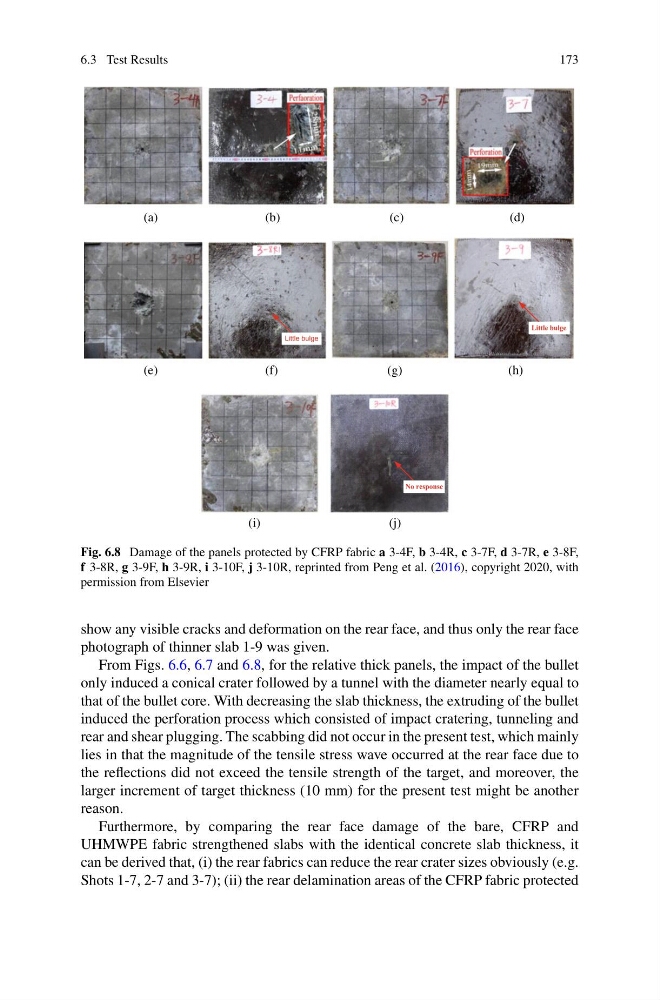
Fig. 6.8 Damage of the panels protected by CFRP fabric a 3-4F, b 3-4R, c 3-7F, d 3-7R, e 3-8F,
f 3-8R, g 3-9F, h 3-9R, i 3-10F, j 3-10R, reprinted from Peng et al. (2016), copyright 2020, with
permission from Elsevier
show any visible cracks and deformation on the rear face, and thus only the rear face
photograph of thinner slab 1-9 was given.
From Figs. 6.6, 6.7 and 6.8, for the relative thick panels, the impact of the bullet
only induced a conical crater followed by a tunnel with the diameter nearly equal to
that of the bullet core. With decreasing the slab thickness, the extruding of the bullet
induced the perforation process which consisted of impact cratering, tunneling and
rear and shear plugging. The scabbing did not occur in the present test, which mainly
lies in that the magnitude of the tensile stress wave occurred at the rear face due to
the reflections did not exceed the tensile strength of the target, and moreover, the
larger increment of target thickness (10 mm) for the present test might be another
reason.
Furthermore, by comparing the rear face damage of the bare, CFRP and
UHMWPE fabric strengthened slabs with the identical concrete slab thickness, it
can be derived that, (i) the rear fabrics can reduce the rear crater sizes obviously (e.g.
Shots 1-7, 2-7 and 3-7); (ii) the rear delamination areas of the CFRP fabric protected
173
(a)
(b)
(c)
(d)
(e)
(f)
(g)
(h)
(i)
(j)
Fig. 6.8 Damage of the panels protected by CFRP fabric a 3-4F, b 3-4R, c 3-7F, d 3-7R, e 3-8F,
f 3-8R, g 3-9F, h 3-9R, i 3-10F, j 3-10R, reprinted from Peng et al. (2016), copyright 2020, with
permission from Elsevier
show any visible cracks and deformation on the rear face, and thus only the rear face
photograph of thinner slab 1-9 was given.
From Figs. 6.6, 6.7 and 6.8, for the relative thick panels, the impact of the bullet
only induced a conical crater followed by a tunnel with the diameter nearly equal to
that of the bullet core. With decreasing the slab thickness, the extruding of the bullet
induced the perforation process which consisted of impact cratering, tunneling and
rear and shear plugging. The scabbing did not occur in the present test, which mainly
lies in that the magnitude of the tensile stress wave occurred at the rear face due to
the reflections did not exceed the tensile strength of the target, and moreover, the
larger increment of target thickness (10 mm) for the present test might be another
reason.
Furthermore, by comparing the rear face damage of the bare, CFRP and
UHMWPE fabric strengthened slabs with the identical concrete slab thickness, it
can be derived that, (i) the rear fabrics can reduce the rear crater sizes obviously (e.g.
Shots 1-7, 2-7 and 3-7); (ii) the rear delamination areas of the CFRP fabric protected