

5.4 Numerical Simulations Based on 3D Mesoscopic Concrete Model
155
of the projectile is relatively high. Meanwhile, compared with other three targets,
the advantage of anti-penetration performance of CA-UHPC target becomes more
obvious with the increase of impact velocity. For instance, when V 0 = 400 m/s,
the DOP of projectile into CA-UHPC target is 0.66, 0.63 and 0.57 times that of
projectile into QA-UHPC, BA-UHPC and LA-UHPC targets, respectively; when V 0
= 1000 m/s, the DOP of projectile into CA-UHPC target is 0.49, 0.41 and 0.35
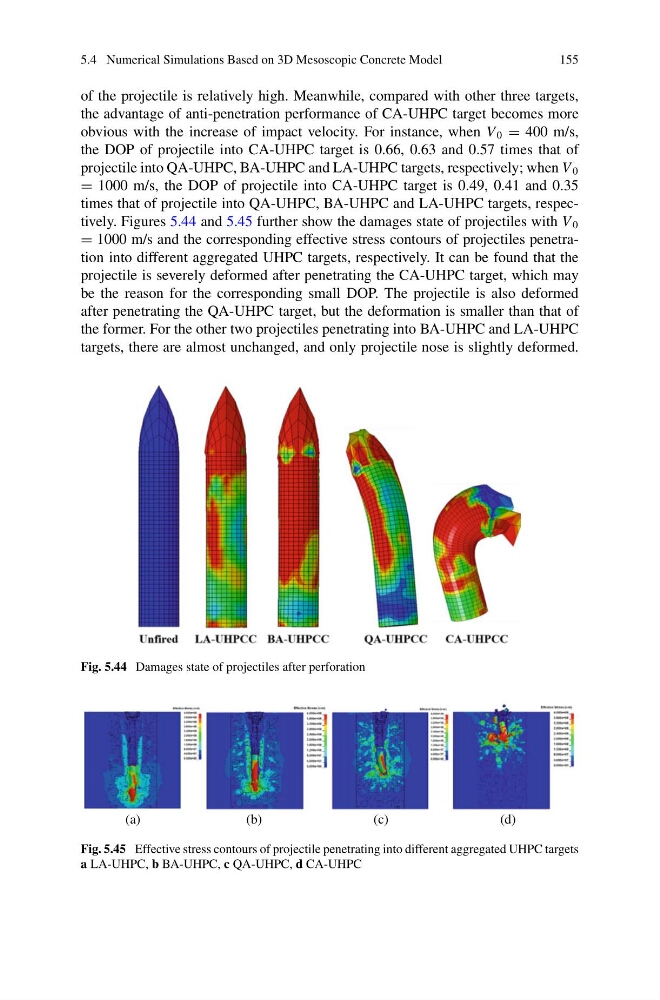
times that of projectile into QA-UHPC, BA-UHPC and LA-UHPC targets, respectively. Figures 5.44 and 5.45 further show the damages state of projectiles with V 0
= 1000 m/s and the corresponding effective stress contours of projectiles penetration into different aggregated UHPC targets, respectively. It can be found that the
projectile is severely deformed after penetrating the CA-UHPC target, which may
be the reason for the corresponding small DOP. The projectile is also deformed
after penetrating the QA-UHPC target, but the deformation is smaller than that of
the former. For the other two projectiles penetrating into BA-UHPC and LA-UHPC
targets, there are almost unchanged, and only projectile nose is slightly deformed.
Fig. 5.44 Damages state of projectiles after perforation
(a)
(b)
(c)
(d)
Fig. 5.45 Effective stress contours of projectile penetrating into different aggregated UHPC targets
a LA-UHPC, b BA-UHPC, c QA-UHPC, d CA-UHPC
155
of the projectile is relatively high. Meanwhile, compared with other three targets,
the advantage of anti-penetration performance of CA-UHPC target becomes more
obvious with the increase of impact velocity. For instance, when V 0 = 400 m/s,
the DOP of projectile into CA-UHPC target is 0.66, 0.63 and 0.57 times that of
projectile into QA-UHPC, BA-UHPC and LA-UHPC targets, respectively; when V 0
= 1000 m/s, the DOP of projectile into CA-UHPC target is 0.49, 0.41 and 0.35
times that of projectile into QA-UHPC, BA-UHPC and LA-UHPC targets, respectively. Figures 5.44 and 5.45 further show the damages state of projectiles with V 0
= 1000 m/s and the corresponding effective stress contours of projectiles penetration into different aggregated UHPC targets, respectively. It can be found that the
projectile is severely deformed after penetrating the CA-UHPC target, which may
be the reason for the corresponding small DOP. The projectile is also deformed
after penetrating the QA-UHPC target, but the deformation is smaller than that of
the former. For the other two projectiles penetrating into BA-UHPC and LA-UHPC
targets, there are almost unchanged, and only projectile nose is slightly deformed.
Fig. 5.44 Damages state of projectiles after perforation
(a)
(b)
(c)
(d)
Fig. 5.45 Effective stress contours of projectile penetrating into different aggregated UHPC targets
a LA-UHPC, b BA-UHPC, c QA-UHPC, d CA-UHPC