

5.4 Numerical Simulations Based on 3D Mesoscopic Concrete Model
143
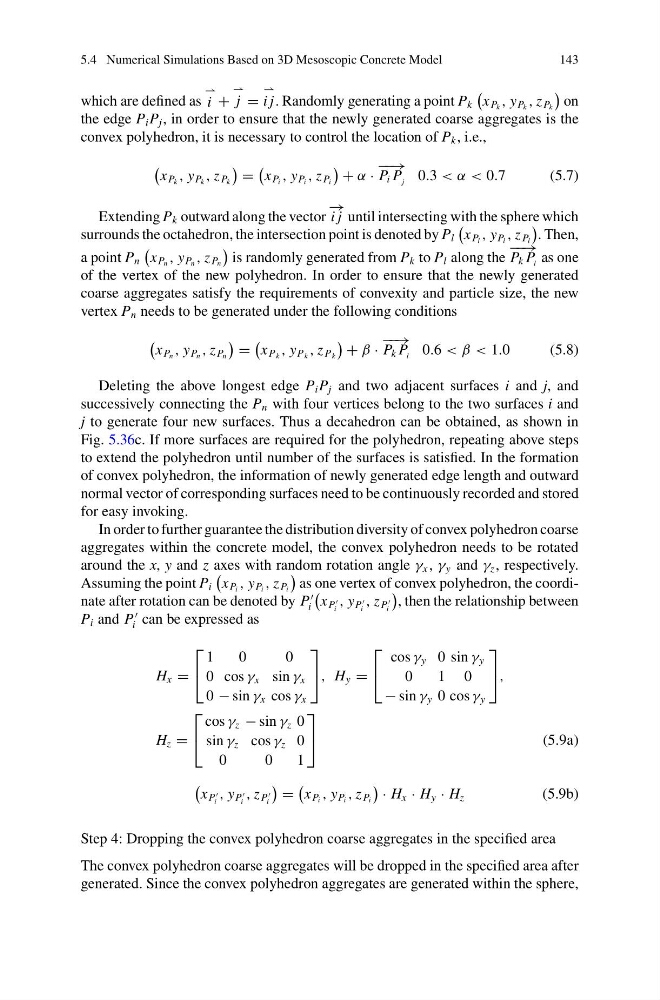
which are defined as
i +
j =
i j. Randomly generating a point P k
x P k , y P k , z P k
on
the edge P i P j , in order to ensure that the newly generated coarse aggregates is the
convex polyhedron, it is necessary to control the location of P k , i.e.,
x P k , y P k , z P k
=
x P i , y P i , z P i
+ α ·
− − →
P i P j 0.3 < α < 0.7
(5.7)
Extending P k outward along the vector
− →
i j until intersecting with the sphere which
surrounds the octahedron, the intersection point is denoted by P l
x P l , y P l , z P l
. Then,
a point P n
x P n , y P n , z P n
is randomly generated from P k to P l along the
− − →
P k P l as one
of the vertex of the new polyhedron. In order to ensure that the newly generated
coarse aggregates satisfy the requirements of convexity and particle size, the new
vertex P n needs to be generated under the following conditions
x P n , y P n , z P n
=
x P k , y P k , z P k
+ β ·
− − →
P k P l 0.6 < β < 1.0
(5.8)
Deleting the above longest edge P i P j and two adjacent surfaces i and j, and
successively connecting the P n with four vertices belong to the two surfaces i and
j to generate four new surfaces. Thus a decahedron can be obtained, as shown in
Fig. 5.36c. If more surfaces are required for the polyhedron, repeating above steps
to extend the polyhedron until number of the surfaces is satisfied. In the formation
of convex polyhedron, the information of newly generated edge length and outward
normal vector of corresponding surfaces need to be continuously recorded and stored
for easy invoking.
In order to further guarantee the distribution diversity of convex polyhedron coarse
aggregates within the concrete model, the convex polyhedron needs to be rotated
around the x, y and z axes with random rotation angle γ x , γ y and γ z , respectively.
Assuming the point P i
x P i , y P i , z P i
as one vertex of convex polyhedron, the coordinate after rotation can be denoted by P
i
x P
i
, y P
i
, z P
i
, then the relationship between
P i and P
i can be expressed as
H x =
⎡
⎣
1
0
0
0 cos γ x sin γ x
0 − sin γ x cos γ x
⎤
⎦ , H y =
⎡
⎣
cos γ y 0 sin γ y
0
1 0
− sin γ y 0 cos γ y
⎤
⎦ ,
H z =
⎡
⎣
cos γ z − sin γ z 0
sin γ z cos γ z 0
0
0
1
⎤
⎦
(5.9a)
x P
i
, y P
i
, z P
i
=
x P i , y P i , z P i
· H x · H y · H z
(5.9b)
Step 4: Dropping the convex polyhedron coarse aggregates in the specified area
The convex polyhedron coarse aggregates will be dropped in the specified area after
generated. Since the convex polyhedron aggregates are generated within the sphere,
143
which are defined as
i +
j =
i j. Randomly generating a point P k
x P k , y P k , z P k
on
the edge P i P j , in order to ensure that the newly generated coarse aggregates is the
convex polyhedron, it is necessary to control the location of P k , i.e.,
x P k , y P k , z P k
=
x P i , y P i , z P i
+ α ·
− − →
P i P j 0.3 < α < 0.7
(5.7)
Extending P k outward along the vector
− →
i j until intersecting with the sphere which
surrounds the octahedron, the intersection point is denoted by P l
x P l , y P l , z P l
. Then,
a point P n
x P n , y P n , z P n
is randomly generated from P k to P l along the
− − →
P k P l as one
of the vertex of the new polyhedron. In order to ensure that the newly generated
coarse aggregates satisfy the requirements of convexity and particle size, the new
vertex P n needs to be generated under the following conditions
x P n , y P n , z P n
=
x P k , y P k , z P k
+ β ·
− − →
P k P l 0.6 < β < 1.0
(5.8)
Deleting the above longest edge P i P j and two adjacent surfaces i and j, and
successively connecting the P n with four vertices belong to the two surfaces i and
j to generate four new surfaces. Thus a decahedron can be obtained, as shown in
Fig. 5.36c. If more surfaces are required for the polyhedron, repeating above steps
to extend the polyhedron until number of the surfaces is satisfied. In the formation
of convex polyhedron, the information of newly generated edge length and outward
normal vector of corresponding surfaces need to be continuously recorded and stored
for easy invoking.
In order to further guarantee the distribution diversity of convex polyhedron coarse
aggregates within the concrete model, the convex polyhedron needs to be rotated
around the x, y and z axes with random rotation angle γ x , γ y and γ z , respectively.
Assuming the point P i
x P i , y P i , z P i
as one vertex of convex polyhedron, the coordinate after rotation can be denoted by P
i
x P
i
, y P
i
, z P
i
, then the relationship between
P i and P
i can be expressed as
H x =
⎡
⎣
1
0
0
0 cos γ x sin γ x
0 − sin γ x cos γ x
⎤
⎦ , H y =
⎡
⎣
cos γ y 0 sin γ y
0
1 0
− sin γ y 0 cos γ y
⎤
⎦ ,
H z =
⎡
⎣
cos γ z − sin γ z 0
sin γ z cos γ z 0
0
0
1
⎤
⎦
(5.9a)
x P
i
, y P
i
, z P
i
=
x P i , y P i , z P i
· H x · H y · H z
(5.9b)
Step 4: Dropping the convex polyhedron coarse aggregates in the specified area
The convex polyhedron coarse aggregates will be dropped in the specified area after
generated. Since the convex polyhedron aggregates are generated within the sphere,