

5.4 Numerical Simulations Based on 3D Mesoscopic Concrete Model
141
smaller concrete model. When the volume fraction of coarse aggregates is satisfied
for each small concrete model, then the smaller parts are gathered into a whole, which
can reduce the computing cost and improve the modelling efficiency. Besides, in the
process of dropping coarse aggregates, the larger ones are dropped first, then dropping
the smaller ones according to the gradation curve of coarse aggregates. The above
methods can be achieved by compiling the control conditions with MATLAB. The
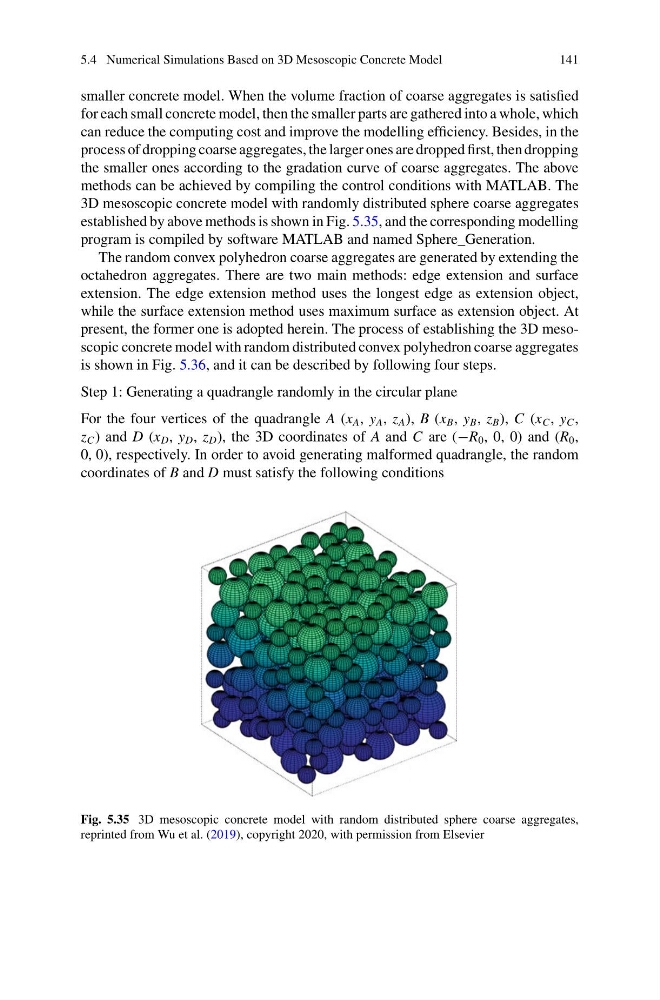
3D mesoscopic concrete model with randomly distributed sphere coarse aggregates
established by above methods is shown in Fig. 5.35, and the corresponding modelling
program is compiled by software MATLAB and named Sphere_Generation.
The random convex polyhedron coarse aggregates are generated by extending the
octahedron aggregates. There are two main methods: edge extension and surface
extension. The edge extension method uses the longest edge as extension object,
while the surface extension method uses maximum surface as extension object. At
present, the former one is adopted herein. The process of establishing the 3D mesoscopic concrete model with random distributed convex polyhedron coarse aggregates
is shown in Fig. 5.36, and it can be described by following four steps.
Step 1: Generating a quadrangle randomly in the circular plane
For the four vertices of the quadrangle A (x A , y A , z A ), B (x B , y B , z B ), C (x C , y C ,
z C ) and D (x D , y D , z D ), the 3D coordinates of A and C are (−R 0 , 0, 0) and (R 0 ,
0, 0), respectively. In order to avoid generating malformed quadrangle, the random
coordinates of B and D must satisfy the following conditions
Fig. 5.35 3D mesoscopic concrete model with random distributed sphere coarse aggregates,
reprinted from Wu et al. (2019), copyright 2020, with permission from Elsevier
141
smaller concrete model. When the volume fraction of coarse aggregates is satisfied
for each small concrete model, then the smaller parts are gathered into a whole, which
can reduce the computing cost and improve the modelling efficiency. Besides, in the
process of dropping coarse aggregates, the larger ones are dropped first, then dropping
the smaller ones according to the gradation curve of coarse aggregates. The above
methods can be achieved by compiling the control conditions with MATLAB. The
3D mesoscopic concrete model with randomly distributed sphere coarse aggregates
established by above methods is shown in Fig. 5.35, and the corresponding modelling
program is compiled by software MATLAB and named Sphere_Generation.
The random convex polyhedron coarse aggregates are generated by extending the
octahedron aggregates. There are two main methods: edge extension and surface
extension. The edge extension method uses the longest edge as extension object,
while the surface extension method uses maximum surface as extension object. At
present, the former one is adopted herein. The process of establishing the 3D mesoscopic concrete model with random distributed convex polyhedron coarse aggregates
is shown in Fig. 5.36, and it can be described by following four steps.
Step 1: Generating a quadrangle randomly in the circular plane
For the four vertices of the quadrangle A (x A , y A , z A ), B (x B , y B , z B ), C (x C , y C ,
z C ) and D (x D , y D , z D ), the 3D coordinates of A and C are (−R 0 , 0, 0) and (R 0 ,
0, 0), respectively. In order to avoid generating malformed quadrangle, the random
coordinates of B and D must satisfy the following conditions
Fig. 5.35 3D mesoscopic concrete model with random distributed sphere coarse aggregates,
reprinted from Wu et al. (2019), copyright 2020, with permission from Elsevier