

5.3 Corundum Aggregated UHPCC Target
127
(a)
(b)
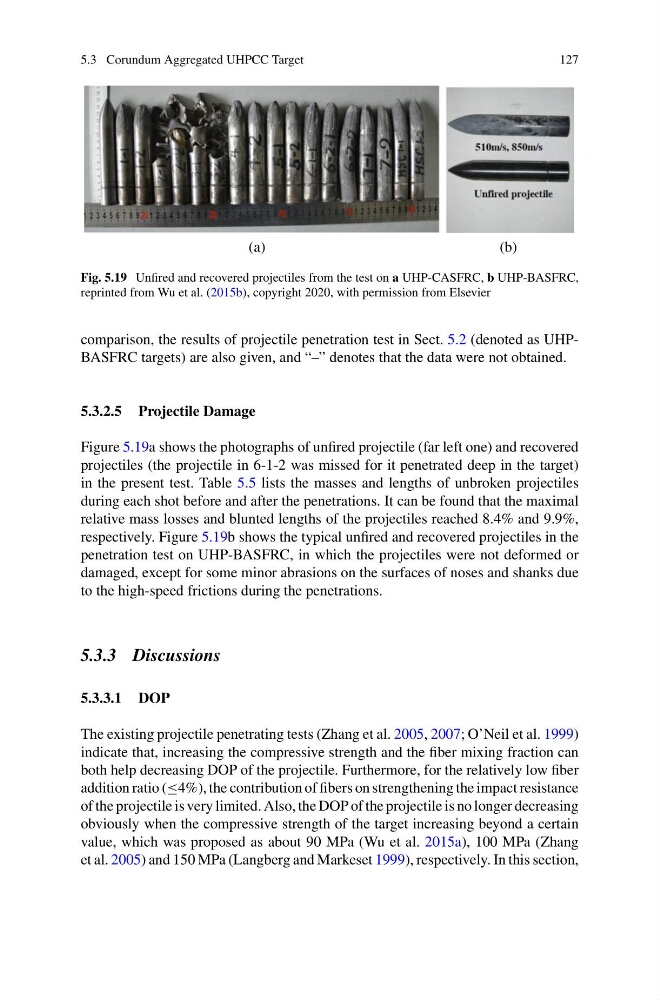
Fig. 5.19 Unfired and recovered projectiles from the test on a UHP-CASFRC, b UHP-BASFRC,
reprinted from Wu et al. (2015b), copyright 2020, with permission from Elsevier
comparison, the results of projectile penetration test in Sect. 5.2 (denoted as UHPBASFRC targets) are also given, and “–” denotes that the data were not obtained.
5.3.2.5 Projectile Damage
Figure 5.19a shows the photographs of unfired projectile (far left one) and recovered
projectiles (the projectile in 6-1-2 was missed for it penetrated deep in the target)
in the present test. Table 5.5 lists the masses and lengths of unbroken projectiles
during each shot before and after the penetrations. It can be found that the maximal
relative mass losses and blunted lengths of the projectiles reached 8.4% and 9.9%,
respectively. Figure 5.19b shows the typical unfired and recovered projectiles in the
penetration test on UHP-BASFRC, in which the projectiles were not deformed or
damaged, except for some minor abrasions on the surfaces of noses and shanks due
to the high-speed frictions during the penetrations.
5.3.3 Discussions
5.3.3.1 DOP
The existing projectile penetrating tests (Zhang et al. 2005, 2007; O’Neil et al. 1999)
indicate that, increasing the compressive strength and the fiber mixing fraction can
both help decreasing DOP of the projectile. Furthermore, for the relatively low fiber
addition ratio (≤4%), the contribution of fibers on strengthening the impact resistance
of the projectile is very limited. Also, the DOP of the projectile is no longer decreasing
obviously when the compressive strength of the target increasing beyond a certain
value, which was proposed as about 90 MPa (Wu et al. 2015a), 100 MPa (Zhang
et al. 2005) and 150 MPa (Langberg and Markeset 1999), respectively. In this section,
127
(a)
(b)
Fig. 5.19 Unfired and recovered projectiles from the test on a UHP-CASFRC, b UHP-BASFRC,
reprinted from Wu et al. (2015b), copyright 2020, with permission from Elsevier
comparison, the results of projectile penetration test in Sect. 5.2 (denoted as UHPBASFRC targets) are also given, and “–” denotes that the data were not obtained.
5.3.2.5 Projectile Damage
Figure 5.19a shows the photographs of unfired projectile (far left one) and recovered
projectiles (the projectile in 6-1-2 was missed for it penetrated deep in the target)
in the present test. Table 5.5 lists the masses and lengths of unbroken projectiles
during each shot before and after the penetrations. It can be found that the maximal
relative mass losses and blunted lengths of the projectiles reached 8.4% and 9.9%,
respectively. Figure 5.19b shows the typical unfired and recovered projectiles in the
penetration test on UHP-BASFRC, in which the projectiles were not deformed or
damaged, except for some minor abrasions on the surfaces of noses and shanks due
to the high-speed frictions during the penetrations.
5.3.3 Discussions
5.3.3.1 DOP
The existing projectile penetrating tests (Zhang et al. 2005, 2007; O’Neil et al. 1999)
indicate that, increasing the compressive strength and the fiber mixing fraction can
both help decreasing DOP of the projectile. Furthermore, for the relatively low fiber
addition ratio (≤4%), the contribution of fibers on strengthening the impact resistance
of the projectile is very limited. Also, the DOP of the projectile is no longer decreasing
obviously when the compressive strength of the target increasing beyond a certain
value, which was proposed as about 90 MPa (Wu et al. 2015a), 100 MPa (Zhang
et al. 2005) and 150 MPa (Langberg and Markeset 1999), respectively. In this section,