

112
5 Projectile Penetrations into Coarse Aggregated UHPCC Targets
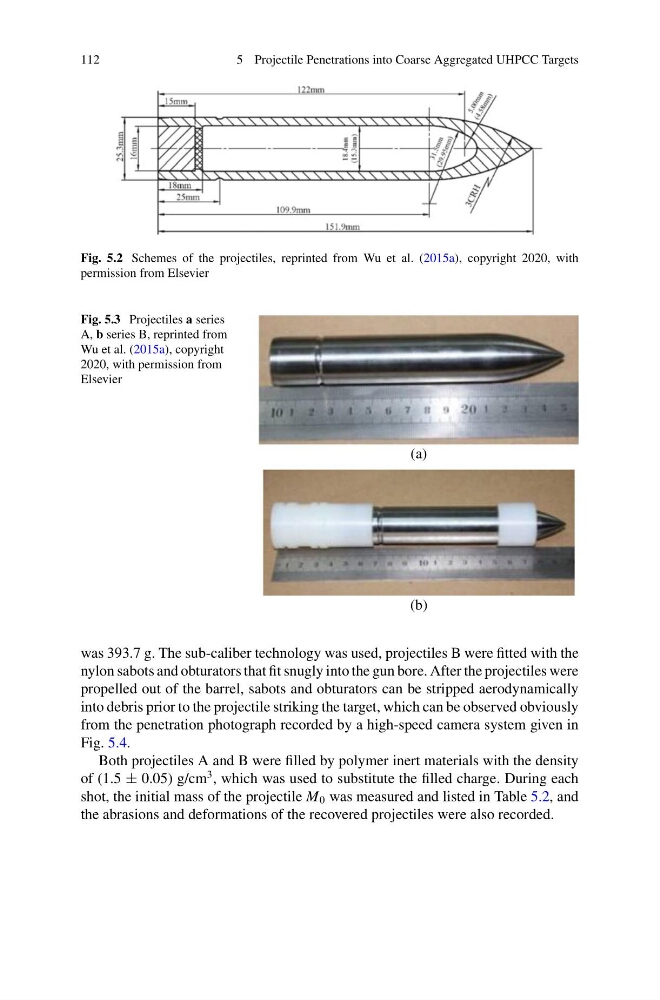
Fig. 5.2 Schemes of the projectiles, reprinted from Wu et al. (2015a), copyright 2020, with
permission from Elsevier
Fig. 5.3 Projectiles a series
A, b series B, reprinted from
Wu et al. (2015a), copyright
2020, with permission from
Elsevier
(a)
(b)
was 393.7 g. The sub-caliber technology was used, projectiles B were fitted with the
nylon sabots and obturators that fit snugly into the gun bore. After the projectiles were
propelled out of the barrel, sabots and obturators can be stripped aerodynamically
into debris prior to the projectile striking the target, which can be observed obviously
from the penetration photograph recorded by a high-speed camera system given in
Fig. 5.4.
Both projectiles A and B were filled by polymer inert materials with the density
of (1.5 ± 0.05) g/cm
3 , which was used to substitute the filled charge. During each
shot, the initial mass of the projectile M 0 was measured and listed in Table 5.2, and
the abrasions and deformations of the recovered projectiles were also recorded.
5 Projectile Penetrations into Coarse Aggregated UHPCC Targets
Fig. 5.2 Schemes of the projectiles, reprinted from Wu et al. (2015a), copyright 2020, with
permission from Elsevier
Fig. 5.3 Projectiles a series
A, b series B, reprinted from
Wu et al. (2015a), copyright
2020, with permission from
Elsevier
(a)
(b)
was 393.7 g. The sub-caliber technology was used, projectiles B were fitted with the
nylon sabots and obturators that fit snugly into the gun bore. After the projectiles were
propelled out of the barrel, sabots and obturators can be stripped aerodynamically
into debris prior to the projectile striking the target, which can be observed obviously
from the penetration photograph recorded by a high-speed camera system given in
Fig. 5.4.
Both projectiles A and B were filled by polymer inert materials with the density
of (1.5 ± 0.05) g/cm
3 , which was used to substitute the filled charge. During each
shot, the initial mass of the projectile M 0 was measured and listed in Table 5.2, and
the abrasions and deformations of the recovered projectiles were also recorded.