

5.2 Basalt Aggregated UHPCC Target
109
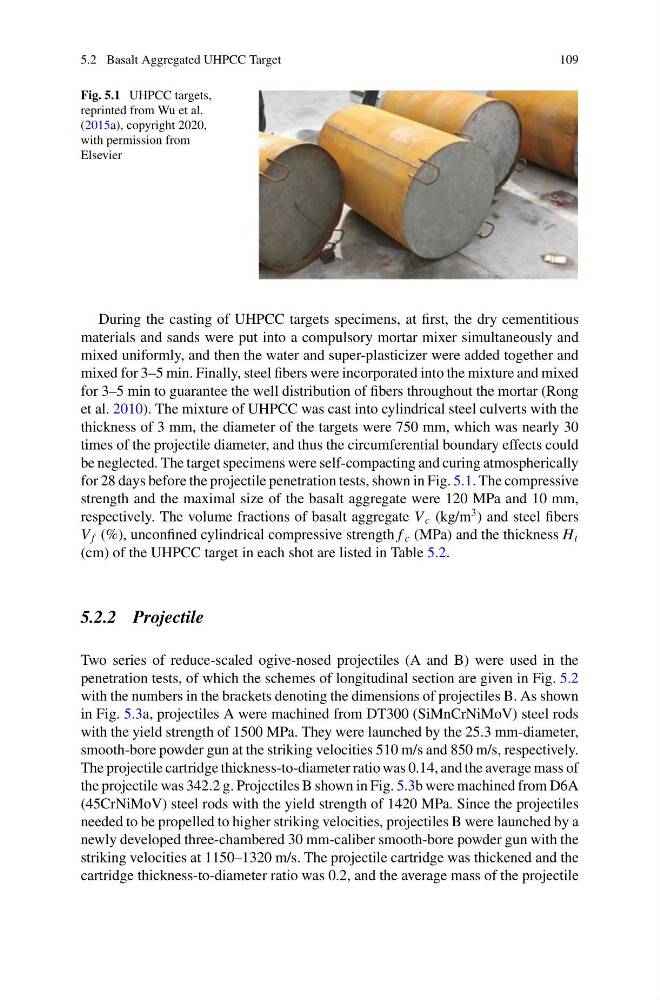
Fig. 5.1 UHPCC targets,
reprinted from Wu et al.
(2015a), copyright 2020,
with permission from
Elsevier
During the casting of UHPCC targets specimens, at first, the dry cementitious
materials and sands were put into a compulsory mortar mixer simultaneously and
mixed uniformly, and then the water and super-plasticizer were added together and
mixed for 3–5 min. Finally, steel fibers were incorporated into the mixture and mixed
for 3–5 min to guarantee the well distribution of fibers throughout the mortar (Rong
et al. 2010). The mixture of UHPCC was cast into cylindrical steel culverts with the
thickness of 3 mm, the diameter of the targets were 750 mm, which was nearly 30
times of the projectile diameter, and thus the circumferential boundary effects could
be neglected. The target specimens were self-compacting and curing atmospherically
for 28 days before the projectile penetration tests, shown in Fig. 5.1. The compressive
strength and the maximal size of the basalt aggregate were 120 MPa and 10 mm,
respectively. The volume fractions of basalt aggregate V c (kg/m
3 ) and steel fibers
V f (%), unconfined cylindrical compressive strength f c (MPa) and the thickness H t
(cm) of the UHPCC target in each shot are listed in Table 5.2.
5.2.2 Projectile
Two series of reduce-scaled ogive-nosed projectiles (A and B) were used in the
penetration tests, of which the schemes of longitudinal section are given in Fig. 5.2
with the numbers in the brackets denoting the dimensions of projectiles B. As shown
in Fig. 5.3a, projectiles A were machined from DT300 (SiMnCrNiMoV) steel rods
with the yield strength of 1500 MPa. They were launched by the 25.3 mm-diameter,
smooth-bore powder gun at the striking velocities 510 m/s and 850 m/s, respectively.
The projectile cartridge thickness-to-diameter ratio was 0.14, and the average mass of
the projectile was 342.2 g. Projectiles B shown in Fig. 5.3b were machined from D6A
(45CrNiMoV) steel rods with the yield strength of 1420 MPa. Since the projectiles
needed to be propelled to higher striking velocities, projectiles B were launched by a
newly developed three-chambered 30 mm-caliber smooth-bore powder gun with the
striking velocities at 1150–1320 m/s. The projectile cartridge was thickened and the
cartridge thickness-to-diameter ratio was 0.2, and the average mass of the projectile
109
Fig. 5.1 UHPCC targets,
reprinted from Wu et al.
(2015a), copyright 2020,
with permission from
Elsevier
During the casting of UHPCC targets specimens, at first, the dry cementitious
materials and sands were put into a compulsory mortar mixer simultaneously and
mixed uniformly, and then the water and super-plasticizer were added together and
mixed for 3–5 min. Finally, steel fibers were incorporated into the mixture and mixed
for 3–5 min to guarantee the well distribution of fibers throughout the mortar (Rong
et al. 2010). The mixture of UHPCC was cast into cylindrical steel culverts with the
thickness of 3 mm, the diameter of the targets were 750 mm, which was nearly 30
times of the projectile diameter, and thus the circumferential boundary effects could
be neglected. The target specimens were self-compacting and curing atmospherically
for 28 days before the projectile penetration tests, shown in Fig. 5.1. The compressive
strength and the maximal size of the basalt aggregate were 120 MPa and 10 mm,
respectively. The volume fractions of basalt aggregate V c (kg/m
3 ) and steel fibers
V f (%), unconfined cylindrical compressive strength f c (MPa) and the thickness H t
(cm) of the UHPCC target in each shot are listed in Table 5.2.
5.2.2 Projectile
Two series of reduce-scaled ogive-nosed projectiles (A and B) were used in the
penetration tests, of which the schemes of longitudinal section are given in Fig. 5.2
with the numbers in the brackets denoting the dimensions of projectiles B. As shown
in Fig. 5.3a, projectiles A were machined from DT300 (SiMnCrNiMoV) steel rods
with the yield strength of 1500 MPa. They were launched by the 25.3 mm-diameter,
smooth-bore powder gun at the striking velocities 510 m/s and 850 m/s, respectively.
The projectile cartridge thickness-to-diameter ratio was 0.14, and the average mass of
the projectile was 342.2 g. Projectiles B shown in Fig. 5.3b were machined from D6A
(45CrNiMoV) steel rods with the yield strength of 1420 MPa. Since the projectiles
needed to be propelled to higher striking velocities, projectiles B were launched by a
newly developed three-chambered 30 mm-caliber smooth-bore powder gun with the
striking velocities at 1150–1320 m/s. The projectile cartridge was thickened and the
cartridge thickness-to-diameter ratio was 0.2, and the average mass of the projectile