

108
5 Projectile Penetrations into Coarse Aggregated UHPCC Targets
polyhedron coarse aggregates were proposed with the MATLAB compiler, respectively. The influences of two coarse aggregates shapes on the projectile impact resistance of concrete targets were further discussed, and the sphere coarse aggregates
were adopted to guarantee both the calculation accuracy and efficiency. Then, by
simulating the projectile impact tests on the CA-UHPC targets, the 3D mesoscopic
concrete model with randomly distributed sphere coarse aggregates and the corresponding constitutive parameters were validated numerically by LS-DYNA. Finally,
the influence of four coarse aggregates on the projectile penetration resistance of
UHPC targets were discussed. The obtained conclusions are beneficial to the design
and constructions of UHPCC in the protective engineering.
5.2 Basalt Aggregated UHPCC Target
5.2.1 Target
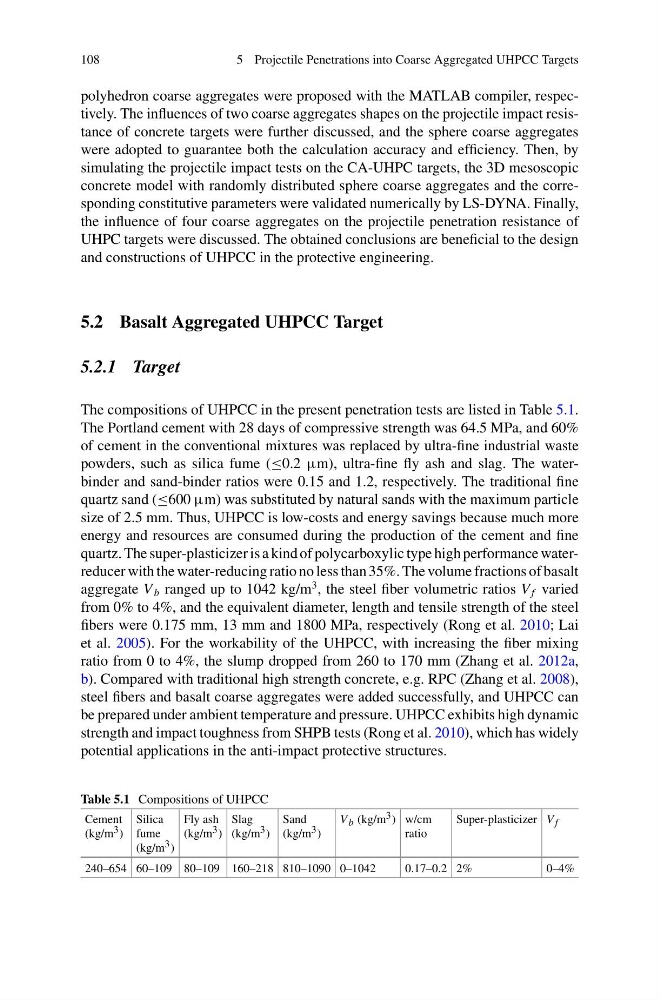
The compositions of UHPCC in the present penetration tests are listed in Table 5.1.
The Portland cement with 28 days of compressive strength was 64.5 MPa, and 60%
of cement in the conventional mixtures was replaced by ultra-fine industrial waste
powders, such as silica fume (≤0.2 µm), ultra-fine fly ash and slag. The waterbinder and sand-binder ratios were 0.15 and 1.2, respectively. The traditional fine
quartz sand (≤600 µm) was substituted by natural sands with the maximum particle
size of 2.5 mm. Thus, UHPCC is low-costs and energy savings because much more
energy and resources are consumed during the production of the cement and fine
quartz. The super-plasticizer is a kind of polycarboxylic type high performance waterreducer with the water-reducing ratio no less than 35%. The volume fractions of basalt
aggregate V b ranged up to 1042 kg/m
3 , the steel fiber volumetric ratios V f varied
from 0% to 4%, and the equivalent diameter, length and tensile strength of the steel
fibers were 0.175 mm, 13 mm and 1800 MPa, respectively (Rong et al. 2010; Lai
et al. 2005). For the workability of the UHPCC, with increasing the fiber mixing
ratio from 0 to 4%, the slump dropped from 260 to 170 mm (Zhang et al. 2012a,
b). Compared with traditional high strength concrete, e.g. RPC (Zhang et al. 2008),
steel fibers and basalt coarse aggregates were added successfully, and UHPCC can
be prepared under ambient temperature and pressure. UHPCC exhibits high dynamic
strength and impact toughness from SHPB tests (Rong et al. 2010), which has widely
potential applications in the anti-impact protective structures.
Table 5.1 Compositions of UHPCC
Cement
(kg/m 3 )
Silica
fume
(kg/m 3 )
Fly ash
(kg/m 3 )
Slag
(kg/m 3 )
Sand
(kg/m 3 )
V b (kg/m 3 ) w/cm
ratio
Super-plasticizer V f
240–654 60–109 80–109 160–218 810–1090 0–1042
0.17–0.2 2%
0–4%
5 Projectile Penetrations into Coarse Aggregated UHPCC Targets
polyhedron coarse aggregates were proposed with the MATLAB compiler, respectively. The influences of two coarse aggregates shapes on the projectile impact resistance of concrete targets were further discussed, and the sphere coarse aggregates
were adopted to guarantee both the calculation accuracy and efficiency. Then, by
simulating the projectile impact tests on the CA-UHPC targets, the 3D mesoscopic
concrete model with randomly distributed sphere coarse aggregates and the corresponding constitutive parameters were validated numerically by LS-DYNA. Finally,
the influence of four coarse aggregates on the projectile penetration resistance of
UHPC targets were discussed. The obtained conclusions are beneficial to the design
and constructions of UHPCC in the protective engineering.
5.2 Basalt Aggregated UHPCC Target
5.2.1 Target
The compositions of UHPCC in the present penetration tests are listed in Table 5.1.
The Portland cement with 28 days of compressive strength was 64.5 MPa, and 60%
of cement in the conventional mixtures was replaced by ultra-fine industrial waste
powders, such as silica fume (≤0.2 µm), ultra-fine fly ash and slag. The waterbinder and sand-binder ratios were 0.15 and 1.2, respectively. The traditional fine
quartz sand (≤600 µm) was substituted by natural sands with the maximum particle
size of 2.5 mm. Thus, UHPCC is low-costs and energy savings because much more
energy and resources are consumed during the production of the cement and fine
quartz. The super-plasticizer is a kind of polycarboxylic type high performance waterreducer with the water-reducing ratio no less than 35%. The volume fractions of basalt
aggregate V b ranged up to 1042 kg/m
3 , the steel fiber volumetric ratios V f varied
from 0% to 4%, and the equivalent diameter, length and tensile strength of the steel
fibers were 0.175 mm, 13 mm and 1800 MPa, respectively (Rong et al. 2010; Lai
et al. 2005). For the workability of the UHPCC, with increasing the fiber mixing
ratio from 0 to 4%, the slump dropped from 260 to 170 mm (Zhang et al. 2012a,
b). Compared with traditional high strength concrete, e.g. RPC (Zhang et al. 2008),
steel fibers and basalt coarse aggregates were added successfully, and UHPCC can
be prepared under ambient temperature and pressure. UHPCC exhibits high dynamic
strength and impact toughness from SHPB tests (Rong et al. 2010), which has widely
potential applications in the anti-impact protective structures.
Table 5.1 Compositions of UHPCC
Cement
(kg/m 3 )
Silica
fume
(kg/m 3 )
Fly ash
(kg/m 3 )
Slag
(kg/m 3 )
Sand
(kg/m 3 )
V b (kg/m 3 ) w/cm
ratio
Super-plasticizer V f
240–654 60–109 80–109 160–218 810–1090 0–1042
0.17–0.2 2%
0–4%