

94
4 Triaxial Compressive Behavior of UHPCC …
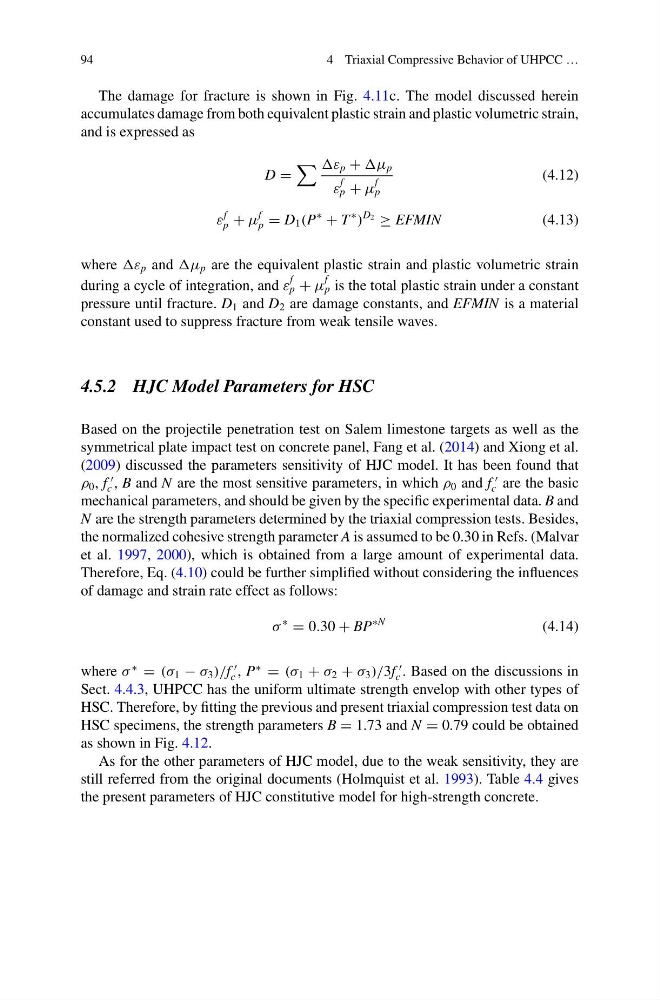
The damage for fracture is shown in Fig. 4.11c. The model discussed herein
accumulates damage from both equivalent plastic strain and plastic volumetric strain,
and is expressed as
D =
ε p + μ p
ε
f
p + μ
f
p
(4.12)
ε
f
p + μ
f
p = D 1 (P
∗
+ T
∗
)
D 2 ≥ EFMIN
(4.13)
where ε p and μ p are the equivalent plastic strain and plastic volumetric strain
during a cycle of integration, and ε
f
p + μ
f
p is the total plastic strain under a constant
pressure until fracture. D 1 and D 2 are damage constants, and EFMIN is a material
constant used to suppress fracture from weak tensile waves.
4.5.2 HJC Model Parameters for HSC
Based on the projectile penetration test on Salem limestone targets as well as the
symmetrical plate impact test on concrete panel, Fang et al. (2014) and Xiong et al.
(2009) discussed the parameters sensitivity of HJC model. It has been found that
ρ 0 , f
c , B and N are the most sensitive parameters, in which ρ 0 and f
c are the basic
mechanical parameters, and should be given by the specific experimental data. B and
N are the strength parameters determined by the triaxial compression tests. Besides,
the normalized cohesive strength parameter A is assumed to be 0.30 in Refs. (Malvar
et al. 1997, 2000), which is obtained from a large amount of experimental data.
Therefore, Eq. (4.10) could be further simplified without considering the influences
of damage and strain rate effect as follows:
σ
∗
= 0.30 + BP
∗N
(4.14)
where σ
∗
= (σ 1 − σ 3 )/f
c , P
∗
= (σ 1 + σ 2 + σ 3 )/3f
c . Based on the discussions in
Sect. 4.4.3, UHPCC has the uniform ultimate strength envelop with other types of
HSC. Therefore, by fitting the previous and present triaxial compression test data on
HSC specimens, the strength parameters B = 1.73 and N = 0.79 could be obtained
as shown in Fig. 4.12.
As for the other parameters of HJC model, due to the weak sensitivity, they are
still referred from the original documents (Holmquist et al. 1993). Table 4.4 gives
the present parameters of HJC constitutive model for high-strength concrete.
4 Triaxial Compressive Behavior of UHPCC …
The damage for fracture is shown in Fig. 4.11c. The model discussed herein
accumulates damage from both equivalent plastic strain and plastic volumetric strain,
and is expressed as
D =
ε p + μ p
ε
f
p + μ
f
p
(4.12)
ε
f
p + μ
f
p = D 1 (P
∗
+ T
∗
)
D 2 ≥ EFMIN
(4.13)
where ε p and μ p are the equivalent plastic strain and plastic volumetric strain
during a cycle of integration, and ε
f
p + μ
f
p is the total plastic strain under a constant
pressure until fracture. D 1 and D 2 are damage constants, and EFMIN is a material
constant used to suppress fracture from weak tensile waves.
4.5.2 HJC Model Parameters for HSC
Based on the projectile penetration test on Salem limestone targets as well as the
symmetrical plate impact test on concrete panel, Fang et al. (2014) and Xiong et al.
(2009) discussed the parameters sensitivity of HJC model. It has been found that
ρ 0 , f
c , B and N are the most sensitive parameters, in which ρ 0 and f
c are the basic
mechanical parameters, and should be given by the specific experimental data. B and
N are the strength parameters determined by the triaxial compression tests. Besides,
the normalized cohesive strength parameter A is assumed to be 0.30 in Refs. (Malvar
et al. 1997, 2000), which is obtained from a large amount of experimental data.
Therefore, Eq. (4.10) could be further simplified without considering the influences
of damage and strain rate effect as follows:
σ
∗
= 0.30 + BP
∗N
(4.14)
where σ
∗
= (σ 1 − σ 3 )/f
c , P
∗
= (σ 1 + σ 2 + σ 3 )/3f
c . Based on the discussions in
Sect. 4.4.3, UHPCC has the uniform ultimate strength envelop with other types of
HSC. Therefore, by fitting the previous and present triaxial compression test data on
HSC specimens, the strength parameters B = 1.73 and N = 0.79 could be obtained
as shown in Fig. 4.12.
As for the other parameters of HJC model, due to the weak sensitivity, they are
still referred from the original documents (Holmquist et al. 1993). Table 4.4 gives
the present parameters of HJC constitutive model for high-strength concrete.