

394
9 Topologic Optimization of Vibrations of Size-Dependent Beams
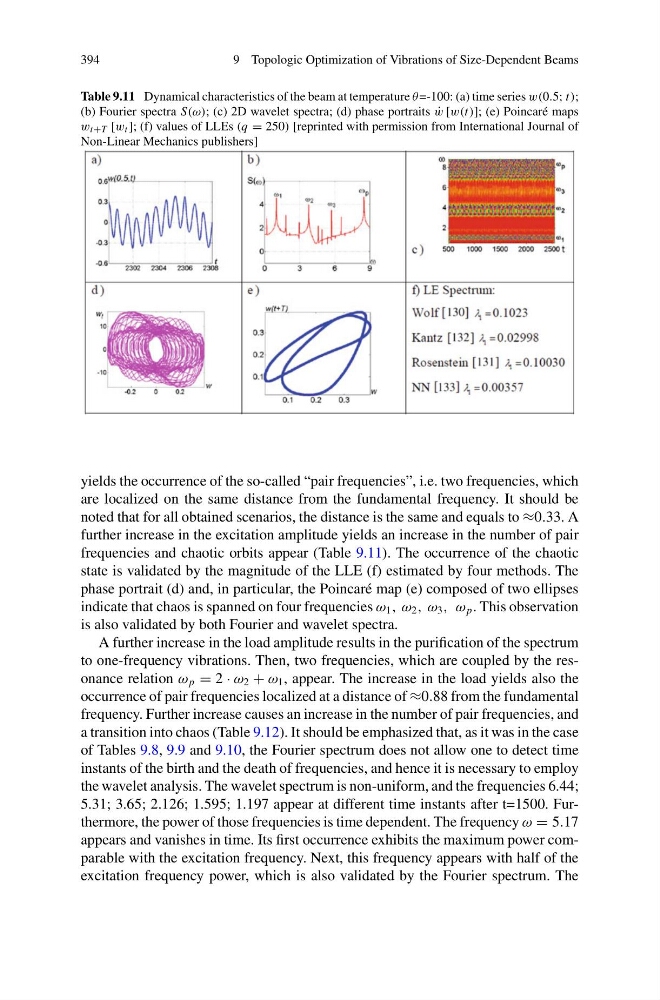
Table 9.11 Dynamical characteristics of the beam at temperature θ=-100: (a) time series w(0.5; t);
(b) Fourier spectra S(ω); (c) 2D wavelet spectra; (d) phase portraits ˙
w [w(t)]; (e) Poincaré maps
w t+T [w t ]; (f) values of LLEs (q = 250) [reprinted with permission from International Journal of
Non-Linear Mechanics publishers]
yields the occurrence of the so-called “pair frequencies”, i.e. two frequencies, which
are localized on the same distance from the fundamental frequency. It should be
noted that for all obtained scenarios, the distance is the same and equals to ≈0.33. A
further increase in the excitation amplitude yields an increase in the number of pair
frequencies and chaotic orbits appear (Table 9.11). The occurrence of the chaotic
state is validated by the magnitude of the LLE (f) estimated by four methods. The
phase portrait (d) and, in particular, the Poincaré map (e) composed of two ellipses
indicate that chaos is spanned on four frequencies ω 1 , ω 2 , ω 3 , ω p . This observation
is also validated by both Fourier and wavelet spectra.
A further increase in the load amplitude results in the purification of the spectrum
to one-frequency vibrations. Then, two frequencies, which are coupled by the resonance relation ω p = 2 · ω 2 + ω 1 , appear. The increase in the load yields also the
occurrence of pair frequencies localized at a distance of ≈0.88 from the fundamental
frequency. Further increase causes an increase in the number of pair frequencies, and
a transition into chaos (Table 9.12). It should be emphasized that, as it was in the case
of Tables 9.8, 9.9 and 9.10, the Fourier spectrum does not allow one to detect time
instants of the birth and the death of frequencies, and hence it is necessary to employ
the wavelet analysis. The wavelet spectrum is non-uniform, and the frequencies 6.44;
5.31; 3.65; 2.126; 1.595; 1.197 appear at different time instants after t=1500. Furthermore, the power of those frequencies is time dependent. The frequency ω = 5.17
appears and vanishes in time. Its first occurrence exhibits the maximum power comparable with the excitation frequency. Next, this frequency appears with half of the
excitation frequency power, which is also validated by the Fourier spectrum. The
9 Topologic Optimization of Vibrations of Size-Dependent Beams
Table 9.11 Dynamical characteristics of the beam at temperature θ=-100: (a) time series w(0.5; t);
(b) Fourier spectra S(ω); (c) 2D wavelet spectra; (d) phase portraits ˙
w [w(t)]; (e) Poincaré maps
w t+T [w t ]; (f) values of LLEs (q = 250) [reprinted with permission from International Journal of
Non-Linear Mechanics publishers]
yields the occurrence of the so-called “pair frequencies”, i.e. two frequencies, which
are localized on the same distance from the fundamental frequency. It should be
noted that for all obtained scenarios, the distance is the same and equals to ≈0.33. A
further increase in the excitation amplitude yields an increase in the number of pair
frequencies and chaotic orbits appear (Table 9.11). The occurrence of the chaotic
state is validated by the magnitude of the LLE (f) estimated by four methods. The
phase portrait (d) and, in particular, the Poincaré map (e) composed of two ellipses
indicate that chaos is spanned on four frequencies ω 1 , ω 2 , ω 3 , ω p . This observation
is also validated by both Fourier and wavelet spectra.
A further increase in the load amplitude results in the purification of the spectrum
to one-frequency vibrations. Then, two frequencies, which are coupled by the resonance relation ω p = 2 · ω 2 + ω 1 , appear. The increase in the load yields also the
occurrence of pair frequencies localized at a distance of ≈0.88 from the fundamental
frequency. Further increase causes an increase in the number of pair frequencies, and
a transition into chaos (Table 9.12). It should be emphasized that, as it was in the case
of Tables 9.8, 9.9 and 9.10, the Fourier spectrum does not allow one to detect time
instants of the birth and the death of frequencies, and hence it is necessary to employ
the wavelet analysis. The wavelet spectrum is non-uniform, and the frequencies 6.44;
5.31; 3.65; 2.126; 1.595; 1.197 appear at different time instants after t=1500. Furthermore, the power of those frequencies is time dependent. The frequency ω = 5.17
appears and vanishes in time. Its first occurrence exhibits the maximum power comparable with the excitation frequency. Next, this frequency appears with half of the
excitation frequency power, which is also validated by the Fourier spectrum. The